

Workation Abroad From India: Where to Work Remotely Without Your Manager Noticing the Time Zone
In this guide (10)
- The Time Zone Math That Decides Everything
- Best Destinations for Workation Abroad From India
- The WiFi Reality Check
- The Gear That Actually Matters
- The Tax and Legal Stuff Nobody Wants to Talk About
- Managing the Optics With Your Team
- Workation Abroad From India: Monthly Budget Breakdown
- Coworking Spaces Worth Knowing
- When Things Go Wrong
- Planning Your First Workation Abroad From India
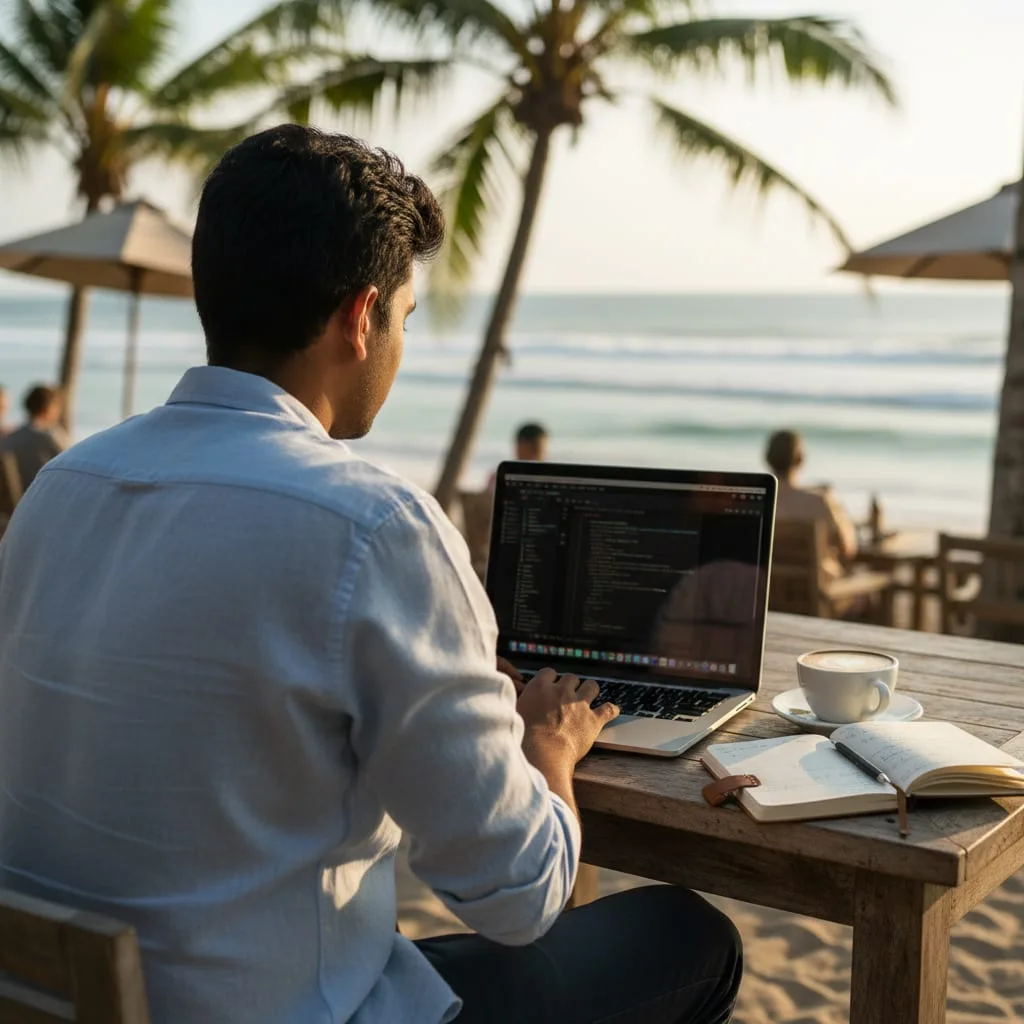
Planning a workation abroad from India? I spent three weeks in Bali last year. Canggu, to be specific. My team had no idea. They assumed I was in my Koramangala flat, suffering through Bangalore traffic like everyone else. Meanwhile, I was taking standup calls from a cafe overlooking rice paddies, and the WiFi was genuinely better than my Airtel Fiber connection back home.
That trip changed how I think about work. Not the productivity nonsense or finding yourself garbage. Just the simple realization that if your job is a laptop and a Slack channel, the location of that laptop is negotiable. A workation abroad from India is not some Instagram fantasy. It is a logistics problem. And logistics problems have solutions.
This piece is not about digital nomad lifestyle or whatever people call it on YouTube. It is a practical breakdown for Indian IT professionals who want to work from somewhere nicer for a few weeks without creating drama with HR. I will cover the destinations that actually work, the time zone math that makes or breaks your plan, and the things nobody tells you about WiFi, visas, and keeping your job while doing this.
The Time Zone Math That Decides Everything
Here is the thing nobody talks about. You can pick any beautiful destination in the world, but if your standup call is at 3 AM local time, you will hate your life within a week. Indian Standard Time is UTC+5:30, and this number determines which destinations are actually workable.
The sweet spot is anywhere between IST-2 to IST+3. This range means your 10 AM standup could be anywhere from 8 AM to 1 PM local time. Uncomfortable, maybe. But survivable. Go further west into Europe or the Americas, and you start waking up at midnight for sprint reviews. Go too far east into Australia or New Zealand, and your evening calls become morning meetings.
I learned this the hard way. A colleague tried working from Lisbon for a month. Portugal is IST-5:30 in summer. His 10 AM daily sync was 4:30 AM local time. He lasted two weeks before flying back, exhausted and grumpy. Meanwhile, my Bali trip was IST+2:30 — my 10 AM calls were 12:30 PM local time, which meant I could have a proper breakfast and still log in with my camera on, looking human.
Best Destinations for Workation Abroad From India
I am ranking these by how well they work for Indian remote workers, not by beaches or nightlife. Beautiful places with garbage WiFi and terrible time zones are useless. Boring cities with excellent infrastructure and IST overlap are gold.
1. Bali, Indonesia (IST+2:30)
Bali tops the list for any workation abroad from India. Canggu and Ubud have coworking spaces on every street. The cost of a Bali trip from India is surprisingly reasonable once you factor in the lower daily expenses. A month in a decent villa with fiber internet runs around 50,000 INR. Coworking day passes cost 500-800 INR. Check Indonesia Tourism for the latest visa requirements.
The 2.5 hour time difference is perfect. Your 9 AM IST is 11:30 AM Bali time. You can surf at sunrise, grab breakfast, and still make morning calls looking refreshed instead of zombified. Visa on arrival for 30 days, extendable to 60. No questions asked at immigration if you say tourism.
Downsides: Power cuts happen. Get a place with backup or work from coworking spaces with generators. The rainy season from November to March means occasional WiFi drops during storms. And the Bali expat scene can get annoying — too many people trying to sell you crypto or sound healing sessions.

2. Thailand — Chiang Mai and Bangkok (IST+1:30)
Chiang Mai is the OG remote work destination for a reason. The infrastructure exists specifically for people like us. Punspace, CAMP, Yellow — coworking options are excellent and cheap. Monthly memberships under 8,000 INR with unlimited coffee and fast WiFi.
Bangkok works too if you prefer a bigger city. The time zone is only 1.5 hours ahead of IST. Your 9 AM call is 10:30 AM local. The food is incredible, cheap, and vegetarian options exist everywhere thanks to the Buddhist influence. The elephant in the room: Thailand technically requires a work permit for any work done on Thai soil. In practice, nobody checks. Do not volunteer this information at immigration. You are a tourist exploring temples.
Thailand has a new 10-year Long Term Resident visa for remote workers, but it requires showing 80,000 USD annual income. For shorter trips, Indians can stay visa-free for up to 30 days (from 15 September 2026); for longer stays, the Thai Embassy says to apply for an appropriate e-visa. Flying into Bangkok from Bangalore costs around 15,000-25,000 INR if you book flights strategically.
3. Dubai and Abu Dhabi, UAE (IST-1:30)
Not the cheapest option, but the most reliable. The UAE runs like clockwork. WiFi is excellent everywhere. Power cuts do not exist. And the time zone is almost perfect — IST-1:30 means your 9 AM standup is 7:30 AM local time. Early, but manageable.
Dubai has a one-year remote work visa that costs around 2,000 AED (roughly 45,000 INR) plus health insurance. But for trips under 30 days, Indians get visa-free entry now. Just walk in, work from your hotel or a cafe, and walk out. No paperwork.
The costs are higher. A decent hotel room is 5,000 INR per night minimum. But if your company expense policy is generous or you split an Airbnb with friends, Dubai works. The malls have excellent WiFi and free seating. Nobody bothers you if you are on a laptop for hours. I have done entire work days from the Dubai Mall food court.

4. Georgia (IST-1:30)
This is my sleeper pick. Georgia for Indian travelers is ridiculously underrated. Tbilisi is beautiful, cheap, and has surprisingly good internet. A one-bedroom apartment in the city center costs 25,000-30,000 INR per month. Good restaurants charge 300-400 INR for a full meal with wine. Yes, wine is that cheap.
Most Indians need a Georgian e-visa, but if you hold a valid US, UK or Schengen/EU visa or residence permit, Georgia is visa-free for up to 90 days in any 180-day period. Once that is sorted, you can fly there, rent an apartment, and work for months. The time zone is IST-1:30, identical to Dubai but at one-third the cost.
The downsides: Georgian winters are cold. Really cold. The country is mountainous and December through February requires actual winter clothing. Also, English is not widely spoken outside Tbilisi tourist areas. Learn basic Georgian or rely heavily on Google Translate. The food is meat-heavy, which can be challenging for vegetarians. But the cheese bread called khachapuri will make up for it.
5. Vietnam — Ho Chi Minh City and Da Nang (IST+1:30)
Vietnam is the budget king. A month in Ho Chi Minh City or Da Nang costs what a week costs in Dubai. Apartment rentals run 20,000-35,000 INR monthly. Coworking spaces charge 4,000-6,000 INR per month. Street food meals cost 100-150 INR.
The time zone is identical to Thailand — IST+1:30. The WiFi is excellent in cities. Vietnamese coffee culture means cafes expect you to sit with a laptop for hours. Nobody rushes you. The ca phe sua da (iced milk coffee) is strong enough to power you through any sprint review.
Visa situation: Indians need an e-visa, which costs around 1,800 INR and takes 3 working days. Valid for 90 days, single entry. Getting an eSIM for data is easy and cheap — about 600-800 INR for a month of unlimited data.

6. Sri Lanka (IST+0:30)
The closest option geographically and time-zone-wise. Sri Lanka is only 30 minutes ahead of IST. Your standup calls happen at nearly the same time. The flight from Chennai or Bangalore is under an hour. And the recent economic situation means prices have dropped while infrastructure has recovered.
Colombo has coworking spaces now. Galle and the southern coast have beachside cafes with decent WiFi. A month in a comfortable apartment costs 40,000-50,000 INR. The ETA (electronic travel authorization) costs about 3,500 INR for 30 days.
The main issue: internet reliability varies. Colombo is fine. Beach towns can be spotty. Always have a backup — local SIM with data, or a portable hotspot. UPI works in some Sri Lankan merchants now, which helps with payments.
7. Malaysia — Kuala Lumpur and Penang (IST+2:30)
Malaysia combines Southeast Asian prices with infrastructure that actually works. KL is a proper metropolis with excellent WiFi everywhere. Penang has the food and the colonial charm. The time zone is IST+2:30, same as Bali.
Indians get visa-free entry for 30 days. A month in KL costs around 60,000-80,000 INR including accommodation and food. The food situation is excellent for vegetarians — Indian restaurants everywhere, plus Malaysian Indian cuisine is fantastic.
Malaysia does not have a remote work visa, so officially you should not work on a tourist stamp. Practically, nobody checks. Work from your apartment, not from a coworking space that requires registration.
8. Portugal — Lisbon (IST-5:30 to IST-4:30)
Including this because Portugal has the famous D7 digital nomad visa that everyone talks about. The visa is real and Indians can apply. But let us be honest about the time zone problem.
Portugal is IST-5:30 in winter, IST-4:30 in summer. Your 10 AM call is between 4:30 AM and 5:30 AM local time. This only works if your entire team is in the US, or if you negotiate a shifted schedule with your manager. For standard IST work hours, Portugal is rough.
If you can make the hours work, Lisbon is wonderful. Excellent public transport, great food, safe, English-friendly. The digital nomad visa requires showing 760 EUR monthly income and costs about 75 EUR to process. Valid for two years, renewable.
The WiFi Reality Check
Here is what the Instagram digital nomads do not show you. Not all WiFi is created equal. Speed matters less than consistency. A 50 Mbps connection that drops during your screen share presentation is worse than a stable 15 Mbps line.
Before booking any accommodation, ask specific questions. What is the download and upload speed? Is it fiber or DSL? What happens during power cuts — is there backup power for the router? Can you test the speed during a video call?
I always book places with verified reviews mentioning WiFi. Airbnb reviews that say "WiFi worked great" are gold. Generic "nice place" reviews tell you nothing. On my Bali trip, I specifically filtered for listings where the host responded to WiFi questions with actual speed test results.
Backup plans are essential. Always get a local SIM card with data on day one. Airalo and other eSIM providers let you set this up before landing. A 10GB data plan is usually enough for emergency hotspot use during calls if the main WiFi dies.
The Gear That Actually Matters
I have refined my travel work kit over multiple trips. The essentials are non-negotiable.
Noise-cancelling headphones. Not earbuds — proper over-ear headphones. The Sony WH-1000XM5 or equivalent. Cafe background noise, construction outside your Airbnb, roosters at 5 AM in Bali — all of these disappear. Your voice stays clear on calls. Worth every rupee.
A portable laptop stand saves your neck. Working hunched over a laptop on a cafe table for eight hours destroys your posture. I use a foldable aluminum stand that weighs nothing and raises the screen to eye level. Combine with a wireless keyboard and you have an ergonomic setup anywhere.
Get a USB-C hub with Ethernet port. WiFi can be flaky. An Ethernet cable to the router is always more reliable. A good hub also gives you extra USB ports, HDMI if you want to connect to a TV, and SD card slots for photos.
Essential: power bank and multi-plug adapter. Universal adapter that works in any country. Power bank that can charge your laptop, not just your phone — at least 20,000 mAh with 65W USB-C output.
Controversial opinion: bring a second screen. I travel with a portable 15-inch USB-C monitor now. It weighs 800 grams and folds flat. Having two screens doubles productivity for code reviews and documentation work. Not essential, but a game-changer if you can fit it.
The Tax and Legal Stuff Nobody Wants to Talk About
Let me be direct. You probably should not tell immigration you are working. Tourist visas in most countries technically prohibit work. However, this applies to local employment — taking a job from a local citizen. Working remotely for an Indian company, paid in INR to your Indian bank account, is a grey area that nobody enforces.
Do not volunteer information at immigration. When asked what you do, say you are a software engineer on vacation. If they ask about your stay duration, give the actual dates. Your accommodation? Mention the hotel or Airbnb address. Do not mention anything about work, clients, or remote employment. This is not lying — you are genuinely on vacation, you just happen to also have work responsibilities.
Tax residency is a separate issue. India uses the 183-day rule. If you spend more than 182 days in India during a financial year, you are tax resident in India. Short trips abroad do not affect this. You remain fully Indian tax resident, filing ITR as usual, with no obligations to the destination country.
Things get complicated if you stay abroad for extended periods. More than 60 days in some countries can trigger registration requirements. More than 183 days triggers tax residency considerations. For workations under a month, none of this applies. You are just a tourist who happens to check email.
Company policy is your real risk. Some employers explicitly prohibit working from abroad. Others require VPN access from Indian IPs only. Check your employment contract and IT policies before going. If it is ambiguous, stay quiet. If it explicitly says India-only, you need to either get permission or accept the risk.
Managing the Optics With Your Team
The technical side of working abroad is easy. The social side requires more thought.
Camera backgrounds matter. If your Slack video shows palm trees through the window, questions will follow. Use blurred backgrounds or virtual backgrounds. Or position your camera facing a plain wall. My Bali setup had the laptop facing a white wall — zero visual clues that I was not in Bangalore.
Sound discipline matters more. Learn your mute button. Background sounds give you away faster than visuals. The call to prayer in Bali, the specific traffic sounds of Bangkok, the Arabic announcements in Dubai — any of these during a call raises questions. Noise-cancelling helps, but mute yourself when not speaking.
Availability should not change. The whole point of picking a good time zone is maintaining normal hours. Log on at your usual time, attend all meetings, respond to Slack within your usual timeframe. If you become less available, people notice. If you become MORE available because you are in a better routine, even better.
Do not post on social media during work hours. Save the beach photos for the weekend. LinkedIn is especially dangerous — your manager probably follows you. Post after your trip, not during. "Throwback to my Bali trip" a month later is fine. Real-time stories while your Jira ticket is overdue is not.
Workation Abroad From India: Monthly Budget Breakdown
Rough monthly budgets for a comfortable workation abroad from India, assuming you want good WiFi accommodation and occasional coworking space access.
Bali: 80,000-120,000 INR/month. Accommodation 40,000-60,000, food 15,000-20,000, coworking 5,000-10,000, transport and misc 15,000-25,000.
Thailand: 60,000-100,000 INR/month. Bangkok is pricier, Chiang Mai cheaper. Accommodation runs 30,000-50,000, everything else follows.
Georgia: 50,000-80,000 INR/month. Easily the cheapest European option. Apartments 25,000-35,000, food absurdly cheap.
Vietnam: 50,000-80,000 INR/month. Similar to Georgia. HCMC slightly more than Da Nang.
Dubai: 150,000-250,000 INR/month. Hotels are expensive, Airbnbs better. Food ranges from cheap Indian restaurants to expensive fine dining.
Malaysia: 70,000-100,000 INR/month. KL mid-range, Penang slightly cheaper.
Sri Lanka: 50,000-80,000 INR/month. Prices have dropped significantly post-2022.
Portugal: 120,000-180,000 INR/month. European prices, though cheaper than Western Europe.
For handling forex, I use a Niyo or similar travel card for most expenses, keeping some USD or local currency cash for emergencies. Avoid airport exchange counters. Withdraw from ATMs or use cards directly.
Coworking Spaces Worth Knowing
A shortlist of tested coworking spaces that work well for Indian remote workers.
Bali: Dojo Bali (Canggu) — strong WiFi, power backup, 24/7 access. Outpost (Ubud) — beautiful setting, decent internet. Hubud (Ubud) — the OG space, slightly dated but reliable.
Thailand: Punspace (Chiang Mai) — multiple locations, excellent value. AIS D.C. (Bangkok) — free with AIS SIM card, surprisingly good. TCDC (Bangkok) — design-focused, great atmosphere.
Vietnam: Dreamplex (HCMC) — corporate feel, very reliable. Toong (multiple cities) — stylish, good community. The Hive (Da Nang) — beachside, less crowded.
Georgia: Impact Hub Tbilisi — international crowd, English-friendly. Terminal (Tbilisi) — larger space, cheaper rates.
For Dubai and Malaysia, most cafes and hotel lobbies work fine. Dedicated coworking costs more and adds less value. In Sri Lanka, the coworking scene is still developing — hotel WiFi or apartment internet is usually better.
When Things Go Wrong
They will. The WiFi will die during an important call. The power will cut during a deployment. Your laptop will decide to update at the worst possible moment. Here is how I handle disasters.
Always have two internet options. Main WiFi plus phone hotspot minimum. In some cases, I have booked backup time at a nearby coworking space just in case.
Know the nearest reliable internet. On day one of any trip, I identify the nearest cafe or coworking with confirmed good WiFi. If my accommodation internet dies, I have a backup location within 10 minutes.
Have a cover story for emergencies. "My internet is down, calling from mobile data, might be choppy" is always acceptable. Everyone has internet issues. You do not need to explain that your internet is down in Bali specifically.
Keep your India number active. Two-factor authentication codes, bank OTPs, office verification calls — all go to your Indian number. Get an international roaming pack or use WiFi calling. Missing an OTP during a critical moment is not a fun experience abroad.
Planning Your First Workation Abroad From India
Do not commit to a month immediately. Your first workation abroad from India should be a trial run. Pick a destination with excellent time zone overlap — Bali, Thailand, or Vietnam. Book for 10-14 days, including a weekend on each end for travel buffer.
Test everything. Your workflow, your equipment, your time management, your ability to handle calls from different environments. Figure out what breaks and what works. Then scale up.
The first time I tried this, I overpacked, chose accommodation with bad WiFi, and had my laptop screen glare out in the afternoon sun. Fixable problems, but they would have ruined a longer trip. By the third time, I had the system dialed. Now I can work from almost anywhere with 24 hours notice.
Your office does not need to know. Your manager does not need to know. What matters is that your work gets done, you attend your meetings, and you respond to Slack within normal timeframes. Where your laptop physically sits during that process is increasingly irrelevant.
The rice paddies outside my Canggu cafe did not make me more productive. But they made me happier. And a happier developer is a better developer. That is the real argument for a workation abroad from India — not lifestyle or freedom or any of that. Just the simple fact that changing your environment can change your relationship with work. Try it once. See what happens.
Want to take your workation philosophy even further? Our slow travel from India guide explains why staying 2-4 weeks in a single destination beats city-hopping, with practical tips for remote workers who want immersive experiences abroad.
For remote workers considering a longer-term move abroad, check out our detailed guide on digital nomad visa options for Indians covering 12 countries with formal remote work visas.