

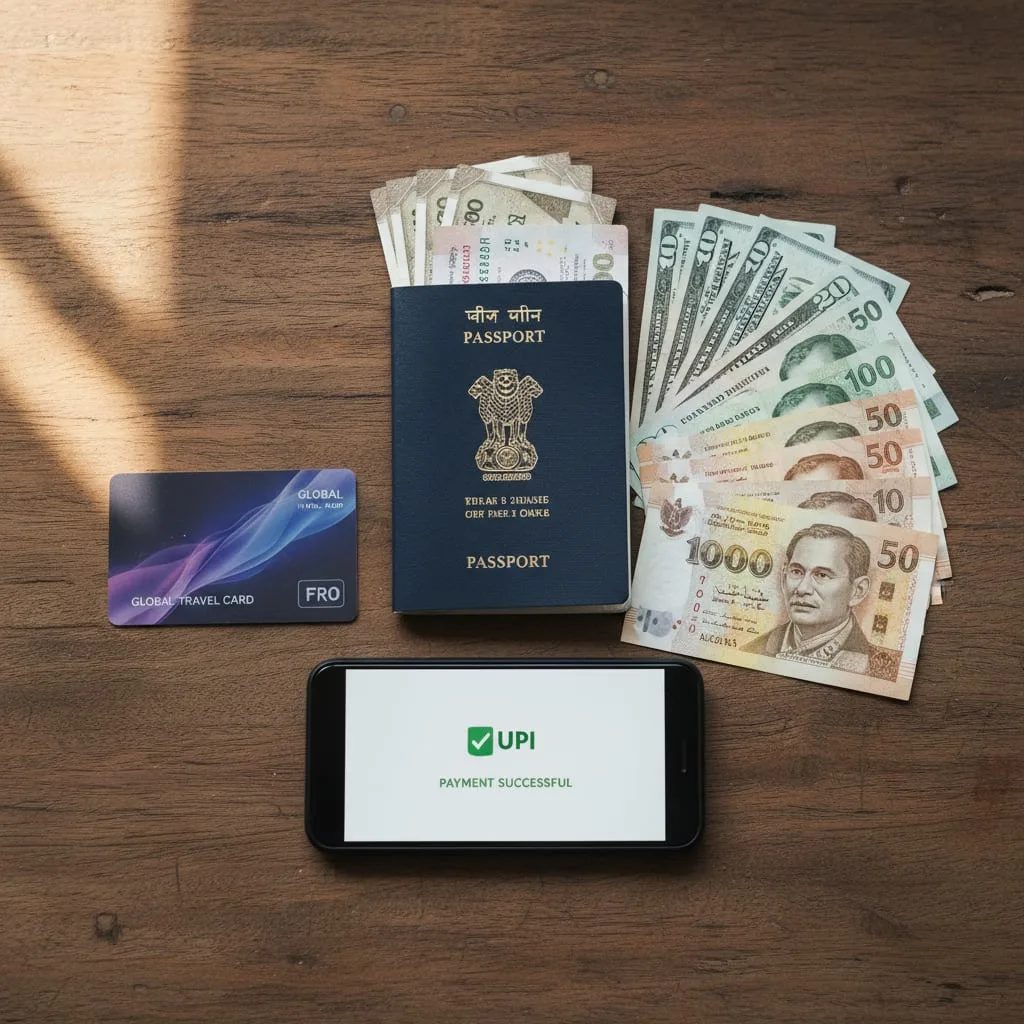
Forex for Indian Travelers: Cards vs Cash vs UPI — The Money Math Nobody Explains
In this guide (10)
- Forex for Indian Travelers Comparison: The Real Cost Table
- Forex Cards: The Clear Winner for Indian Travelers
- Credit Cards in the Forex Comparison: Backup Only
- The DCC Scam: How Merchants Steal 8% From Tourists
- Cash Comparison: Not Dead, But Use It Wisely
- UPI Abroad: Indian Travelers Have Options Now
- The GST and TCS Nobody Mentions
- My Exact Forex Stack for a 10-Day Trip
- Pro Tips From 14 Trips of Mistakes
- The Bottom Line: Stop Donating Money to Banks
I lost ₹4,200 on my first trip to Bangkok. Not on a scam. Not on bad food. On basic money exchange that nobody bothered to explain to me. This forex for Indian travelers comparison is the article I wish existed before that trip.
Here's what happened: I withdrew 10,000 Thai Baht from an ATM using my SBI debit card. The ATM showed a "convenient" INR conversion. I thought I was being smart. Back home, my statement revealed the reality — a forex markup fee, an ATM operator fee, my bank's international withdrawal fee, and a GST slapped on top of everything. That "convenient" ₹23,500 withdrawal actually cost me ₹27,700.
That was 2019. Since then, I've done this comparison obsessively across 14 international trips. I've used Niyo, Fi Money, HDFC ForexPlus, Thomas Cook cards, raw cash, my HDFC Millennia credit card, and yes, even UPI in Singapore. I've tracked every rupee.
This is the forex for Indian travelers comparison breakdown I wish someone had given me before that Bangkok trip.

Forex for Indian Travelers Comparison: The Real Cost Table
Let's cut through the marketing. Here's what a ₹10,000 spend actually costs you through each payment method in Thailand (December 2025 rates, THB 1 = ₹2.45 interbank):
| Payment Method | Exchange Rate Used | Fees Applied | Actual Cost for ₹10,000 Spend |
|---|---|---|---|
| Niyo Global Card | ₹2.45 (live interbank) | Zero markup | ₹10,000 |
| Fi Money Card | ₹2.45 (live interbank) | Zero markup | ₹10,000 |
| BookMyForex Card | ₹2.47 (locked rate) | 1% load fee | ₹10,180 |
| HDFC ForexPlus | ₹2.50 (bank rate) | 2% load markup | ₹10,400 |
| Credit Card (HDFC Millennia) | ₹2.45 (Visa rate) | 3.5% markup + GST | ₹10,420 |
| Debit Card ATM (SBI) | ₹2.48 (network rate) | 3.5% + ₹150 ATM + ₹220 Thai ATM | ₹10,870 |
| Airport Exchange (Mumbai) | ₹2.58 | Baked into rate | ₹10,530 |
| UPI (Singapore only) | ₹2.48 | ~1.5% markup | ₹10,270 |
See that? The difference between the best option (Niyo/Fi at ₹10,000) and the worst option (debit card ATM at ₹10,870) is ₹870 on just ₹10,000 spend. On a 7-day trip where you might spend ₹80,000-1,00,000, that's ₹7,000-₹8,700 you're throwing away. This forex comparison isn't just academic — it's real money.
And that's before we talk about the DCC scam, which can add another 5-8% if you're not careful.
Also worth noting: many premium travel cards include rental car insurance abroad, which pairs well with having your international driving license from India sorted.Forex Cards: The Clear Winner for Indian Travelers
I'll say it directly: if you're not using a zero-markup forex card in 2026, you're donating money to banks. But not all forex cards are equal, and this comparison matters.
The Zero-Markup Champions
Niyo Global (DCB Bank) — This is my primary card. Zero forex markup, real-time interbank rates, free ATM withdrawals up to ₹30,000/month abroad. The app is basic but functional. Only catch: you need to transfer money via NEFT/IMPS (no instant UPI load). Takes 2-4 hours to reflect.
Fi Money (Federal Bank) — Slightly slicker app, same zero markup. They've added virtual card support, so you can start using it instantly while waiting for the physical card. ATM withdrawals have a 3% fee though, so use it for card swipes only.
Jupiter Edge (via IndusInd) — The newest entrant. Zero markup, but the card has a ₹499/year fee after the first year. Worth it if you travel 2+ times annually.
The Old Guard (Still Usable)
BookMyForex/Thomas Cook/Yatra Forex — These work on a "lock the rate" model. You load money at today's rate plus 1-2% margin, and that rate stays fixed regardless of market movements. Useful if you're loading 3 months before a trip and expect the rupee to fall. Otherwise, you're paying extra for a hedge you don't need.
HDFC ForexPlus/ICICI Travel Card — Bank-issued cards with 2-3% markup baked into the loading rate. Convenient if you want everything in one bank, but you're paying for that convenience. In my forex for Indian travelers comparison, I've stopped recommending these unless someone absolutely refuses to open another account.
The Loading Strategy That Saves Money
Here's a trick that took me four trips to figure out. Load your forex card in tranches:
- Load 70% of your expected spend 2-3 days before departure
- Keep 30% in your Indian bank account
- If you need more abroad, load via NEFT/IMPS (works even internationally if you have net banking)
Why? Because over-loading means your money sits in a foreign currency earning nothing. Under-loading means emergency credit card usage at 3.5% markup. The 70-30 split handles most scenarios.

Credit Cards in the Forex Comparison: Backup Only
Most Indian credit cards charge 3.5% forex markup plus 18% GST on that markup. That's effectively 4.13% extra on every swipe. For a ₹50,000 spend abroad, you're bleeding ₹2,065 in fees.
There are exceptions, though.
The Rare Zero/Low Markup Credit Cards
HDFC Infinia (invitation only) — 2% markup, offset by reward points worth ~3.3%. Net positive if you're strategic about redemption. But you need ₹10+ lakh annual income to get invited.
SBI Elite — 1.99% markup, but the ₹4,999 annual fee and earning rate make it worthwhile only for heavy spenders.
Axis Atlas — 2% markup, excellent for booking flights (5X points on travel). The travel benefits offset the markup if you use it exclusively for flight bookings.
Based on my forex for Indian travelers comparison, use credit cards as backup only. Swipe when your forex card gets blocked (happens more than you'd think), when the merchant doesn't accept your card network (Visa vs Mastercard vs RuPay), or when you need purchase protection (forex cards don't offer this).
One non-negotiable rule: always carry two different card networks. I have Niyo (Visa) and Fi (Mastercard). This saved me twice when one network was down.
The DCC Scam: How Merchants Steal 8% From Tourists
This one burns me. Dynamic Currency Conversion is legal theft that happens a hundred times a day at tourist spots worldwide.
Here's how it works: you're at a shop in Dubai. You swipe your card. The machine shows two options — Pay AED 500, or Pay ₹11,250 (at OUR guaranteed rate!).
Seems helpful, right? Your brain thinks, "Oh nice, I can see the exact INR amount!" The merchant helpfully suggests the INR option.
NEVER PICK INR.
That "guaranteed rate" is typically 5-8% worse than the actual interbank rate. The merchant gets a kickback for pushing you into DCC. The payment processor makes a killing. You lose ₹750 on a ₹10,000 transaction.
Always select local currency. If the machine automatically shows INR without asking, hit cancel and try again. Tell the merchant you want to be charged in local currency. Some will push back — stand firm.
I've had merchants in Thailand literally argue with me about this. "Sir, INR is better for you!" No. It's better for them.
If you're checking your Singapore trip budget or Dubai trip costs, factor in DCC as a hidden risk if you're not vigilant.
Cash Comparison: Not Dead, But Use It Wisely
Hot take: cash isn't obsolete for international travel. I carry $200 equivalent in local currency on every trip. Here's why and how.
When Cash Wins
Street food vendors (that ₹150 pad thai in Bangkok isn't taking your Niyo card), night markets and bazaars, taxi drivers in countries without Grab/Uber, tipping in countries where it's expected, and emergency backup when all cards fail. It happens.
Where to Exchange: The Hierarchy
Best rates: BookMyForex / ExTravelMoney online order (delivered to doorstep 2-3 days before departure). You're paying 0.5-1% over interbank. Check the RBI reference rates to verify you're getting a fair deal.
Good rates: Local money changers in Paharganj (Delhi), Fort area (Mumbai), Chickpet (Bangalore). Negotiate aggressively. Walk away and come back. They'll drop 0.3-0.5% if you're exchanging ₹50,000+.
Acceptable rates: Bank forex desks. HDFC and ICICI are slightly better than SBI. No negotiation possible, but fully legitimate with proper receipts.
Terrible rates: Airport counters. The Thomas Cook kiosk at Mumbai T2 international charges 5-7% markup. The one at Singapore Changi is worse. Only use airports if you literally have no other option.
Worst rates: Exchanging at your destination's airport. I've seen 10% markups at Bangkok Suvarnabhumi. Criminally bad.
The RBI Cash Limits
You can carry up to $3,000 (or equivalent in other currencies) in cash per trip. Above $10,000, you need to declare at customs. The RBI's Liberalized Remittance Scheme (LRS) allows $250,000 per financial year total across all foreign remittances — travel, education, investments, everything.
Also: 20% TCS (Tax Collected at Source) applies on forex purchase above ₹10 lakh in a financial year. You get it back as a tax credit, but it's locked up until you file returns. Keep your forex purchases under this threshold if possible.
UPI Abroad: Indian Travelers Have Options Now
I used UPI in Singapore last year. It worked. But it's not the magic solution some people think.
As of 2026, UPI is accepted in Singapore, UAE, Bhutan, Nepal, Sri Lanka, France, Mauritius, and a few other countries via the BHIM UPI app. The catch? It only works at specific merchant terminals that support the UPI QR code standard. In Singapore, I'd estimate 40% of shops accepted it. In Dubai, maybe 25%.
The exchange rate isn't great either — roughly 1-2% worse than interbank. Better than credit card markup, worse than zero-markup forex cards.
I wrote a detailed breakdown in the UPI abroad guide. Use it as backup, not primary.
The GST and TCS Nobody Mentions
Here's where the hidden costs pile up.
GST on forex services: 18% GST applies on forex card loading fees, credit card markup fees, and money changer commissions. When your credit card charges 3.5% markup, you're actually paying 3.5% + (18% of 3.5%) = 4.13%.
TCS (Tax Collected at Source): No TCS on forex up to ₹10 lakh per financial year. Above ₹10 lakh, it's 20% TCS. This applies to forex cards, cash, credit card spends abroad — everything.
The TCS isn't a tax per se — you can claim it back when filing ITR. But it's still money locked up until next April-June when you file. If you're taking multiple international trips in a year, spread your forex purchases across financial years if possible.
My Exact Forex Stack for a 10-Day Trip
After all this forex for Indian travelers comparison research, here's what I actually carry:
- Niyo Global Card: Loaded with 70% of expected spend (primary for all card payments)
- Fi Money Card: Loaded with 20% (backup card, different network)
- HDFC Millennia Credit Card: Emergency only (purchase protection, 3.5% markup)
- Cash: $200 equivalent in local currency, exchanged via BookMyForex
- Small INR notes: ₹2,000 for the airport Uber home
This setup has worked across Thailand, Singapore, Indonesia, UAE, Malaysia, and Vietnam. No issues. Minimal fees.
Before your first trip, check the international travel checklist to make sure you've covered everything beyond forex.
Pro Tips From 14 Trips of Mistakes
These are the lessons I learned the hard way:
Activate international transactions 24 hours before departure. Both on the card (via app) and with your bank if required. I've had cards blocked at Dubai Mall because I forgot this step.
Save your card issuer's international helpline in your phone. Not the 1800 number — that won't work abroad. Niyo's is +91-22-71277177, and Fi's is +91-80-68415155. You'll need these if your card gets blocked at 11 PM in Phuket.
Test your card at an ATM before you travel. Seriously. Withdraw ₹500 from your forex card at an Indian ATM. Make sure the PIN works and the card is active.
Screenshot your card details. Front and back. Store in a secure note app. If you lose the physical card, you can still provide details to the bank or use the virtual card for online bookings.
Don't use hotel exchange desks. They're as bad as airports. Walk 5 minutes to a local exchanger instead.
Set card spending limits slightly above your expected max. If you might spend ₹50,000 in a day (shopping trip?), set the limit at ₹60,000. Getting declined because you hit your own limit is embarrassing.
If the whole money planning is stressing you out, that's normal — I've written about managing first international trip anxiety separately.
The Bottom Line: Stop Donating Money to Banks
Every rupee you lose to bad exchange rates, hidden markups, and unnecessary fees is a rupee you could have spent on an extra day of travel, a nicer hotel, or that meal you've been eyeing.
This forex for Indian travelers comparison comes down to this: zero-markup cards (Niyo, Fi, Jupiter Edge) for 90% of spending, a backup credit card for emergencies, and a small cash buffer for street vendors. That's it. Skip the expensive bank forex cards. Forget over-exchanging at airports. And never fall for DCC.
I spent years figuring this out through expensive mistakes. You don't have to.
Now go book that trip. The money math is the boring part — the actual travel is where the stories happen. Also be aware of hidden charges on international trips that can drain your travel budget beyond forex fees. These forex strategies work particularly well in destinations like Hong Kong and Macau, where card acceptance is universal.