
Vegetarian Survival Guide to Thailand: What Every Indian Traveler Needs to Know
In this guide (10)
- The Fish Sauce Problem: Why "Vegetarian" Doesn't Mean What You Think
- Your Secret Weapon: Jay Restaurants (The Yellow Flag Saviours)
- The 7-Eleven Survival Strategy That Saved My Trip
- Safe Thai Dishes: What Vegetarian Food Thailand Indian Travelers Can Actually Order
- Thai Phrases That Actually Work: Your Pocket Survival Reference
- City-by-City Breakdown: Vegetarian Food Thailand Indian Travelers Can Find
- Apps and Resources: Download Before You Go
- Budget Breakdown: What Vegetarian Food Actually Costs
- For Jain Travelers: Extra Considerations
- Final Thoughts From Someone Who's Been There
The first time I ordered "vegetarian" pad thai in Bangkok, I took one bite and immediately tasted something fishy. Literally. My server had smiled, nodded when I said vegetarian, and then served me noodles swimming in fish sauce. That's when I realized: finding vegetarian food Thailand Indian travelers can actually eat requires a completely different playbook than what works back home.
My mom would've fainted looking at that plate. She's the kind of pure veg person who won't even eat at restaurants that serve non-veg. And here I was, in a country where fish sauce is basically treated like water — they put it in everything. EVERYTHING. Even dishes that look completely vegetarian, like stir-fried vegetables or papaya salad, usually contain nam pla (fish sauce) or oyster sauce.
But here's the thing — after three trips to Thailand and countless trial-and-error meals, I've cracked the code. Thailand can actually be a vegetarian paradise for Indian travelers if you know where to look, what to say, and which places to avoid entirely. This isn't some generic list. This is survival knowledge from someone who's been through the struggle.
The Fish Sauce Problem: Why "Vegetarian" Doesn't Mean What You Think
Let me be brutally honest with you. In Thai cooking, fish sauce isn't considered non-vegetarian by most locals. It's just... seasoning. Like how we use salt. When you tell a Thai street vendor you're vegetarian, they hear "no chunks of meat." They don't hear "no fish sauce, no oyster sauce, no shrimp paste."
This isn't their fault — it's a cultural difference. Thai Buddhism allows fish sauce because it's a fermented product, not actual fish meat. But for us Indians, especially those from strict vegetarian families, this is a massive problem.
Dishes that almost ALWAYS contain hidden fish sauce:
- Pad Thai — Yes, even the ones with only vegetables and tofu
- Som Tam (Papaya Salad) — The dressing is fish sauce-based
- Tom Yum Soup — Fish sauce plus shrimp paste
- Green/Red Curry — Shrimp paste in the curry paste itself
- Stir-fried vegetables — Oyster sauce or fish sauce for flavor
- Fried rice — Fish sauce is the default seasoning
I know, I know. That list basically covers every famous Thai dish. Don't panic yet.
Your Secret Weapon: Jay Restaurants (The Yellow Flag Saviours)
The first time I saw a yellow flag with red Chinese characters outside a small shophouse in Bangkok's Chinatown, I didn't know what it meant. Turns out, those flags mark Jay restaurants — and they became my absolute lifeline.
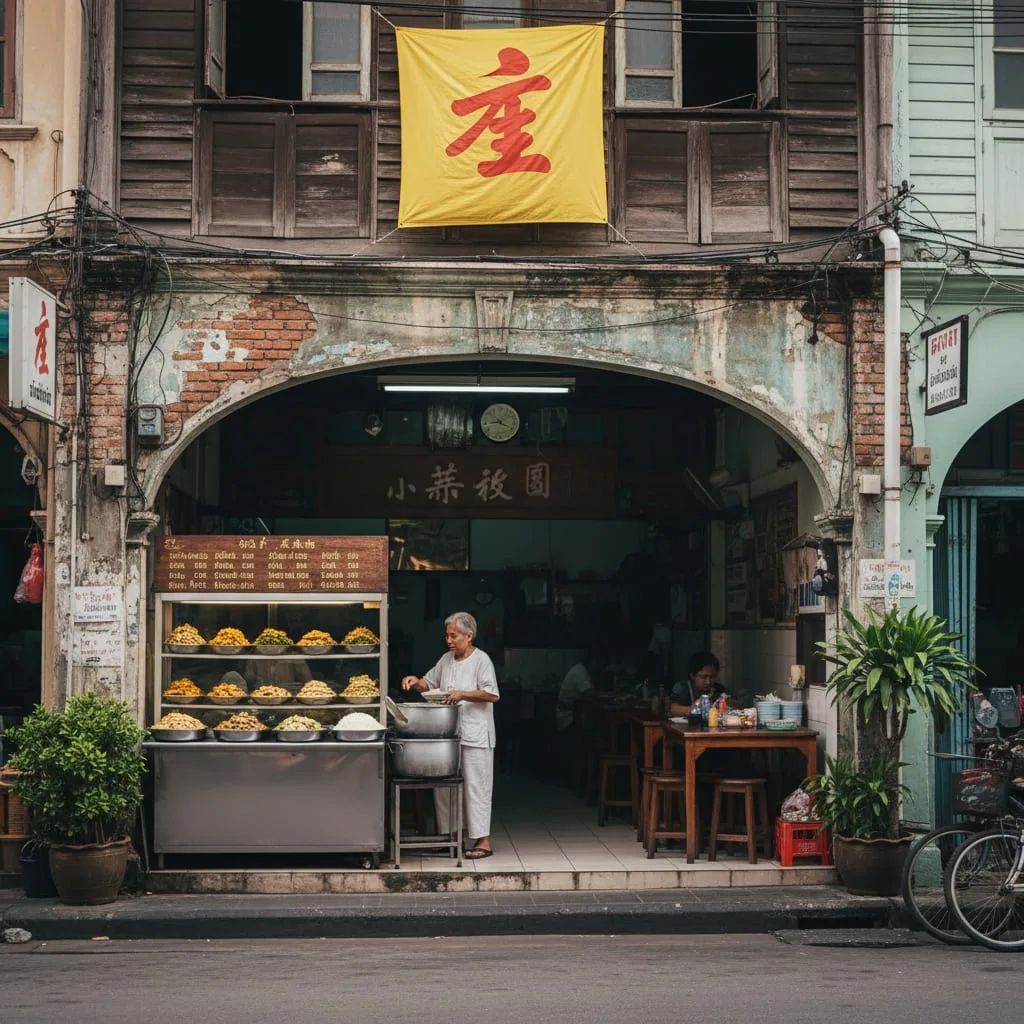
Jay (เจ) means Chinese Buddhist vegetarian. It's not just vegetarian — it's basically Jain-friendly. No meat, no fish, no eggs, no garlic, no onion. Sound familiar? For those of us following sattvic or Jain dietary restrictions, Jay restaurants are like finding a Haldiram's in the middle of nowhere.
The best part? Jay food is CHEAP. We're talking 40-60 THB (about INR 95-140) for a full plate of rice with two or three vegetable dishes. Compare that to tourist-oriented "vegetarian" restaurants charging 200-300 THB for the same thing.
Where to find Jay restaurants:
- Bangkok Chinatown (Yaowarat) — The motherlode. Soi Texas and the streets around Wat Mangkon have dozens of Jay shops
- Near any major Buddhist temple — Temples often have Jay food stalls outside, especially on Buddhist holy days
- Chiang Mai Old City — Pra Pokklao Road has several permanent Jay restaurants
- Phuket Town — Not Patong, but actual Phuket Town near the shrines
Pro tip: During the annual Vegetarian Festival (late September/October), Jay food explodes across Thailand. The Tourism Authority of Thailand even promotes the festival to international visitors. Every other shop puts up the yellow flag. It's vegetarian heaven for about 9 days.
The 7-Eleven Survival Strategy That Saved My Trip
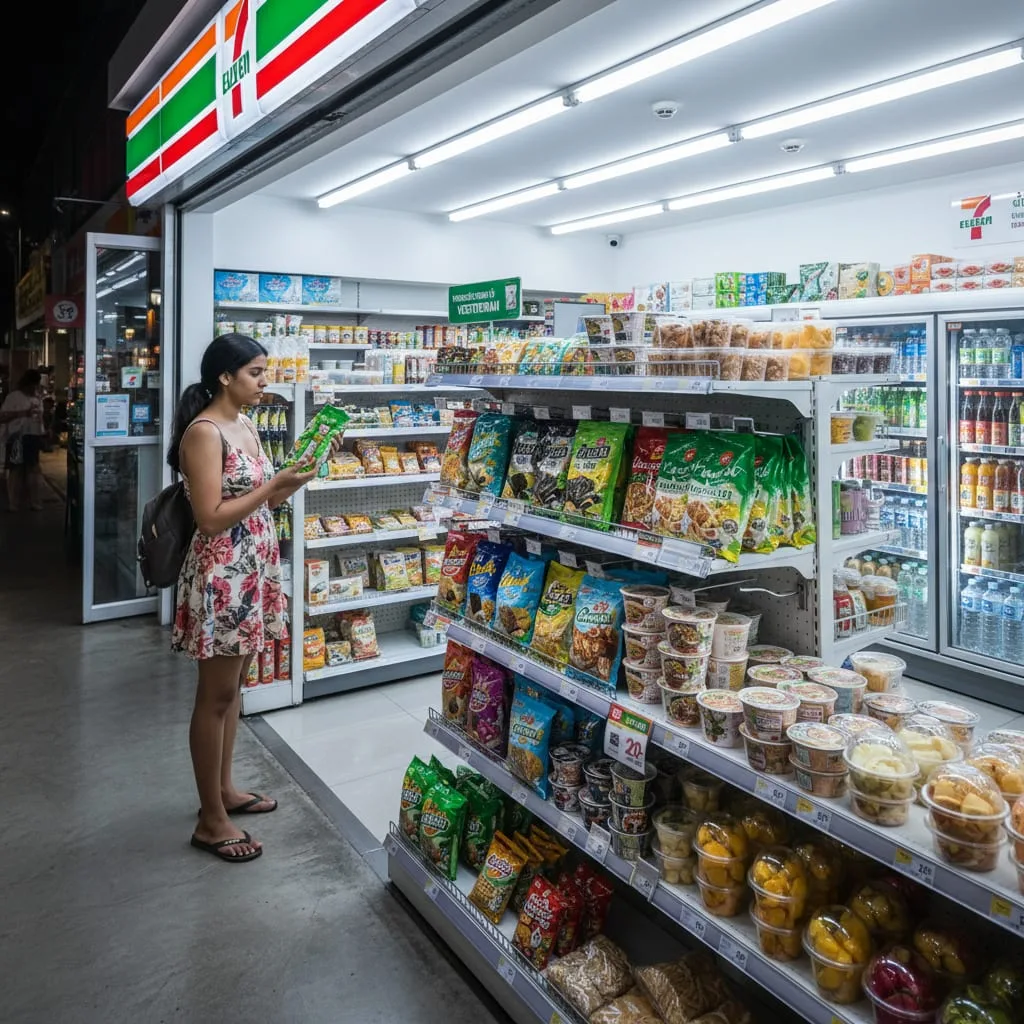
I'm not exaggerating when I say 7-Eleven saved me more times than any restaurant. Thailand has a 7-Eleven on literally every corner — sometimes two on the same street. And unlike the fancy restaurants where communication is a nightmare, 7-Eleven has labeled packaging you can actually read.
Reliably vegetarian items at Thai 7-Eleven:
- Onigiri with vegetable fillings — Look for the corn mayo one (green label). Avoid anything with "tuna" or pink filling
- Plain white bread and butter — Boring but safe. About 25 THB
- Fresh fruits — Pre-cut mango, watermelon, pineapple. Life savers at 20-30 THB
- Mama instant noodles (tom yum vegetarian flavor) — Look for the one with a clear "V" symbol. About 12 THB
- Nuts and dried fruits — Various brands, all clearly labeled
- Toasted sandwiches — The cheese and corn one is vegetarian. Ask them to toast it fresh
- Lay's chips — Original, sour cream, and several other flavors are vegetarian
- Yogurt — Meiji brand has clear vegetarian options
The green leaf symbol on Thai packaging indicates vegetarian. It's not 100% reliable (some products with the symbol still contain egg), but it's a good starting point.
I know surviving on 7-Eleven food sounds depressing. But when it's 11 PM, you're exhausted from temple-hopping, and every restaurant nearby is serving pad thai with mystery sauce — that convenience store cheese sandwich hits different. Trust me.
Safe Thai Dishes: What Vegetarian Food Thailand Indian Travelers Can Actually Order
Okay, enough doom and gloom. Let's talk about Thai dishes that are either naturally vegetarian or can be made vegetarian with minimal modifications. These are the dishes I've personally eaten dozens of times without any fishy surprises.
Naturally Vegetarian Thai Food (Usually Safe)
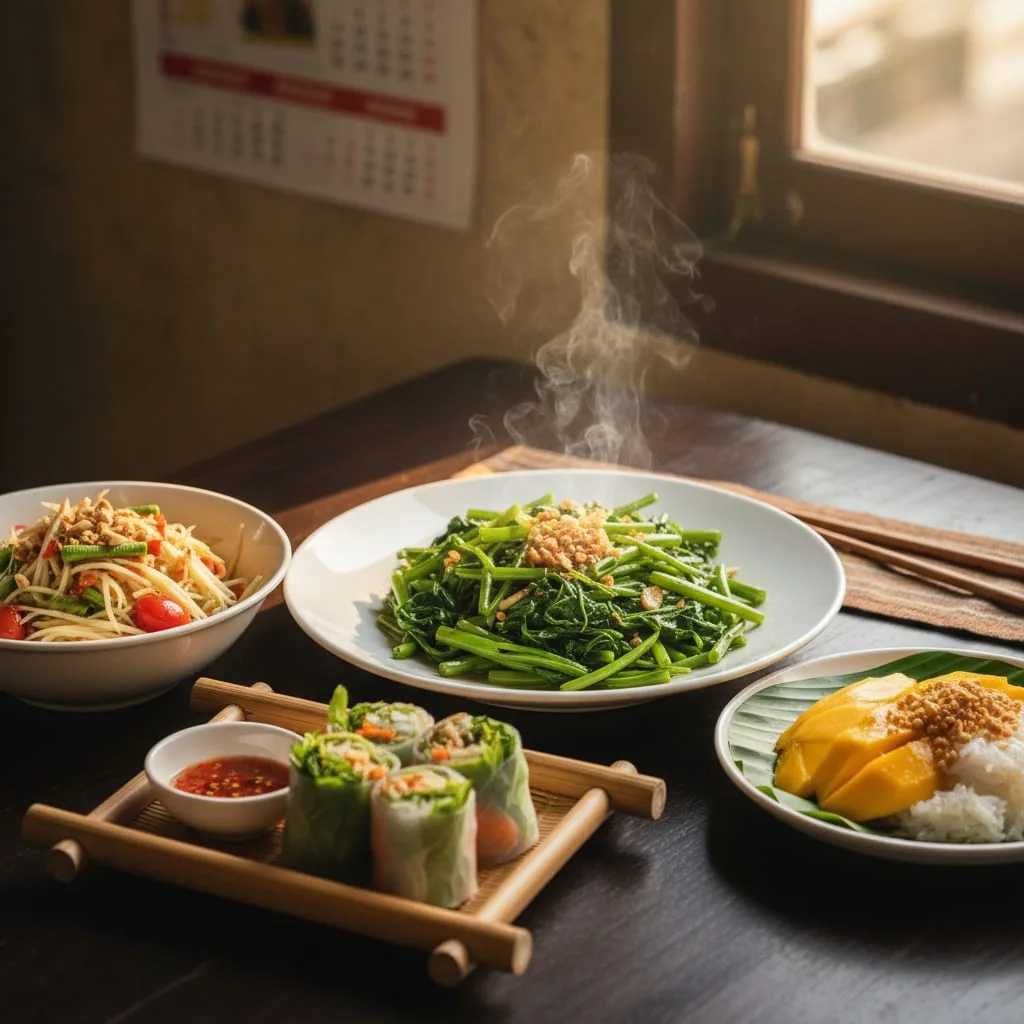
- Khao Niao Mamuang (Mango Sticky Rice) — Just rice, coconut milk, and mango. The best Thai dessert, period. About 60-80 THB
- Poh Pia Sod (Fresh Spring Rolls) — Rice paper with vegetables and sometimes tofu. The sauce might have fish sauce, so ask for sweet chili instead
- Khao Pad Sapparod (Pineapple Fried Rice) — At Jay restaurants only. Regular restaurants use fish sauce
- Roti with condensed milk — Indian-origin flatbread found at night markets. Sweet, crispy, vegetarian. 30-40 THB
- Coconut ice cream — Served in a coconut shell with peanuts and corn. Most vendors don't add any animal products
Order With Modifications
- Pak Boong Fai Daeng (Stir-fried Morning Glory) — Say "mai sai nam pla, mai sai nam man hoi" (no fish sauce, no oyster sauce). Use soy sauce instead
- Pad Pak Ruam (Mixed Vegetable Stir-fry) — Same modifications as above
- Khao Pad (Fried Rice) — "Gin jay" version at Jay restaurants, or with soy sauce instead of fish sauce at regular places
- Massaman Curry — Some places make it vegetarian on request. But verify the curry paste is fish-sauce free
Avoid Completely
- Any curry at non-Jay restaurants — The paste contains shrimp paste
- Tom Yum or Tom Kha soups — Shrimp paste is fundamental to these
- Pad Thai anywhere except Jay restaurants — Even "vegetarian" versions use fish sauce
- Som Tam — Unless specifically marked as "Jay Som Tam"
Thai Phrases That Actually Work: Your Pocket Survival Reference
Communication is 80% of the battle. I've tried showing Google Translate to street vendors — half the time they squint at the screen, shrug, and add fish sauce anyway. What works better is learning a few key phrases and, more importantly, knowing HOW to say them.
Essential phrases (with pronunciation):
- Gin Jay (กินเจ) — "I eat vegetarian (Buddhist style)." This is your magic phrase. Pronounced: gin + jay (like the letter J)
- Mai sai nam pla (ไม่ใส่น้ำปลา) — "No fish sauce." Pronounced: my + sigh + nahm + plah
- Mai sai nam man hoi (ไม่ใส่น้ำมันหอย) — "No oyster sauce." Pronounced: my + sigh + nahm + mun + hoy
- Mai sai neua sat (ไม่ใส่เนื้อสัตว์) — "No meat." Pronounced: my + sigh + nua + sat
- Mai sai kai (ไม่ใส่ไข่) — "No egg." Pronounced: my + sigh + kai
- Phom/Chan gin jay — "I eat vegetarian." Phom for men, Chan for women
Pro tip: Save these phrases as screenshots on your phone WITH the Thai script. When speaking doesn't work, showing the Thai text usually does. I also recommend the "Thai Vegetarian" card from the Happy Cow website — print it and laminate it.
City-by-City Breakdown: Vegetarian Food Thailand Indian Travelers Can Find
Bangkok: Your Best Bet for Vegetarian Food
Bangkok is honestly the easiest Thai city for Indian vegetarians. The combination of Chinatown Jay restaurants, Little India, and modern vegetarian cafes means you won't starve.
Little India (Sukhumvit Soi 3/1): When you desperately need dal chawal and can't look at another stir-fry, head here. Punjab Sweet House and Royal India have proper North Indian vegetarian food. Thali meals run about 250-350 THB (INR 590-825). It's not cheap by Thai standards, but sometimes you need that comfort.
Chinatown (Yaowarat): Walk down Soi Texas any morning and you'll find 4-5 Jay restaurants serving breakfast congee, steamed buns, and rice plates. My favorite is a nameless shop with blue plastic chairs near the gold shops — rice with three vegetables for 50 THB.
Modern vegetarian cafes (great for Indian travelers): May Veggie Home near Chong Nonsi BTS does excellent Thai-Western fusion. Expect to pay 150-200 THB per dish. Broccoli Revolution in Sukhumvit is Instagram-fancy and overpriced, but guaranteed safe.
If you're planning your first Bangkok trip, check out our Bangkok itinerary for Indian travelers which includes vegetarian-friendly areas.
Chiang Mai: Surprisingly Good
Chiang Mai's backpacker culture means more vegetarian awareness than other Thai cities. The Old City has several dedicated vegetarian restaurants, and even regular places understand the concept better.
Pun Pun Vegetarian near Wat Suan Dok is run by monks and serves organic vegetarian Thai food. Meals cost 50-80 THB, and everything is clearly labeled. The mushroom larb is incredible — spicy, tangy, and completely fish-sauce-free.
Anchan Vegetarian on Nimmanhaemin Road does blue-flower rice bowls that are both beautiful and delicious. More expensive at 120-180 THB, but worth it for a proper sit-down meal.
The Sunday Walking Street market has several vegetarian stalls — look for the "jay" signs on handwritten boards.
Phuket: Tricky But Manageable
Phuket is harder because it's dominated by tourist-oriented Thai-seafood places. The beach areas like Patong are particularly difficult — everything revolves around fish.
Your best strategy: head to Phuket Town (the actual town, not the beaches). The area around Jui Tui Shrine has several Jay restaurants, especially during festival season. Kopitiam by Wilai serves vegetarian options with clear labeling.
For emergencies, the Tesco Lotus and Big C hypermarkets have food courts with vegetarian stalls marked by the Jay symbol.
Thai Islands: Pack Snacks
Koh Samui, Koh Phangan, Koh Tao — all beautiful, all basically vegetarian deserts. The small islands rely heavily on fishing, and vegetarian options are limited to expensive resort restaurants or random backpacker cafes.
My vegetarian food Thailand survival strategy for islands (works for all Indian travelers):
- Stock up on snacks before taking the ferry
- Locate the nearest 7-Eleven immediately upon arrival
- Find ONE reliable restaurant and eat there repeatedly
- Consider accommodations with kitchen access to cook your own food
Apps and Resources: Download Before You Go
For vegetarian food Thailand Indian travelers shouldn't rely on asking locals or random Google searches alone. These tools have saved me — and countless other Indian travelers seeking vegetarian food in Thailand:
- HappyCow — THE essential app for vegetarian travelers. Crowd-sourced database with excellent Thailand coverage, especially for Bangkok and Chiang Mai
- Google Maps — Search "jay restaurant" or "เจ" near your location. The Thai script search works better than English
- Google Translate — Download Thai for offline use. The camera feature can translate menus, though accuracy varies
- Grab Food — Thailand's food delivery app has vegetarian filters. Useful for hotel delivery when you're too tired to venture out
Speaking of Southeast Asian vegetarian food, our vegetarian food guide for Malaysia covers similar strategies that work across the region. And if you want Indian food options in multiple countries, check out where to find Indian food in Singapore and Malaysia.
Budget Breakdown: What Vegetarian Food Actually Costs
When it comes to vegetarian food Thailand Indian travelers actually have an advantage — it's generally cheaper than meat dishes. Here's what you'll actually spend:
- Jay restaurant meal: 40-70 THB (INR 95-165)
- Street food vegetarian dish: 50-80 THB (INR 120-190)
- 7-Eleven meal: 60-100 THB (INR 140-235)
- Modern vegetarian cafe: 150-250 THB (INR 355-590)
- Indian restaurant thali: 250-400 THB (INR 590-945)
- Hotel restaurant vegetarian: 200-400 THB (INR 470-945)
A realistic daily food budget for a vegetarian Indian traveler: 400-600 THB (INR 945-1,420) if you mix Jay restaurants with occasional cafe meals.
For Jain Travelers: Extra Considerations
If you follow Jain dietary restrictions, Thailand becomes harder but not impossible. Jay food is your best friend because it naturally excludes garlic and onion (considered tamastic in Buddhist tradition too).
However, Jay food often includes:
- Root vegetables — Potatoes, carrots, etc. which strict Jains avoid
- Mushrooms — Common in Jay dishes
Your options:
- Ask for dishes without root vegetables: "Mai sai man farang, mai sai carrot" (no potato, no carrot)
- Stick to fruit, rice, and above-ground vegetables
- Indian restaurants in Bangkok can prepare Jain food on request — but call ahead
We've written a dedicated Jain food guide for Bali with strategies that also apply to Thailand.
If you want the hotels, transfers and main sightseeing arranged, see our Bangkok Pattaya tour package and Thailand family tour package. Both include hotel breakfast and leave most other meals free, so you can eat where this guide suggests.
Final Thoughts From Someone Who's Been There
My first Thailand trip was genuinely stressful. I survived on 7-Eleven sandwiches, fruit, and the one Indian restaurant I found. By my third trip, I had a system — Jay restaurants for proper meals, safe street food items, backup snacks always in my bag.
Finding vegetarian food in Thailand as an Indian traveler isn't impossible — it just takes preparation. Thailand isn't naturally vegetarian-friendly, but it's not hostile either. The Buddhist culture means people understand the concept even if they don't practice it the way we do. You just need to communicate clearly and know where to look.
One last thing: don't let food stress ruin your trip. Thailand has too many incredible temples, beaches, and experiences to spend all your mental energy worrying about fish sauce. Learn the phrases, find your reliable spots for vegetarian food Thailand Indian travelers rely on, and then let go and enjoy the country.
Planning your Thailand trip? Make sure to check Thailand visa requirements for Indian passport holders before booking. And if you need help planning a vegetarian-friendly itinerary, TripCabinet's Thailand packages can customize your entire trip around your dietary needs — just tell us you're vegetarian when enquiring, and we'll handle the rest.
For a comprehensive look at which destinations are best for Indian food lovers beyond Thailand, see our ranking of 12 countries where Indians never go hungry.
How to Find Vegetarian Food in Thailand
Step-by-step guide to eating vegetarian in Thailand as an Indian traveler
Learn key Thai phrases
Memorize "gin jay" (eat vegetarian), "mai sai nam pla" (no fish sauce), and "mai sai kai" (no egg). Save these in your phone with Thai script.
Look for Jay restaurants
Find yellow flags with red Chinese characters displaying the Jay symbol. These Buddhist vegetarian restaurants serve completely meat-free food.
Use HappyCow app
Download HappyCow before your trip. It maps vegetarian and vegan restaurants with reviews from other travelers.
Stock up at 7-Eleven
Keep vegetarian snacks from 7-Eleven as backup. Look for the green leaf symbol on packaging for vegetarian items.
Visit Indian restaurants for comfort food
Head to Sukhumvit Soi 3/1 (Little India) in Bangkok for guaranteed pure veg Indian meals when you need familiar food.