
Thailand Visa for Indians 2026: The Visa Exemption Update Nobody Explained Properly
In this guide (14)
- Thailand Visa for Indians 2026: What Actually Changed
- Documents Required for Thailand Entry (Even Without a Visa)
- The Thailand Arrival Card (TM6): Is It Dead Yet?
- Immigration at Suvarnabhumi: A Play-by-Play
- Common Reasons Indians Get Denied Entry to Thailand
- Extending Your Thailand Stay Beyond 30 Days
- Thailand Pass and Digital Arrival: Do They Still Exist?
- Which Airport Should You Fly Into?
- Embassy Contacts for Indians in Thailand
- Can Indians Enter Thailand by Land Border?
- What About Phuket? Any Special Rules?
- My Pre-Flight Checklist for Thailand
- The Actual Cost of Thailand Entry in 2026
- Final Thoughts on Thailand Visa for Indians 2026
I still remember standing in the visa-on-arrival queue at Suvarnabhumi Airport in 2019, passport in one hand, 2,000 baht in the other, wondering if I'd filled out the form correctly. The queue snaked around twice. Kids were crying. Someone's application got rejected because their photo was the wrong size. The Thailand visa for Indians 2026 situation has changed completely since then — and most people still don't understand what actually happened.
Fast forward to my January 2026 trip, and I walked through immigration in under 15 minutes. No visa fee. No application form. No queue that made you question your life choices. I've seen so much confusion online about the current Thailand visa rules for Indian passport holders that I had to write this down properly.
Update, 17 September 2026: Thailand has cut the visa-free stay for Indian passport holders from 60 days to 30 days. The 60-day scheme, introduced in July 2024, ended on 14 September 2026, and the 30-day visa exemption applies from 15 September 2026 under Ministry of Interior announcements published in the Royal Gazette on 31 August 2026. If you want to stay longer than 30 days, the Royal Thai Embassy in New Delhi says to apply for an appropriate e-visa at thaievisa.go.th. The figures in this guide have been updated to match.
Thailand Visa for Indians 2026: What Actually Changed
Okay so here's where it gets confusing for most people. Thailand used to offer Indians a "visa on arrival" — meaning you'd land, fill forms, pay money, wait in line, and get a 15-day stamp. That system still technically exists, but you don't need it anymore.
India is still on Thailand's visa exemption list in 2026. Since 15 September 2026, Indian passport holders can enter Thailand without any visa for stays up to 30 days. Not 15. Not 60 anymore. Thirty days.
I know what you're thinking — "But my cousin went last month and said he needed a visa." Your cousin probably didn't know about the change, panicked, and applied for an e-Visa anyway. Or he's confusing Thailand with another country. It happens more than you'd think.
The Thailand visa exemption for Indians is not a temporary COVID recovery measure. It's a proper policy change. The Thai government extended it, then made it semi-permanent, and as of my last trip, it's absolutely still in effect. This makes planning your Thailand visa for Indians 2026 travel incredibly simple.

Documents Required for Thailand Entry (Even Without a Visa)
No visa doesn't mean no documents. This is where Indians sometimes get into trouble. Immigration officers can still ask questions and request proof. Here's what I always carry:
The Non-Negotiables
- Valid passport — Must be valid for at least 6 months from your entry date. Not 6 months from when you booked. From when you land. I've seen people turned away for this.
- Confirmed return or onward ticket — This is the big one. You cannot enter Thailand on a one-way ticket without a very good explanation and documentation. Book your return flight before you land.
- Proof of accommodation — Hotel booking, Airbnb confirmation, or a letter from whoever you're staying with. Booking.com confirmations work fine, even if they're refundable.
- Proof of funds — Officially, they want to see 20,000 THB per person (roughly ₹48,000 at current rates) or equivalent. Cash or bank statement.
Documents They Rarely Ask But You Should Have
- Travel insurance (not mandatory but smart)
- Printed copy of your hotel booking (phones die at the worst times)
- A rough itinerary if you're staying the full 30 days
I've been asked for documents maybe 3 times out of 9 trips. But the one time you don't have them is the time they ask. Murphy's law applies especially hard at immigration counters.
The Thailand Arrival Card (TM6): Is It Dead Yet?
The TM6 arrival/departure card — that small white and blue form you had to fill before landing — has been mostly phased out for air travelers. Thailand went digital during COVID and mostly stayed that way.
For flights into Suvarnabhumi (Bangkok), Don Mueang (Bangkok's second airport), and Phuket International, you typically don't need to fill out a paper TM6 anymore. The airline shares your details digitally with immigration.
But — and this is important — if you're entering by land border (say, from Malaysia at Sadao or from Laos), you might still need the paper form. Border crossings operate on different systems, and some haven't fully digitized yet.
My advice: Don't worry about it unless you're doing a land crossing. At borders, pick up the form there — they have stacks of them.
Immigration at Suvarnabhumi: A Play-by-Play
Let me walk you through exactly what happened on my last trip when I landed at 11 PM:
11:05 PM: Plane doors open. I speed-walk to immigration because I've learned that being in the first 50 people makes a massive difference.
11:12 PM: Reach immigration hall. There are three queue types: Thai passports, visa holders, and visa-exempt foreign passports. I join the visa-exempt line.
11:18 PM: Reach the counter. The officer takes my passport, scans it, looks at me, looks at the passport photo, looks at me again.
"How many days?"
"Twelve days."
"Where staying?"
"Sukhumvit, Bangkok. Then Chiang Mai."
He stamped. Done.
11:20 PM: Walking toward baggage claim.
The whole interaction took maybe 2 minutes. The other 13 minutes was walking and queueing. Late-night flights are genuinely the best for this — morning arrivals from India can see 45-minute waits because multiple flights land around the same time.
Common Reasons Indians Get Denied Entry to Thailand
Yes, denial happens. Not often, but it happens. I've never been denied, but I've witnessed it happen to others in the queue. Here's what triggers problems:
No Return Ticket
This is the number one issue. Some travelers think they'll "figure it out" once they're there. Immigration doesn't like that. They want to see that you're leaving within 30 days. Book a refundable ticket if you're not sure of your plans.
Insufficient Funds
If you look like you can't afford to be there — no hotel booking, vague answers about where you're staying, no cash, no bank statement showing funds — you're flagged as a risk. They might ask to see your wallet. Not joking. Carry at least some cash and have your bank app ready to show your balance.
Suspicious Travel Pattern
This one affects digital nomads and people who "visa run" frequently. If you've been entering Thailand every month, staying the maximum time, leaving for a day, and coming back — immigration notices. They might deny entry or give you a shorter stamp.
Previous Overstays
If you've overstayed in Thailand before (even years ago), it's in their system. The visa overstay consequences for Indian passport holders are severe — Thailand has a tiered ban system based on overstay duration. Depending on how long you overstayed, you might be banned for 1-10 years. There's no negotiating this at the immigration counter.
Unable to Answer Basic Questions
If you can't answer "where are you staying" or "what are you doing in Thailand" coherently, that's a red flag. I'm not saying memorize a script, but know your basic travel details.
Extending Your Thailand Stay Beyond 30 Days
The visa-free entry under the Thailand visa for Indians 2026 rules gives you 30 days. But what if you want to stay longer?
Option 1: The 30-Day Extension
You can extend your stay by 30 additional days at any Thai Immigration Office. The main one in Bangkok is at Chaeng Watthana — take the MRT and then a taxi, or just grab a Bolt directly.
What you need:
- Your passport
- One passport-size photo (4x6 cm)
- Completed TM.7 application form (available there)
- 1,900 THB fee
- Proof of accommodation
Get there early. I mean 8 AM early. The queue gets ridiculous by noon. On a good day, you're done in 2-3 hours. On a bad day, 5 hours. Bring a book.
Option 2: Border Run
Leave Thailand, enter a neighboring country, come back, get a new 30-day stamp. People do this by taking a bus to Cambodia or flying to Kuala Lumpur for a day.
This works, but do it too often and you'll get the suspicious travel pattern flag I mentioned earlier. Once or twice a year is fine. Every month is asking for trouble.
Option 3: Apply for an e-Visa Before Travel
If you know you want more than 30 days from the start, apply for a Thailand tourist e-Visa before leaving India. This gets you up to 90 days on a single entry. The process is online through Thailand's official e-Visa portal.
Requirements include passport scan, photo, flight itinerary, bank statement (last 6 months), accommodation proof, and a fee of around $40 USD. Processing takes 3-5 business days usually. Apply at least 2 weeks before travel to be safe.
Thailand Pass and Digital Arrival: Do They Still Exist?
Remember the Thailand Pass? That COVID-era system where you had to upload vaccination certificates and get a QR code before boarding? That's gone. Dead. Finished.
As of 2026, there are no COVID-related entry requirements for Thailand. No vaccination proof, no health insurance mandates, no pre-arrival registration. You just show up with your passport like the old days.
What does exist is the digital arrival system integrated with airlines, which automatically shares your details with immigration. Some airports are testing full biometric entry, but as an Indian passport holder in 2026, you still go through the normal human-staffed counters.
Which Airport Should You Fly Into?
Most Indians land at Suvarnabhumi (pronounced soo-wanna-poom, BKK code). It's the big modern one with the giant demon statues. Immigration here is efficient but can get crowded during peak hours.
Don Mueang (DMK) is Bangkok's second airport, mostly used by AirAsia and other budget carriers. Smaller, older, but immigration is often faster simply because fewer people use it.
Phuket International is great if you're heading straight to the beaches. Immigration can be slow during high season (November-February) because of European tourist volumes.
Pro tip: If you're doing Bangkok + islands, fly into Suvarnabhumi, explore Bangkok, then take a domestic flight from Don Mueang to Phuket or Krabi. Domestic flights don't require immigration — you're already in the country.
Embassy Contacts for Indians in Thailand
If you need help before travel or while in Thailand, here are the relevant contacts:
Royal Thai Embassy in New Delhi
56-N, Nyaya Marg, Chanakyapuri
New Delhi - 110021
Phone: +91-11-2467 2029
Email: [email protected]
Indian Embassy in Bangkok
46 Soi Prasarnmit (Sukhumvit 23)
Bangkok 10110
Phone: +66-2-258-0300
Emergency: +66-81-903-3572
I've never needed the embassy for visa issues (because there's no visa to deal with), but it's good to have the number saved in case you lose your passport or face any other trouble.
Can Indians Enter Thailand by Land Border?
Yes, the visa exemption applies to land borders too. Indians can enter through:
- Sadao/Padang Besar — Thai-Malaysian border, common if you're combining Malaysia and Thailand trips
- Poipet — Thai-Cambodian border
- Nong Khai — Thai-Lao border (Friendship Bridge)
Land crossings are slightly more scrutinized because they're popular with people doing frequent visa runs. Have all your documents ready and be prepared for slightly more questions than at airports.
What About Phuket? Any Special Rules?
Phuket follows the same Thailand visa rules as the rest of the country. There's no separate Phuket visa, no special registration, nothing different. You land, go through immigration, get your 30-day stamp, and you're free to explore.
The old "Phuket Sandbox" from COVID era is completely finished. Just normal entry now.
My Pre-Flight Checklist for Thailand
After 9 trips, here's exactly what I do before every Thailand flight:
- 48 hours before: Check passport validity, print hotel booking, screenshot return ticket
- 24 hours before: Web check-in, download offline Google Maps of Bangkok/destination
- At airport: Carry a pen (in case of any forms), keep passport in easily accessible pocket
- On flight: Fill landing card if distributed (rare now), organize documents
- After landing: Speed-walk to immigration, have passport open to photo page, keep phone away unless asked for documents
Simple stuff, but it makes the arrival smooth every time.
The Actual Cost of Thailand Entry in 2026
With the visa exemption, entering Thailand costs exactly zero rupees in fees. You don't pay anything to immigration. No visa fee. No arrival tax. Nothing.
Compare this to the old visa-on-arrival which cost 2,000 THB (around ₹4,800) — that's money saved that can go toward one fancy dinner or three street food meals.
The only cost is if you want to extend your stay, which is 1,900 THB at the immigration office.
Once your entry is sorted, you can compare our land-only Thailand packages: the 4-night Bangkok Pattaya tour package, the 5-night Phuket Krabi tour package for beaches and islands, and the 5-night Thailand family tour package. Flights are booked separately.
Final Thoughts on Thailand Visa for Indians 2026
Thailand travel from India has never been easier than it is right now. The Thailand visa for Indians 2026 situation is genuinely excellent — 30 visa-free days is enough for most holidays, and the extension option is straightforward if you need more time.
Don't listen to random WhatsApp forwards about visa rules. Don't pay agents for "visa assistance" when no visa is needed. Don't stress about it more than necessary.
Book your flight, book your hotel, carry your documents, and walk through immigration like the thousands of Indians who do it every day. If you're planning your first Thailand trip or want someone to handle all the planning logistics, check out our Thailand packages — we've helped plenty of first-timers have stress-free trips.
The only thing you should actually worry about is whether to start with Bangkok's street food or head straight to the islands. And honestly, you can't go wrong either way.
Planning to visit multiple countries? Check out our complete indian passport visa free countries 2026 ranking to see all your options without visa hassles.
The 30-day visa exemption also makes Thailand an excellent choice for destination weddings abroad from India, with Phuket and Krabi being top picks for beach ceremonies.
Planning a multi-country trip? Our Southeast Asia backpacking route guide covers complete 2-4 week itineraries through Thailand, Cambodia, Vietnam, and Laos with detailed visa strategies for each country.
How to Enter Thailand Visa-Free as an Indian in 2026
Step-by-step guide for Indians entering Thailand under the visa exemption scheme.
Check passport validity
Ensure your Indian passport is valid for at least 6 months from your entry date into Thailand.
Book confirmed return ticket
Book a confirmed return or onward ticket within 30 days. Immigration will ask for this.
Arrange accommodation proof
Have hotel booking confirmations ready. Booking.com confirmations work fine even if refundable.
Carry proof of funds
Carry at least 20,000 THB in cash or equivalent, or a bank statement showing sufficient funds.
Complete arrival requirements
Fill the digital arrival form if prompted, or have your flight details ready for immigration questions.
Queue at immigration
At Suvarnabhumi or Don Mueang, join the Foreign Passport queue. Have passport, boarding pass, and documents ready.
Answer immigration questions
Be prepared to state your purpose (tourism), duration of stay, and where you are staying. Keep answers simple and consistent.
Collect passport and enter
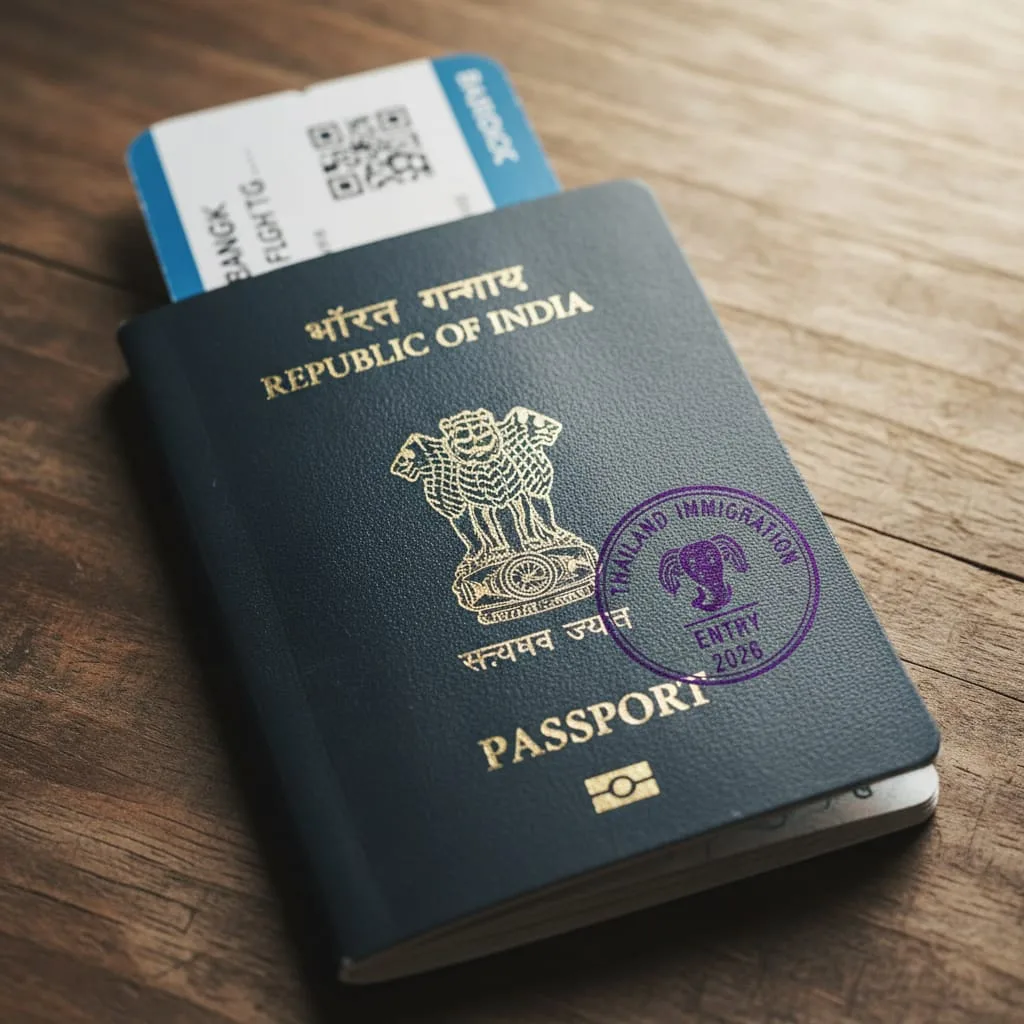
Receive your passport with entry stamp showing 30-day validity. You are now legally in Thailand.