

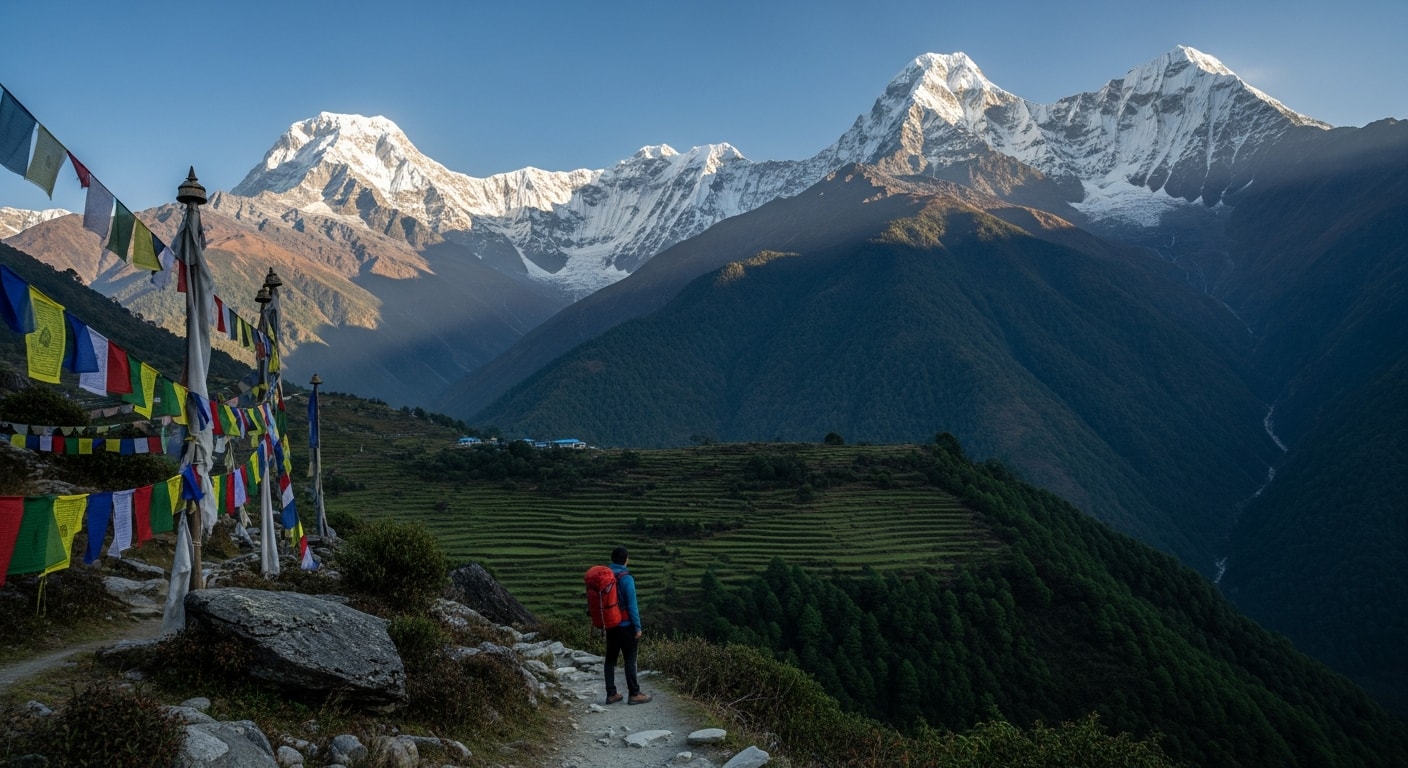
Nepal Trekking Guide from India: Annapurna Circuit & Everest Base Camp
In this guide (14)
- Why Nepal Is the Trekking Capital for Indian Travelers
- Everest Base Camp Trek: The One Everyone Wants to Do
- Annapurna Circuit: The Trek That Should Be More Famous
- Annapurna Base Camp and Poon Hill: Shorter Treks for Beginners
- Nepal Trekking from India: EBC vs Annapurna Circuit vs ABC vs Poon Hill
- Altitude Sickness: The Silent Danger Every Indian Trekker Must Understand
- Getting to Nepal from India: Flights, Buses, and the Lukla Factor
- Best Season for Nepal Trekking from India
- Guide vs Solo: What Indian Trekkers Should Know
- Packing Essentials: What to Bring and What to Rent in Kathmandu
- Nepal Trekking Budget Breakdown for Indian Travelers
- Insider Tips That Most Guides Will Not Tell You
- Practical Information at a Glance
- Frequently Asked Questions About Nepal Trekking from India
I was standing at 5,364 metres, snot frozen to my face, legs shaking from twelve days of walking, and all I could think was: "This dal bhat better be unlimited tonight." That was Everest Base Camp. And honestly? The trek to get there was more spectacular than the destination itself. If you are an Indian looking to do something that will genuinely change the way you see mountains — not Manali-level mountains, but the kind that make you feel cosmically small — nepal trekking from india is the most accessible, affordable, and life-altering adventure you can book.
Nepal does not require a visa for Indian citizens. Flights from Delhi cost less than a nice dinner at a five-star hotel. And the Himalayas? They are right there, practically in our backyard, waiting for you to stop scrolling through Instagram reels and actually go walk among them. This guide covers everything — Everest Base Camp, the Annapurna Circuit, shorter treks for beginners, costs in rupees, altitude sickness survival, and the packing list I wish someone had given me before my first trek.
Why Nepal Is the Trekking Capital for Indian Travelers
Let me be blunt. No other country on Earth offers this combination: no visa needed, direct flights under ₹10,000, world-class trekking trails, and teahouse accommodation so you don't need to carry a tent. Nepal trekking from india is genuinely the easiest international adventure you can plan. I have trekked in Ladakh, Himachal, and Uttarakhand — and Nepal's infrastructure puts all of them to shame. The Nepal Tourism Board has invested heavily in trail maintenance and teahouse standards over the past decade.
Here's what makes it special. The teahouse system means you sleep in a bed every night, eat hot meals, and charge your phone (for ₹200-300 per charge at altitude). You don't need prior mountaineering experience. You don't need expensive gear — most of it can be rented in Kathmandu's Thamel district for a fraction of what you'd pay in India. And the trails are so well-marked that even a solo trekker with basic navigation skills can manage several routes.
The people are warm, the momos are better than anything in Delhi (I said what I said), and the Nepali rupee is almost at parity with the Indian rupee — so your money stretches far. A plate of dal bhat costs ₹300-500 at teahouses, and it comes with unlimited refills. "Dal Bhat Power, 24 Hour" — the signs at every teahouse don't lie.
Everest Base Camp Trek: The One Everyone Wants to Do

Let's get the big one out of the way. EBC is the trek that launched a thousand Instagram posts and gave every IT professional in Bangalore a desktop wallpaper. But beyond the hype, it is a genuinely magnificent experience. Here's the breakdown.
Duration: 12-14 days round trip from Lukla
Difficulty: 7/10
Highest point: Kala Patthar at 5,644m (EBC itself is 5,364m)
Cost: ₹40,000-80,000 for the trek (excluding India-Kathmandu flights)
Permits needed: TIMS card + Sagarmatha National Park entry — roughly ₹5,000 total
The trek starts with a flight to Lukla — famously one of the most thrilling airport landings in the world. The runway is short, tilted uphill, and ends at a mountain wall. Your heart will be in your throat, and you haven't even started walking yet. From Lukla, you hike through Sherpa villages, cross suspension bridges draped in prayer flags, and gradually climb through forests into the stark, rocky landscape above the treeline.
Namche Bazaar (3,440m) is where most trekkers spend an extra acclimatization day. Smart move. Don't skip it. This is also where you get your first proper view of Everest — tiny and distant, but unmistakable. From Namche, the trail passes through Tengboche with its stunning monastery, then Dingboche, Lobuche, and finally Gorak Shep — the last settlement before base camp.
Here's a tip most guides won't emphasize enough: Kala Patthar gives you better Everest views than EBC itself. Base camp is a rocky glacier moraine surrounded by tents. Kala Patthar is a rocky outcrop at 5,644m with a panoramic view of Everest's south face, the Khumbu Icefall, and surrounding peaks. Wake up at 4 AM for the sunrise climb. It's brutal in the cold, but the view at dawn is worth every frozen step.
Teahouse accommodation ranges from ₹500 per night for a basic room (plywood walls, foam mattress) to ₹1,500 for slightly better lodges at lower elevations. Rooms are typically free or very cheap if you eat at the teahouse — they make their money on food, not beds. A meal costs ₹300-800 depending on altitude and what you order. Stick to dal bhat. It's the cheapest, most filling, and safest option.
Annapurna Circuit: The Trek That Should Be More Famous
I'll say it plainly: the Annapurna Circuit is a better trek than EBC. Fight me. While EBC gives you one big mountain viewed from one angle, the Annapurna Circuit takes you through an absurd variety of landscapes — subtropical jungle, terraced rice paddies, arid Tibetan plateaus, and Arctic-level high passes — all in one trek. You start in a t-shirt and end in every layer you own.
Duration: 12-18 days (most people do 14-16)
Difficulty: 8/10
Highest point: Thorong La Pass at 5,416m
Cost: ₹35,000-60,000 for the trek
Permits: TIMS card + ACAP (Annapurna Conservation Area Permit) — roughly ₹4,000
The circuit starts in Besisahar (accessible by bus from Kathmandu or Pokhara) and loops around the entire Annapurna massif. The first few days are relatively easy — warm weather, lush vegetation, and riverside trails. Then the landscape shifts dramatically. By the time you reach Manang (3,519m), you're in a high-altitude desert that looks more like Ladakh than what you'd expect from Nepal.
Manang is where you acclimatize before the big push to Thorong La Pass. Spend two nights here. Explore the old monastery, hike to the ice lake above town, and eat apple pie at every bakery (it's surprisingly good at 3,500m). Then comes the pass itself — the crux of the entire trek. You start walking at 4 AM from Thorong Phedi (4,450m), climb 966 metres in the dark, and reach the pass as the sun rises over the Himalayas. Exhausting. Absolutely freezing. And magnificent beyond words.

On the other side of the pass is Muktinath — a sacred temple for both Hindus and Buddhists. Indian pilgrims get free entry, and after five hours of grueling descent, a hot spring and a temple visit feel like a spiritual reset. From Muktinath, the trail continues through the Kali Gandaki gorge (the deepest gorge on Earth) down to Tatopani (literal translation: "hot water" — there are natural hot springs), and eventually to Pokhara.
For Indian trekkers, the spiritual significance of Muktinath adds a dimension that EBC simply cannot match. It is one of the 108 Divya Desams and attracts pilgrims from across India year-round.
Annapurna Base Camp and Poon Hill: Shorter Treks for Beginners
Not everyone has two weeks to spare. And not everyone wants to push themselves to 5,400 metres on their first trek. That's perfectly fine. Nepal has shorter options that still deliver jaw-dropping mountain scenery.
Annapurna Base Camp (ABC) Trek
Duration: 7-10 days
Difficulty: 5/10 — genuinely manageable for fit beginners
Highest point: 4,130m (ABC)
Cost: ₹25,000-40,000
ABC is a stunner. You hike through rhododendron forests, past terraced Gurung villages, and into a natural amphitheatre surrounded by Annapurna I (8,091m), Machapuchare (the iconic fishtail peak), Annapurna South, and Hiunchuli. The 360-degree panorama at base camp during sunrise is one of those moments you remember for the rest of your life. No exaggeration.
The trail is well-established with teahouses every few hours. If you can climb Rajgad Fort near Pune without stopping, you have the fitness level for ABC. The altitude is lower than EBC, which means less risk of altitude sickness for folks coming from sea-level cities like Mumbai or Chennai.
Poon Hill Trek
Duration: 4-5 days
Difficulty: 3/10 — perfect first-time trek
Highest point: 3,210m (Poon Hill)
Cost: ₹15,000-25,000
If you've never trekked above 2,000 metres and want a taste of the Himalayas without committing to two weeks, Poon Hill is your answer. The sunrise viewpoint gives you a panorama of Dhaulagiri (8,167m), the entire Annapurna range, and Machapuchare — all from a comfortable altitude. The trail passes through beautiful Gurung villages like Ghandruk and Ghorepani, with hot meals and warm beds every night. It's also excellent as a warm-up before tackling EBC or the circuit on a future trip.
Nepal Trekking from India: EBC vs Annapurna Circuit vs ABC vs Poon Hill
| Trek | Days | Difficulty | Max Altitude | Cost (INR) | Best For |
|---|---|---|---|---|---|
| Everest Base Camp | 12-14 | 7/10 | 5,644m | ₹40,000-80,000 | Bucket-list achievement, Everest views |
| Annapurna Circuit | 12-18 | 8/10 | 5,416m | ₹35,000-60,000 | Diverse landscapes, serious trekkers |
| Annapurna Base Camp | 7-10 | 5/10 | 4,130m | ₹25,000-40,000 | Fit beginners, shorter time |
| Poon Hill | 4-5 | 3/10 | 3,210m | ₹15,000-25,000 | First-timers, quick weekend+ trip |
Altitude Sickness: The Silent Danger Every Indian Trekker Must Understand
This is not something to skim over. Acute Mountain Sickness (AMS) has killed fit, young, otherwise healthy trekkers who ignored the warning signs. If you are coming from a sea-level city like Mumbai, Kolkata, or Chennai, you need extra caution because your body has zero altitude adaptation.
Symptoms to watch for: Persistent headache that doesn't respond to paracetamol. Nausea or loss of appetite. Dizziness and fatigue beyond normal tiredness. Difficulty sleeping. If you experience any combination of these above 3,000m, do not ascend further until they resolve.
Serious warning signs (descend immediately): Confusion or disorientation. Loss of coordination — stumbling, can't walk a straight line. Severe headache with vomiting. Shortness of breath at rest. These indicate HAPE or HACE — both can be fatal within hours without descent.
Prevention tips that actually work:
- Follow the "climb high, sleep low" rule — hike higher during the day, then sleep at a lower camp
- Never gain more than 300-500m of sleeping elevation per day above 3,000m
- Stay hydrated — 3 to 4 litres of water daily (your urine should be clear)
- Avoid alcohol completely above 3,000m (yes, even that celebratory beer at Namche)
- Consider Diamox (Acetazolamide) — 125mg twice daily starting 24 hours before going above 3,000m
- Don't skip acclimatization days. Ever. Not even if you feel fine
I watched a guy in our group ignore his headache at Dingboche because he "didn't want to slow everyone down." He was evacuated by helicopter from Lobuche the next day. The helicopter ride cost ₹2,50,000. Good travel insurance would have covered it — his didn't. Get proper coverage before you fly to Kathmandu.
Getting to Nepal from India: Flights, Buses, and the Lukla Factor
You have two main options for reaching Kathmandu, and the choice affects your overall budget significantly.
By air: Direct flights from Delhi (DEL) to Kathmandu (KTM) cost ₹5,000-12,000 one way depending on season and advance booking. Mumbai, Bangalore, and Kolkata also have direct or one-stop options. Airlines include IndiGo, Air India, Nepal Airlines, and Buddha Air. Book 2-3 months ahead for the best fares. October flights (peak trekking season) sell out fast and cost more.
By land: Budget travelers can take a train to Gorakhpur (UP) and then a bus to the Sunauli/Bhairahawa border crossing. Or train to Raxaul (Bihar) and cross to Birgunj. From either border town, buses to Kathmandu take 6-8 hours on winding mountain roads. Total cost: under ₹2,000 from Delhi. The trade-off is time and comfort — it is a long, bumpy ride.
For EBC, you need a connecting flight from Kathmandu to Lukla. This costs ₹12,000-18,000 one way and is weather-dependent. Flights get cancelled regularly due to clouds and wind — build 2-3 buffer days into your itinerary at both ends. For Annapurna treks, take a tourist bus from Kathmandu to Pokhara (₹500-800, 7 hours) or a quick domestic flight (₹5,000-8,000, 25 minutes).
Best Season for Nepal Trekking from India
Timing matters enormously. Pick the wrong month and you will spend two weeks walking through clouds and rain, seeing nothing.
October-November (peak season): This is the sweet spot. The monsoon has just ended, so the air is washed clean and the skies are crystal clear. Mountain views are at their absolute best. Temperatures are comfortable during the day (10-15°C at moderate altitude) though nights get cold above 4,000m. Downside: trails are crowded and teahouses fill up — book through a guide or agency to guarantee beds.
March-May (spring): The second-best window. Warmer than autumn, which is nicer at higher elevations. Rhododendrons bloom in massive forests of red, pink, and white along the lower trails — gorgeous. Skies aren't quite as clear as October, and afternoon clouds are common, but mornings are usually spectacular. Less crowded than peak season. If you are planning nepal trekking from india and want fewer crowds, late March to mid-April hits the sweet spot.
December-February (winter): Cold. Very cold. Temperatures drop to -20°C at EBC level. Some high passes (like Thorong La) may be closed due to snow. Teahouses at higher elevations sometimes shut down. But the skies are incredibly clear, and you will have the trails almost to yourself. Only for experienced, well-equipped trekkers.
June-September (monsoon): Just don't. Heavy rain, leeches on the trail, zero visibility, trail damage, and landslide risk. Some people do it. Those people enjoy suffering.
Guide vs Solo: What Indian Trekkers Should Know
Nepal recently made guides mandatory for foreign trekkers in many popular areas. The enforcement for Indian trekkers (who are in a special category due to the open border) is inconsistent. That said, I strongly recommend hiring a guide for your first Nepal trek, regardless of regulations.
Guide costs: ₹2,500-4,000 per day, all-inclusive (they pay for their own food and accommodation). A good guide handles permits, negotiates teahouse rates, carries emergency knowledge, and — critically — knows when you need to stop ascending. They have seen altitude sickness hundreds of times. You haven't.
Porter costs: ₹1,500-2,000 per day. A porter carries up to 25-30kg, freeing you to walk with just a daypack. This is not a luxury — it is a practical decision that can make the difference between finishing the trek and giving up on day three with destroyed knees. Your body will thank you.
If budget is tight, hire a porter-guide (₹2,000-3,000/day) — one person who carries your gear and knows the trail. You can arrange this in Kathmandu's Thamel district or through agencies. TripCabinet can organize your entire Nepal trek including flights, permits, guide, and accommodation — which saves you the headache of negotiating with multiple vendors in Kathmandu.

Packing Essentials: What to Bring and What to Rent in Kathmandu
Overpacking is the number one mistake Indian trekkers make. You do not need to carry everything from India. Kathmandu's Thamel market has rental shops on every corner, and the quality is decent for the price.
Bring from India:
- Trekking boots: The single most important item. Buy them 2-3 months before and break them in properly — wear them on stairs, on weekend hikes, to the grocery store. New boots on day one of EBC is a recipe for blisters and misery
- Moisture-wicking base layers: 2-3 sets. Merino wool is best, synthetic is fine. Cotton kills — it holds sweat and gets cold fast
- Down jacket: Essential above 3,500m. If you don't own one, rent in Thamel (₹500-800 for the full trek duration)
- Sunglasses with UV protection: Snow blindness at altitude is real and extremely painful
- Personal medications: Diamox (prescription), Ibuprofen, Imodium, ORS packets, band-aids, blister plasters
- Headlamp: Teahouses have electricity, but it is unreliable. A headlamp is critical for early morning starts and nighttime bathroom trips
Rent in Kathmandu (Thamel):
- Sleeping bag (rated to -15°C minimum): ₹500-1,000 for the full trek duration
- Trekking poles: ₹300-500
- Down jacket (if needed): ₹500-800
- Duffel bag for porter: ₹200-400
Don't forget: Water purification tablets (cheaper and greener than buying bottled water at ₹200-400 per bottle at altitude), sunscreen SPF 50+, lip balm with SPF, toilet paper (teahouses sometimes run out), and a quick-dry towel. Also bring a power bank — charging points at teahouses above 4,000m cost ₹200-300 per device, and solar doesn't work well in cloudy weather.
Nepal Trekking Budget Breakdown for Indian Travelers
Here is what you will actually spend, broken down honestly. I have seen too many blogs quote unrealistically low numbers.
Flights from India: ₹5,000-12,000 one way (Delhi to Kathmandu). Book early on IndiGo or Air India for the best rates.
Kathmandu to Lukla flight (EBC only): ₹12,000-18,000 one way. Budget ₹30,000 round trip with buffer for cancellation-related hotel nights.
Permits: ₹4,000-5,000 depending on the trek (TIMS + national park or conservation area).
Guide: ₹2,500-4,000/day x 12-16 days = ₹30,000-64,000 for the trek. Split between 2-3 trekkers to save money.
Porter: ₹1,500-2,000/day x 12-16 days = ₹18,000-32,000. Also splittable — one porter can carry for two trekkers.
Teahouse accommodation: Often free if you eat there. Budget ₹0-1,500/night. Total for 14 days: ₹5,000-15,000.
Food: ₹300-800 per meal, 3 meals/day x 14 days = ₹12,600-33,600. Stick to dal bhat (cheapest and unlimited refills) to keep costs down.
Gear rental: ₹2,000-3,000 total in Thamel.
Miscellaneous: Hot showers (₹200-400), WiFi (₹300-500/day), charging (₹200-300), tips for guide and porter (₹3,000-5,000 each). Budget ₹5,000-10,000.
A comfortable budget-friendly EBC trek with a guide, porter, and decent teahouses runs about ₹60,000-80,000 for the trek portion, plus ₹30,000-40,000 for round-trip flights from India including the Lukla connection. All-in budget: ₹90,000-1,20,000. The Annapurna Circuit costs ₹20,000-30,000 less because you skip the expensive Lukla flights.
Insider Tips That Most Guides Will Not Tell You
After three treks in Nepal across four years, here is what I have learned the hard way.
- Bargain for gear in Thamel, not online. Start at 50% of the asking price. Most shops expect negotiation. The "North Face" jacket for ₹3,000? It is not real, but it works perfectly well at altitude. Everyone knows. Nobody cares.
- Carry Indian snacks. After a week of dal bhat, you will crave variety. Thepla, chikki, trail mix from India — worth their weight in gold on the trail. Literally, given teahouse snack prices at altitude.
- The Lukla flight cancellation trick: If your return Lukla-Kathmandu flight gets cancelled (common in bad weather), don't panic. You can trek from Lukla to Phaplu in one day and catch a jeep to Kathmandu. It takes 6-7 hours of walking plus 8-10 hours of driving, but it beats waiting 3 days in Lukla.
- Tip your guide and porter well. ₹3,000-5,000 each is standard for a two-week trek. These people carry your life on their backs — sometimes literally.
- Travel insurance is non-negotiable. Make sure it covers helicopter evacuation above 4,000m. Most standard travel insurance policies from India exclude high-altitude trekking unless you specifically add it. A helicopter evacuation from Gorak Shep costs ₹2,50,000-3,00,000 out of pocket.
- Kathmandu arrival tip: Land a day or two early. Jet lag plus altitude is a terrible combination. Use the time to sort permits, rent gear, and eat your way through Thamel (the momos at Yangling are legendary).
Practical Information at a Glance
How to get there: Fly DEL/BOM/BLR to Kathmandu (₹5,000-12,000 one way). Or train to Gorakhpur + bus via Sunauli border (under ₹2,000).
Visa: Not required for Indian citizens. Carry passport or voter ID.
Currency: Nepali Rupee (NPR). 1 INR is roughly 1.6 NPR. Indian ₹100 and ₹500 notes accepted widely (not ₹2,000 notes).
Best season: October-November (clearest skies) or March-May (warmer, rhododendrons).
Budget: ₹40,000-1,20,000 depending on trek, duration, and comfort level.
What to pack: Broken-in trekking boots, moisture-wicking layers, down jacket, headlamp, sunscreen, water purification tablets. Rent sleeping bag and poles in Kathmandu.
Insurance: Get coverage that includes high-altitude trekking and helicopter evacuation.
Fitness prep: Start 2-3 months before. Stair climbing, running, and weekend hikes. Cardio matters more than strength.
Frequently Asked Questions About Nepal Trekking from India
Do Indians need a visa to trek in Nepal?
No. Indian citizens do not need a visa for Nepal. You can enter with a valid passport or even a voter ID card. You still need trekking permits like TIMS and national park entry permits, which cost around ₹4,000-5,000 total depending on the trek.
How much does the everest base camp trek cost from India?
The EBC trek costs approximately ₹40,000-80,000 depending on whether you hire a guide and porter, teahouse choices, and season. This excludes flights from India to Kathmandu (₹5,000-12,000 one way). Budget trekkers can manage around ₹40,000-50,000 for the trek alone, while comfortable treks with a good guide cost ₹60,000-80,000.
Which is easier: Everest Base Camp or Annapurna Circuit?
Everest Base Camp is slightly easier overall (difficulty 7/10 vs 8/10 for the Annapurna Circuit). EBC has a more gradual altitude gain and well-established teahouse infrastructure. The Annapurna Circuit crosses Thorong La Pass at 5,416m — higher than EBC at 5,364m — and involves longer daily walking distances with more varied terrain.
What is the best time for nepal trekking from india?
October to November is the best season with clear skies after the monsoon and stable weather. March to May is the second-best window with warmer temperatures and blooming rhododendrons. Avoid June to September (monsoon — heavy rain, leeches) and December to February (extreme cold, some passes closed).
Can beginners do the Everest Base Camp trek?
Yes, with proper preparation. EBC does not require technical climbing skills — it is a long-distance hike on established trails. You need good cardiovascular fitness, proper acclimatization days, and the right gear. Beginners should hire a guide and consider starting with a shorter trek like Poon Hill or Annapurna Base Camp first.
Is Annapurna Base Camp good for first-time trekkers from India?
ABC is one of the best first-time treks in Nepal. At 7-10 days and difficulty 5/10, it is shorter than EBC while still offering spectacular mountain views. The trail is well-marked with frequent teahouses, and the maximum altitude of 4,130m is more manageable for Indians coming from sea-level cities. It costs ₹25,000-40,000 — much less than the typical Nepal trip budget.
The Himalayas don't care about your job title, your gym selfies, or how many countries you have checked off a list. They care about whether you can put one foot in front of the other when your lungs are burning and the pass is still two hours away. That is the real gift of nepal trekking from india — it strips everything back to basics. Walk, eat, sleep, repeat. And somewhere between Namche Bazaar and that freezing sunrise at Kala Patthar, you will understand why people keep coming back. I certainly do. See you on the trail.