

Long-Haul Flight Survival Guide: 14+ Hours in Economy for Indian Travelers
In this guide (13)
- Long Haul Flight Tips: Pre-Flight Preparation
- Carry-On Essentials: Long Haul Flight Tips for Comfort
- Indian Food Strategy: Meals and Snacks for Long Haul Flights
- Sleep Strategy: Long Haul Flight Tips for Rest
- Staying Comfortable: DVT Prevention and In-Flight Exercise
- Jet Lag Management: The First 48 Hours Matter
- Layover Strategies: Dubai, Doha, Singapore
- Flying with Kids: A Separate Kind of Survival
- What NOT to Do: Lessons from Fellow Passengers
- Staying Connected: eSIM and WiFi
- Budget Considerations: Long Haul Flight Tips for Saving Money
- Practical Info Summary
- Frequently Asked Questions
Sixteen hours. That's how long I spent wedged between a snoring uncle and a restless toddler on my first Bangalore-to-London flight. I had zero long haul flight tips to work with—just blind optimism and a neck pillow from Sarojini Nagar that deflated by hour three. By hour eight, I'd memorized every crack in the seat-back screen. By hour twelve, I was convinced my legs had permanently fused at the knee. When I finally stumbled off at Heathrow, I looked like I'd been dragged through a dhobi ghat—crumpled, dehydrated, and questioning every life choice that led me to book the cheapest ticket.
That was five years ago. Since then, I've logged over 200 hours in economy class across continents. I've figured out the long haul flight tips veterans swear by—the seat selection hacks, the carry-on essentials that actually matter, and the sleep strategies that don't involve prescription medication. This guide is everything I wish someone had told me before that first miserable journey from India.
Long Haul Flight Tips: Pre-Flight Preparation
Most Indians treat flight preparation like a last-minute exam—panic packing at 2 AM, arriving at the airport three hours early anyway, then realizing you forgot your neck pillow. Let's fix that. Check our international travel packing list for Indians for a complete checklist of what to carry.
Seat Selection: The Most Important Decision You'll Make
Not all economy seats are created equal. Some are basically torture devices with a seatbelt. Others are surprisingly tolerable. The difference comes down to research—one of the most valuable long haul flight tips I can share.
First, check your aircraft type on SeatGuru. A Boeing 777-300ER has wildly different seat maps depending on the airline. Emirates crams more seats in than Singapore Airlines does on the same plane. That "window seat" you booked might have no window at all—just a blank wall where the window should be. SeatGuru marks these problem seats in yellow and red. Trust the ratings.

For sleeping: Window seats are non-negotiable. You can lean against the wall, control the shade, and nobody climbs over you to use the toilet. Rows 30-40 on most wide-body aircraft hit the sweet spot—far enough from the galley noise, close enough to not wait forever for food service.
For legroom: Exit row seats are the holy grail, but they come with trade-offs. You can't keep your bag at your feet (it goes in the overhead bin during takeoff and landing). The armrests don't lift up. And some exit rows have no window. Bulkhead seats give legroom but the TV is often in the armrest, making it smaller and awkward to watch.
Avoid at all costs: Last-row seats that don't recline. Seats directly in front of the emergency exit (no recline either). Anything adjacent to the toilets—the smell, the queue, the constant door banging. Middle seats in the center section. If your only option is 54B (middle seat, last row, near the toilet), seriously consider paying Rs3,000-5,000 for a better seat selection.
Check-In Timing and Online Tricks
Web check-in opens 24-48 hours before departure depending on the airline. Set a reminder and check in the moment it opens. This is when the good seats become available—even seats that were "blocked" during booking often release at check-in. Emirates and Singapore Airlines are notorious for holding premium economy-adjacent seats until this window.
If you're flying Air India, their app is temperamental. Sometimes web check-in works on the desktop site but crashes on mobile. Have both ready. If you're traveling with family, check in together so you can select adjacent seats—airlines prioritize group seating requests made at check-in.
What to Wear (This Matters More Than You Think)
I've seen people board long-haul flights in tight jeans and formal shirts. By hour six, they're miserable, tugging at their waistband, unable to sleep. Don't be that person.
Wear loose cotton kurta-pyjama or track pants. Layers are essential—planes oscillate between freezing (cruise altitude) and stuffy (boarding and landing). A light hoodie or shawl works perfectly. Slip-on shoes you can remove without bending—your feet will swell, and you'll want them off for most of the flight. Compression socks if you're over 35 or have any circulation concerns. I wear them religiously now after a family friend developed DVT on a Delhi-San Francisco flight.
Carry-On Essentials: Long Haul Flight Tips for Comfort
Your under-seat bag is your survival kit for the next 14+ hours. Everything else goes in the overhead bin, and you won't want to keep getting up to access it. Here's what goes in that precious under-seat space:
Sleep Gear (Non-Negotiable)
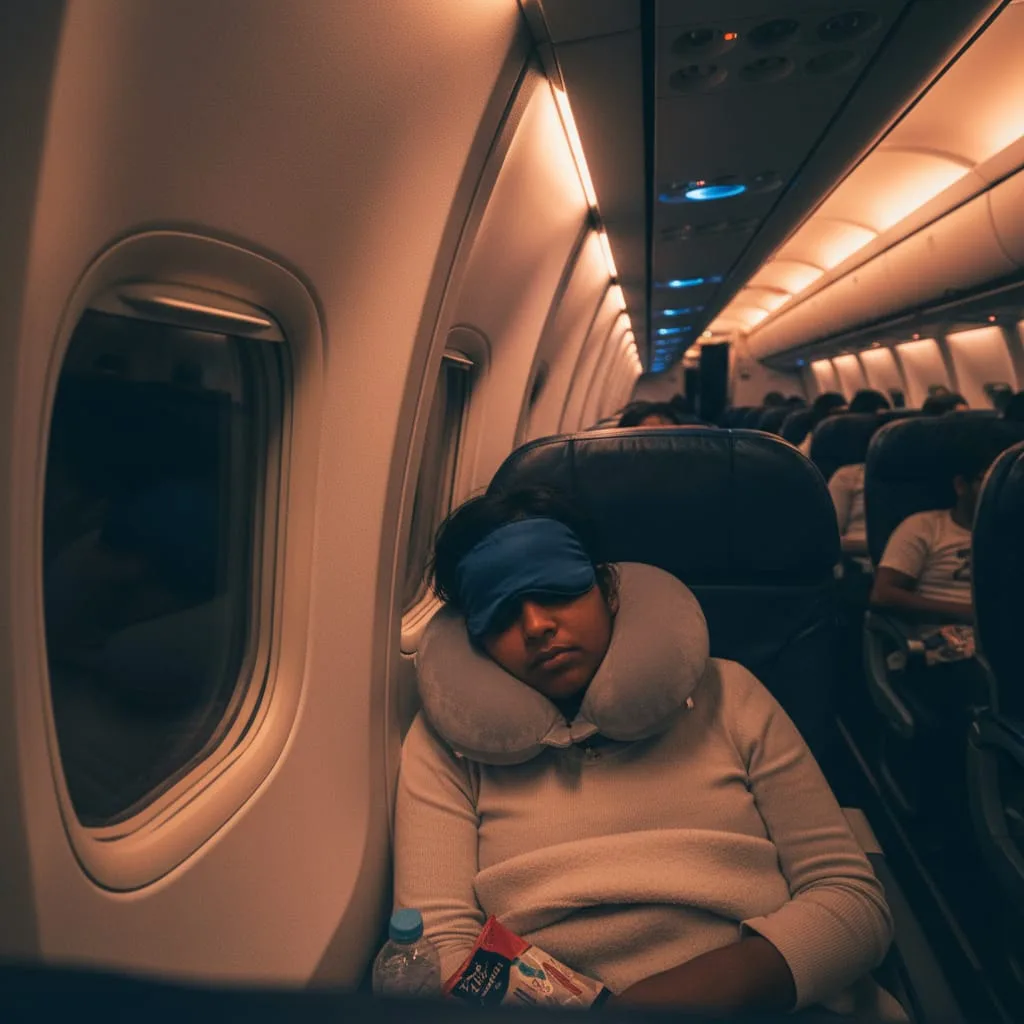
- Memory foam neck pillow: Not the inflatable kind that deflates mid-sleep. A proper U-shaped memory foam pillow that supports your neck. The Cabeau Evolution is expensive (Rs4,000+) but worth it. Budget alternative: any memory foam pillow from Amazon under Rs800.
- Eye mask: Cabin lights come on at random times. Fellow passengers watch bright movies. The person next to you opens their window shade at 3 AM. A good eye mask blocks all of this. I use a contoured one that doesn't press on my eyelids.
- Earplugs or noise-canceling earbuds: Screaming babies, engine drone, announcement dings. Foam earplugs cost Rs50 and block surprising amounts of noise. If you can afford it, AirPods Pro or Sony WF-1000XM5 with noise cancellation are game-changers.
- Thin blanket or shawl: Airline blankets are thin and dubious in cleanliness. Bring your own pashmina or light blanket.
Entertainment (Download Everything Before)
In-flight entertainment systems crash. Screens freeze. Selection is often terrible Bollywood from 2019. Before leaving home, download:
- A full season of a show on Netflix/Prime/Hotstar (at least 8-10 hours of content)
- Podcasts—long-form ones like The Seen and the Unseen or Hardcore History that eat hours
- Audiobooks via Audible or Spotify
- A physical book (Kindle works but batteries die; paperbacks don't)
- Downloaded Spotify playlists (premium required for offline)
Bring a portable charger (power bank under 100Wh is allowed in carry-on). A 20,000mAh bank will charge your phone three times. Also pack a multi-USB cable that fits your devices. These long haul flight tips about entertainment have saved me from sheer boredom countless times.
Comfort and Health Items
- Lip balm and moisturizer—cabin air is dryer than the Thar Desert
- Nasal spray or saline mist—prevents nosebleeds and sinus discomfort
- Hand sanitizer and wet wipes—tray tables are genuinely filthy
- Prescription medications in original packaging
- Melatonin tablets (3mg, available over-the-counter abroad, or buy before you leave)
- Motion sickness tablets if you need them (Avomine works but causes drowsiness)

Indian Food Strategy: Meals and Snacks for Long Haul Flights
Standard airline meals are edible at best. The "chicken or pasta" question at 35,000 feet rarely leads to culinary satisfaction. But there's a workaround—and it's one of my favorite long haul flight tips.
Pre-Order Special Meals
Most airlines let you pre-order special meals through Manage Booking on their website. Do this at least 48 hours before departure. The options relevant for Indian travelers:
- AVML (Asian Vegetarian Meal): Spiced, Indian-style vegetarian. Usually includes rice, dal, sabzi, and an Indian dessert. This is the best option for most vegetarians.
- VJML (Vegetarian Jain Meal): No onion, no garlic, no root vegetables. Stricter than AVML but equally tasty.
- HNML (Hindu Non-Vegetarian Meal): Indian-style non-veg without beef or pork. Typically chicken curry or mutton.
- VGML (Vegetarian Vegan Meal): Western-style vegan—often bland for Indian palates.
Emirates, Singapore Airlines, and Air India have consistently good AVML meals. Qatar Airways and Etihad are decent. Lufthansa's Indian meals are... an acquired taste. British Airways manages to make everything taste like cardboard somehow.
Special meals are served before the regular service, so you eat first while everyone else waits. Small victory, but satisfying.
Snacks to Pack from Home
Flight meals are served on airline schedule, not when you're hungry. Pack snacks that survive security and customs:
- Thepla wrapped in foil (the immortal travel food)
- Khakhra—takes up no space, doesn't crumble
- Chakli or murukku in a hard container
- Roasted makhana or foxnuts
- Trail mix (nuts, dried fruits)
- Digestive biscuits or Parle-G
- Amul cheese cubes (sealed, they survive)
Avoid: Anything with strong smell (pickles will get you stares). Fresh fruits (most countries ban them). Cooked food in liquid (security will toss it). Opened packets (seal everything).
When you land, check the customs rules for your destination. Australia and New Zealand are extremely strict about food items—they'll confiscate anything organic and fine you heavily. The US and UK are more relaxed about sealed, commercially packaged snacks.
Sleep Strategy: Long Haul Flight Tips for Rest
Sleeping on a long flight isn't just about comfort—it's about strategy. Sleep at the wrong time and you'll spend a week zombified by jet lag. Sleep at the right time and you'll hit the ground functional. These long haul flight tips about sleep timing have saved countless trips for me.
Understand Time Zone Math
If you're flying from India to Europe (5-6 hours behind IST), you're gaining time. Sleep in the first half of the flight, stay awake for the last few hours, and you'll land in the morning reasonably adjusted.
If you're flying from India to the US East Coast (9.5-10.5 hours behind IST), the math gets brutal. A Mumbai-Newark flight departs around midnight IST and arrives at 6 AM local time—which is 4:30 PM IST. Your body thinks it's afternoon; Newark says it's breakfast. Try to stay awake for the first 4-5 hours, then sleep the remaining 10 hours. Easier said than done.
For India to Southeast Asia (no significant time difference), just sleep when you're tired. No adjustment needed.
Melatonin and Sleeping Pills
Melatonin (3mg tablet) about 30 minutes before you want to sleep helps reset your circadian rhythm. It's not a sedative—it signals your brain that it's nighttime. Available over-the-counter in most countries, less easily in India (ask at Apollo pharmacy). Zolfresh or Ambien are prescription sleeping pills and work more aggressively, but I'd only recommend them for genuinely desperate situations. The grogginess can be worse than the sleeplessness.
Natural alternatives: chamomile tea (ask the cabin crew), skip caffeine after the first meal service, use your eye mask and earbuds to block stimulation.
Window vs Aisle for Sleep
Window, always. You control the shade. You lean against the wall. Nobody wakes you to get past. The only exception: if you have a bladder situation that requires frequent bathroom trips, go aisle and accept that you'll sleep less.
Staying Comfortable: DVT Prevention and In-Flight Exercise
Deep Vein Thrombosis sounds dramatic until you realize it can happen to anyone sitting still for 12+ hours. Blood clots form in your legs, and in rare cases, they travel to your lungs. It's genuinely dangerous. Prevention is simple: move.
Every Two Hours
- Walk to the galley area and back
- Stand and stretch in the aisle (wait for the seatbelt sign to turn off)
- Do ankle circles while seated—rotate each foot 10 times
- Flex your calves by pressing your toes down, then pulling them up
- Avoid crossing your legs for extended periods
Compression Socks
These look dorky. They also work. Compression socks improve blood flow and reduce swelling. My feet used to balloon on long flights—now they don't. Buy proper medical-grade compression (15-20 mmHg) from a pharmacy, not the cheap ones on Amazon.
Hydration
Cabin air humidity hovers around 10-20%. For reference, the Sahara Desert is more humid. You're dehydrating the entire flight. Drink water constantly—aim for 250ml per hour. Avoid alcohol (it dehydrates you further and disrupts sleep). Coffee in moderation. When the cabin crew comes with the beverage cart, ask for a full water bottle if they have one, not just a tiny cup.
Jet Lag Management: The First 48 Hours Matter
You've landed. Now what? The first two days determine whether you adjust quickly or spend a week feeling like you're moving through mud. Here are my long haul flight tips for the post-landing phase. Flying to Canada from India is one of the longest westward routes — 14 hours to Toronto means serious time zone adjustment needed.
Westward Travel (India to Americas)
You're "gaining" time—the day feels longer. Stay awake until at least 9-10 PM local time on arrival day, even if your body screams for sleep at 3 PM. Get sunlight in the afternoon. Avoid naps longer than 20 minutes. Caffeine before noon only.
Eastward Travel (India to Europe)
You're "losing" time—the day feels shorter. Sleep a bit earlier than usual the first night. Get morning sunlight to reset your body clock. Melatonin at your target bedtime helps.
The general rule: sunlight is your best tool. It resets circadian rhythm faster than anything else. Get outside as soon as you can after landing.
If you're planning a longer trip to Europe, check our Europe trip guide for first-time Indian travelers for more destination-specific advice.
Layover Strategies: Dubai, Doha, Singapore
Most Indian travelers on long-haul routes connect through a Gulf hub or Singapore. A smart layover can make your journey significantly better.
Dubai (DXB)
Terminal 3 (Emirates hub) has decent lounges. If you have a 4+ hour layover, the Marhaba Lounge offers day passes for around Rs3,000. Hot food, showers, quiet seating. The airport also has sleeping pods (hourly rental) if your layover is overnight. Free WiFi throughout. The duty-free is overrated for most products—Mumbai duty-free often has better prices on liquor and electronics.
Doha (DOH)
Hamad International is genuinely stunning. The Oryx Lounge accepts Priority Pass and offers excellent food, showers, and quiet zones. Transfer desks are efficient. If you have 6+ hours, Qatar Airways sometimes offers free hotel stays for economy passengers—check eligibility when booking.
Singapore (SIN)
Changi is the gold standard. Free movie theaters, butterfly garden, swimming pool (Terminal 1, $17 for two hours), nap lounges, transit hotels inside security. For long layovers, the Ambassador Transit Lounge has daybeds and showers. Singapore doesn't require a visa for transit stays under 96 hours if you meet certain conditions—but verify before booking.
Before your trip, read our comprehensive airport immigration guide for first-time Indian travelers so you know exactly what to expect at each step.
Flying with Kids: A Separate Kind of Survival
I've seen families manage beautifully, and I've seen families come apart at the seams somewhere over Kazakhstan. The difference is preparation.
For Infants and Toddlers
- Request a bassinet seat at booking—bulkhead rows have attachable bassinets for babies under 10kg
- Pack twice the diapers and wipes you think you need in your carry-on
- Milk formula is allowed through security in reasonable quantities (tell them at screening)
- Nurse or bottle-feed during takeoff and landing to help with ear pressure
- New toys they've never seen before—wrapped individually for the "unwrapping" excitement factor
- Download their favorite shows on a tablet, fully charged
For Older Kids (5-12)
- Window seats—looking out keeps them occupied for surprising amounts of time
- Activity books, coloring supplies (crayons, not markers)
- Headphones sized for children—adult ones fall off or hurt
- Snacks they love, rationed throughout the flight
- Make them walk the aisle with you every 2-3 hours—burning energy helps them sleep
If you're traveling as a large family, our group travel guide for Indian families covers the logistics of coordinating seating, meals, and managing everyone through immigration.
What NOT to Do: Lessons from Fellow Passengers
These are real things I've witnessed on long-haul flights from India. Don't be these people.
- Don't recline aggressively during meal service. The person behind you has a tray of hot food and 15 inches of space. Wait until meals are cleared.
- Don't take your socks off and put bare feet on the armrest. I've seen this. Multiple times. It's vile.
- Don't stand in the aisle doing elaborate yoga stretches while people are trying to sleep. Use the galley area.
- Don't drink heavily. Altitude amplifies alcohol effects. Two glasses of wine at 35,000 feet hits like four on the ground. You'll dehydrate, sleep terribly, and potentially become that passenger who needs crew intervention.
- Don't spray perfume in the cabin. Enclosed space, recirculated air, other passengers with allergies or sensitivities. Apply before boarding if you must.
- Don't eat smelly food from your carry-on. That achar your mom packed smells delicious to you and horrifying to everyone else.
- Don't watch movies at full brightness with no eye mask while others sleep. Turn down the brightness, use earbuds.
Staying Connected: eSIM and WiFi
Many airlines now offer paid WiFi on long-haul flights. Emirates charges around Rs2,500 for a full-flight pass. Singapore Airlines has packages starting at $5 for basic messaging. Is it worth it? For business travelers who must respond to emails, maybe. For everyone else, disconnect and enjoy the enforced break from the internet.
For connectivity after landing, set up an eSIM before you leave India. It's cheaper than airport SIM cards and works the moment you land. Our eSIM guide for Indian travelers covers the setup process and best providers for different destinations.
Budget Considerations: Long Haul Flight Tips for Saving Money
Not everything needs to be the cheapest option. Here's where I'd spend more:
- Seat selection on flights over 10 hours—Rs3,000-5,000 for a non-miserable experience is worth it
- Quality neck pillow—you'll use it for years
- Noise-canceling earbuds—Rs15,000-20,000 but transformative for sleep
- Compression socks—Rs500-800, prevents genuine health issues
Where to save:
- Airport lounge access if your layover is under 3 hours—not enough time to benefit
- In-flight WiFi—you'll survive a few hours offline
- Premium economy unless it's genuinely upgraded legroom (some airlines call wider seats "premium" without extra space)
Speaking of saving money, if you're searching for flights, check our guide on finding the cheapest international flights from India. The tricks in there can save you Rs10,000-30,000 easily.
Practical Info Summary
Best Airlines for Indian Travelers (Long-Haul Economy):
- Singapore Airlines: Consistently excellent service, good Indian meal options, modern aircraft
- Emirates: Good food, entertainment system is top-notch, Dubai layovers are convenient
- Air India (post-Tata): Improving rapidly, genuinely good Indian food, direct routes to many destinations
- Qatar Airways: Doha is a pleasant hub, good service, Qsuite is legendary (but that's business class)
Essentials Checklist:
- Neck pillow, eye mask, earplugs/earbuds
- Entertainment downloaded offline
- Snacks (thepla, khakhra, nuts)
- Compression socks, loose clothes
- Water bottle (empty through security, fill after)
- Moisturizer, lip balm, nasal spray
- Charger and power bank
- Any medications in original packaging
Pre-Flight Checklist:
- Web check-in 24-48 hours before
- Seat selection (research on SeatGuru first)
- Special meal request (AVML/VJML) at least 48 hours ahead
- Download entertainment
- Charge all devices and power bank
Frequently Asked Questions
What is the best seat for a long-haul flight in economy?
Window seats are best for sleeping as you can lean against the wall and nobody disturbs you. Exit row and bulkhead seats offer more legroom but have trade-offs—no under-seat storage, armrests that don't lift, smaller screens. Avoid seats near toilets and galleys. Use SeatGuru to check your specific aircraft before selecting.
How do I pre-order Indian vegetarian meals on international flights?
Go to your airline's "Manage Booking" section on their website or app. Select AVML (Asian Vegetarian Meal) or VJML (Vegetarian Jain Meal) under special meals. Do this at least 48 hours before departure. Emirates, Air India, and Singapore Airlines have the best Indian meal options in my experience.
How can I prevent jet lag when flying from India to Europe or USA?
Start adjusting your sleep schedule 2-3 days before departure—sleep an hour earlier for eastward flights, an hour later for westward. Stay hydrated, avoid alcohol, and get natural sunlight at your destination. Melatonin (3mg) at your target bedtime helps reset your body clock.
Is it worth paying extra for emergency exit row seats?
Yes, if you're tall or genuinely struggle with legroom on 10+ hour flights. Extra legroom seats typically cost Rs2,000-8,000 depending on the route and airline. The trade-off: you cannot keep any bags at your feet during takeoff/landing, and some exit rows have limited or no recline.
What snacks should Indian travelers carry on long flights?
Pack dry snacks that don't smell strong: thepla, khakhra, chakli, roasted makhana, trail mix, digestive biscuits, and sealed cheese cubes. Avoid pickles, anything with liquid, or open packets. Check customs rules for your destination—Australia and New Zealand are extremely strict about food items.
How do I stay comfortable on a 14-hour economy flight?
Wear loose cotton clothes and slip-on shoes. Use compression socks to prevent swelling. Bring a memory foam neck pillow, eye mask, and noise-canceling earbuds. Walk every 2-3 hours, do ankle exercises, and drink water constantly. Skip heavy meals and alcohol.
Long-haul flights in economy don't have to be miserable. They require preparation, the right gear, and acceptance that you're not going to emerge feeling fresh as a daisy. But with these long haul flight tips strategies, you'll arrive functional, relatively rested, and ready to actually enjoy your destination instead of collapsing into a jet-lagged heap. That first flight to London taught me everything the hard way. Hopefully, this guide means you won't have to.
Once you land, the real challenge begins: beating jet lag. Read our comprehensive jet lag guide for Indian travelers to learn science-backed strategies for adjusting to new time zones when flying east or west.