


Jet Lag Guide for Indian Travelers: How to Beat It Flying East vs West
In this guide (10)
- What Jet Lag Actually Is (Not Just Tiredness)
- Why IST Creates Unique Jet Lag Patterns
- Jet Lag Tips for Indian Travelers: Science-Backed Strategies
- Indian-Specific Jet Lag Tips and Strategies
- Day-by-Day Jet Lag Recovery Plans
- Apps and Tools for Beating Jet Lag
- Common Jet Lag Myths Debunked
- Practical Planning Tips for Travelers
- Frequently Asked Questions
- What TripCabinet Handles for You
I once landed in New York at 7 PM local time, convinced I was a functioning human being. By 9 PM, I was face-down on a restaurant table in Manhattan, fork still in hand, while my friends debated whether to call an ambulance or just let me drool on the tablecloth. That was my introduction to real jet lag — the kind that makes you question your life choices and wonder why you ever left IST. These jet lag tips for Indian travelers come from years of painful trial and error crossing time zones.
Here is what nobody tells you about flying internationally from India: our unique time zone position makes us both lucky and cursed. IST sits at UTC+5:30 — a weird half-hour offset that creates specific patterns when flying east or west. Understanding these patterns is the difference between spending your first three days in Europe as a zombie and actually enjoying that croissant in Paris while fully conscious.
This guide covers the real science of jet lag, why direction matters more than distance, and practical strategies that actually work. I have tested most of these on flights from Bangalore to everywhere from Auckland to San Francisco, and I am sharing what worked — not what sounds good on a wellness blog.
What Jet Lag Actually Is (Not Just Tiredness)
Jet lag is not sleep deprivation. You can sleep twelve hours on a flight and still feel destroyed when you land. The issue is your circadian rhythm — your body's internal 24-hour clock that controls when you feel sleepy, alert, hungry, and even when your body temperature rises and falls.
This clock lives in a tiny part of your brain called the suprachiasmatic nucleus. It takes cues from light exposure through your eyes. When you rapidly cross multiple time zones, your internal clock stays stuck on Indian Standard Time while the sun, meals, and social activities around you operate on a completely different schedule.
The result? Your brain says it is 3 AM and time for deep sleep, but you are sitting in a meeting in London at 9:30 AM wondering why you cannot form sentences. Your digestive system expects lunch at what is now 2 AM local time. Your temperature regulation gets weird. Your focus vanishes. This mismatch between internal time and external time is jet lag.
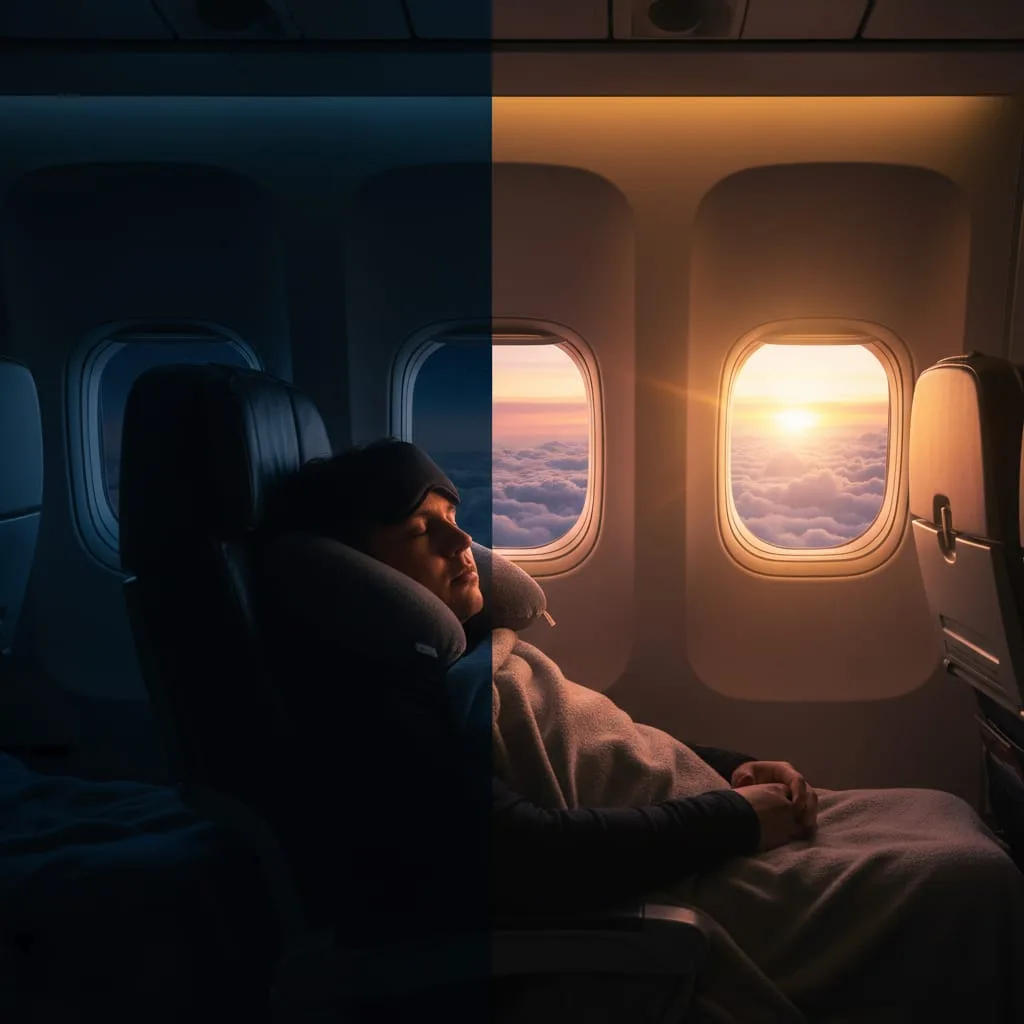
Your body adjusts to new time zones at roughly one to one and a half hours per day. So a 9-hour time difference (like India to Western Europe) means 6-9 days to fully adjust naturally. That is your entire vacation if you do nothing to speed up the process.
Why IST Creates Unique Jet Lag Patterns
India sits at UTC+5:30. That half-hour offset is not just quirky — it creates specific jet lag patterns that differ from what you read in American or European travel guides. These jet lag tips for Indian travelers account for our specific time zone position.
Flying West from India:
- Europe (CET/GMT): 3.5-5.5 hours back. Manageable. You arrive "early" — your body thinks it is 11 PM when it is actually 6 PM in Paris. You will feel sleepy earlier than normal but can power through.
- UK (GMT): 5.5 hours back. Similar pattern. The challenge is not falling asleep at 7 PM and waking at 3 AM.
- East Coast USA (EST): 10.5 hours back. Brutal. When it is midnight in New York, your body thinks it is 10:30 AM the next day. You are fighting to stay awake when everyone else is asleep, and desperate to sleep when everyone is at brunch.
- West Coast USA (PST): 13.5 hours back. Maximum pain. You are essentially flipped. When LA is having dinner at 7 PM, your body insists it is 8:30 AM and time to wake up.
Flying East from India:
- Southeast Asia (ICT/SGT): 1-2.5 hours forward. Almost nothing. Bangkok and Singapore feel like minor shifts.
- Japan/Korea (JST/KST): 3.5-4 hours forward. Mild. You might feel slightly sleepy in the evening, fully adjusted within 2-3 days.
- Australia (AEST): 4.5-5.5 hours forward. Moderate. Your body wants to sleep later than local time. Morning events feel rough, evenings feel fine.
- New Zealand (NZST): 6.5-7.5 hours forward. The furthest east most Indians travel. Similar to Australia but more pronounced.
The key insight: flying west extends your day, flying east shortens it. Most people find westward travel easier because staying awake a few extra hours is more natural than forcing yourself to sleep early. But the further west you go, the harder it gets — the Americas are genuinely difficult for Indian travelers.
Jet Lag Tips for Indian Travelers: Science-Backed Strategies
Light Exposure: The Most Powerful Tool
Light is the primary signal that resets your circadian rhythm. Strategic light exposure — and light avoidance — is more effective than any supplement or hack. According to the Sleep Foundation's research on jet lag, properly timed light exposure can reduce adjustment time by 50% or more.
Flying West (to Europe, Americas): You need to delay your body clock. Seek bright light in the evening local time. After arrival, spend time outdoors between 4-8 PM. Avoid bright morning light for the first 2-3 days — use sunglasses outdoors before noon, keep hotel curtains closed if you wake early.
Flying East (to SE Asia, Australia): You need to advance your body clock. Seek bright morning light. After arrival, get outside between 7-10 AM. Avoid late evening light — dim your environment after 6 PM, use warm/red lighting in your hotel room.
Blue light blocking glasses genuinely help for light avoidance periods. I travel with a cheap pair from Amazon specifically for jet lag management — not fashion, pure function.
Melatonin: Timing Matters More Than Dose
Melatonin is a hormone that signals sleepiness. Taking it does not knock you out like a sleeping pill — it tells your body "it is now nighttime." The timing of when you take it matters far more than how much.
Dosage: Start with 0.5-1mg. Studies show low doses work as well as high doses for circadian adjustment. Higher doses (3-5mg) can help you fall asleep faster but do not reset your clock better. I personally use 0.5mg and find it effective.
Timing: Take melatonin 2-3 hours before your target bedtime in the new time zone. If you want to sleep at 10 PM Paris time, take melatonin at 7-8 PM Paris time — even if your body thinks it is midnight IST.
When to Start: You can begin 1-2 days before departure. If flying to Europe, take melatonin at 5-6 PM IST (which is around 1 AM Paris time) to start shifting your clock early.
Melatonin is available over-the-counter in the USA and many countries, but requires a prescription in India and some European countries. Stock up when traveling abroad if you fly internationally often.
Pre-Adjustment: Shifting Before You Fly
The most effective jet lag prevention starts before you leave India. Three to four days before departure, begin shifting your sleep schedule toward your destination.
Flying West: Go to bed 30-60 minutes later each night. Wake up later. Have dinner later. You are extending your day to match Europe or America.
Flying East: Go to bed 30-60 minutes earlier each night. Wake up earlier. Have breakfast earlier. You are compressing your day to match Australia or Japan.
This is difficult with work schedules, so even partial adjustment helps. Shifting by 2 hours pre-departure is better than shifting zero hours.
Hydration and Cabin Environment
Aircraft cabins run at 10-20% humidity — drier than the Sahara Desert. Dehydration worsens fatigue and cognitive function, compounding jet lag symptoms.
Drink water consistently throughout the flight. I aim for 250ml every 1-2 hours. Yes, this means bathroom trips. The walking helps too.
Alcohol: Avoid it on long flights. Alcohol dehydrates you and disrupts sleep quality. That complimentary wine might help you fall asleep faster, but you will wake up feeling worse and more jet-lagged. I made this mistake once on a Delhi-London flight and regretted it for three days.
Caffeine: Use strategically. Coffee or chai can help you power through when you need to stay awake at your destination, but stop caffeine 6-8 hours before your target bedtime. For flights landing in the evening, skip caffeine entirely on the plane.
Exercise Timing
Exercise shifts your circadian rhythm. Morning exercise advances your clock (helpful flying east), evening exercise delays it (helpful flying west).
On arrival day and the following days, time your workout accordingly. Even a 20-minute walk or hotel gym session helps. Avoid intense exercise close to bedtime as it raises body temperature and alertness.
Indian-Specific Jet Lag Tips and Strategies
The Chai Timing Problem
If you are a regular chai drinker — and let us be honest, most of us are — your body expects chai at specific times. That 4 PM chai is practically a circadian cue in itself. Landing in New York when 4 PM IST is 6:30 AM EST means your body craves chai right when you should be at breakfast.
Strategy: Use chai as a tool, not just a habit. On westbound trips, have your chai later than usual on arrival day to help delay your clock. On eastbound trips, have it earlier to help advance your clock. The caffeine timing plus the ritual itself helps anchor your new schedule.
Ayurvedic Support for Jet Lag
I am not going to pretend ancient remedies replace modern science, but some Ayurvedic approaches complement jet lag management:
Ashwagandha: An adaptogen that may help with stress and sleep quality. Some evidence suggests it can improve sleep onset and reduce cortisol. I take 300-600mg in the evening starting 3-4 days before a major time zone shift. It does not fix jet lag directly but seems to smooth the transition.
Triphala: The digestive disruption from jet lag is real — constipation and weird hunger patterns are common. A mild dose of triphala before bed can help keep things moving. Your gut has its own circadian rhythm that needs to adjust too.
Warm Milk (Haldi Doodh): The traditional sleep remedy. Warm milk with turmeric before bed is genuinely helpful for sleep onset, though the mechanism is partly ritual and comfort rather than pure pharmacology.
These work alongside light exposure and melatonin — not instead of them.
The Work-From-Hotel Day 1 Strategy
If you are traveling for business or a wedding and need to function quickly, here is a strategy I have refined over multiple trips:
Day 1: Arrive, do not schedule anything important. Work from your hotel or take a slow sightseeing day. Nap if needed but set an alarm — no naps longer than 20 minutes, and not after 2 PM local time. Go to bed at a reasonable local time (10-11 PM), even if you are not sleepy.
Day 2: Force yourself awake at a normal local time (7-8 AM) even if you slept poorly. Get morning light. Have a proper local-time breakfast. By evening, you should feel significantly better.
Day 3: Schedule your important meetings, wedding functions, or activities. You should be 70-80% adjusted by now.
I have used this for weddings in the US, conferences in Europe, and family visits in Australia. It works.
Managing Jet Lag During Indian Events Abroad
Indian weddings in destination locations (Bali, Europe, USA) present a unique challenge. The functions run late, often until 1-2 AM. If you just arrived from India and your body thinks it is already 6-7 AM, you are in trouble.
Strategy: Arrive 2-3 days before the wedding starts if possible. Use those days to aggressively adjust using light exposure and melatonin. If you can only arrive one day early, accept that the sangeet will be rough, lean into the mehndi afternoon event, and save your best energy for the actual wedding.
Power naps (15-20 minutes) during afternoon breaks are lifesavers. Set multiple alarms. Do not rely on willpower to wake up — you will fail.
Day-by-Day Jet Lag Recovery Plans
India to Europe (5-6 Hour Time Difference)
Day -2 to -1 (Before Departure): Go to bed 30-60 minutes later than normal. If your flight is overnight, try to sleep on India time during the flight — you will land in the morning anyway.
Arrival Day: Land in the morning, resist the urge to nap. Get outside in the afternoon sun. Have a light dinner at 7-8 PM local time. Take 0.5-1mg melatonin at 8 PM. Sleep at 10 PM. You will probably wake at 4-5 AM — this is normal.
Day 2: Do not get up until 6:30-7 AM even if you wake earlier. Get morning light between 8-10 AM. Avoid napping. Evening light exposure 4-7 PM. Melatonin at 8 PM, sleep at 10 PM.
Day 3-4: You should be mostly adjusted. Continue morning light, avoid sleeping in past 8 AM. By day 4, you are usually fine.
India to USA East Coast (10-11 Hour Time Difference)
This is the tough one. Your schedule needs to essentially flip. Apply these jet lag tips for Indian travelers systematically.
Day -3 to -1: Stay up progressively later each night. On the night before your flight, try to stay up until 3-4 AM IST if possible. Sleep late the next morning.
Flight: Stay awake for the first half of the flight. Sleep for the second half (when it is approaching nighttime in the US). Take melatonin to help sleep on the plane.
Arrival Day: You land in the afternoon or evening US time. Stay awake until 10-11 PM local time. This is extremely difficult — your body thinks it is 8-9 AM and time to wake up. Use caffeine strategically, get outside, stay active. Take melatonin at 9 PM, force yourself to bed by 11 PM.
Day 2-3: You will wake at 4-5 AM. Do not fight it — get up, but stay in dim light until sunrise. No screens, no bright lights. Once the sun is up, get aggressive morning light exposure. Avoid napping even though you will be exhausted by 2 PM. Melatonin at 9 PM, bed by 11 PM.
Day 4-5: The worst is over. Continue the routine. By day 5-6, you should be functional.
Related: For surviving the actual flight, check out our long-haul flight survival guide for Indian travelers — specific tips for 14+ hour flights in economy.
India to Australia (5-6 Hour Time Difference, Eastward)
Day -2 to -1: Go to bed 30-60 minutes earlier each night. Wake up earlier. Your flight will likely be overnight or late evening.
Flight: Sleep as much as possible — you are flying through the night and arriving in the morning.
Arrival Day: Land in the morning, get outside immediately. Maximum morning light exposure. Do not nap. Your body wants to sleep in the evening anyway, so this direction is easier. Bed at 10 PM local time.
Day 2-3: You may wake up slightly late (8-9 AM). Get morning light immediately. By day 2-3, you should be largely adjusted. Australia is relatively gentle for Indian travelers.
Apps and Tools for Beating Jet Lag
Timeshifter: The best jet lag app available. You input your flight details and it creates a personalized schedule for light exposure, melatonin, sleep, and caffeine. It uses the same science discussed above but calculates the optimal timing for your specific trip. Worth the one-time purchase if you travel internationally more than twice a year.
Jet Lag Rooster: Free alternative that provides light exposure schedules based on your flights. Less sophisticated than Timeshifter but functional.
f.lux / Night Shift: These adjust your phone and laptop screen color temperature. Use them to reduce blue light in the evening at your destination.
For staying connected during your trip without worrying about connectivity issues messing up your sleep apps, see our international eSIM guide for Indian travelers.
Common Jet Lag Myths Debunked
"Just power through and you'll adjust faster": Partially true. You do need to stay awake until local bedtime. But you cannot will your circadian rhythm to shift faster — light exposure and melatonin do the heavy lifting, not determination.
"Sleeping pills help with jet lag": Sleeping pills help you sleep, but they do not reset your circadian rhythm. You will wake up at the wrong time anyway. Use melatonin for circadian adjustment, sleeping pills only if you cannot fall asleep at all.
"Flying business class means no jet lag": You can sleep better in business class, which helps with fatigue. But jet lag is about circadian disruption, not sleep quality. A flat bed does not change the fact that London is 5.5 hours behind India.
"Arrive the night before to get more sleep": Actually, arriving in the morning and powering through often works better than arriving at night when you cannot sleep. The morning arrival forces you into the local schedule immediately.
Practical Planning Tips for Travelers
When planning international trips, factor in jet lag recovery time. If you are going to Europe for the first time, do not schedule your most anticipated activity (Vatican tour, Eiffel Tower dinner) on day one. Build in a buffer.
For expensive trips like Australia, where you are investing significant money, arriving 2-3 days early is worth it. You do not want to be groggy at the Great Barrier Reef.
Short trips (under 5 days) present a dilemma. Sometimes it is better to stay on India time as much as possible — sleep at weird hours, avoid fully adjusting — because adjusting twice (there and back) is worse than not adjusting at all. This works for business trips to Europe but not for destinations further west.
Frequently Asked Questions
How long does jet lag last for Indian travelers flying to the USA?
Jet lag from India to the USA typically lasts 5-7 days for full adjustment, though you should feel significantly better by day 3-4 with proper light exposure and melatonin use. The 10-13 hour time difference (depending on East or West Coast) is among the most challenging for Indian travelers. Your body adjusts at roughly 1-1.5 hours per day naturally, but strategic interventions can speed this up considerably.
Is it easier to fly east or west from India?
Flying west (to Europe, Africa, Americas) is generally easier than flying east because it extends your day, and humans find it more natural to stay up later than to force early sleep. However, from India specifically, flying east to Southeast Asia and Australia involves smaller time differences (1-6 hours) compared to flying west to the Americas (9-14 hours), so destination matters more than direction for Indian travelers.
Should I take melatonin for jet lag and what is the right dosage?
Yes, melatonin is effective for jet lag when timed correctly. Start with 0.5-1mg taken 2-3 hours before your target bedtime in the new time zone. Studies show low doses work as well as high doses for circadian adjustment. The timing matters more than the amount. You can begin taking melatonin 1-2 days before departure to start shifting your clock early. Note that melatonin requires a prescription in India but is over-the-counter in the USA and many other countries.
Do Ayurvedic remedies help with jet lag?
Some Ayurvedic remedies can complement jet lag management. Ashwagandha (300-600mg in the evening) may help with sleep quality and stress during time zone transitions. Triphala can address digestive disruption that often accompanies jet lag. Warm milk with turmeric (haldi doodh) supports sleep onset. However, these work alongside light exposure and melatonin, not instead of them. Light exposure remains the most powerful tool for resetting your circadian rhythm.
What is the best app for managing jet lag?
Timeshifter is widely considered the best jet lag app. It creates personalized schedules for light exposure, melatonin timing, sleep windows, and caffeine based on your specific flights and sleep patterns. It uses peer-reviewed circadian science and is worth the one-time purchase for frequent international travelers. Jet Lag Rooster is a free alternative that provides basic light exposure schedules. Both are significantly more effective than guessing or using generic advice.
What TripCabinet Handles for You
When you book international trips through TripCabinet, our team considers these factors in your itinerary planning. We avoid scheduling key activities on arrival days, build in recovery time for long-haul destinations, and can advise on flight timing choices that minimize jet lag impact. These jet lag tips for Indian travelers inform how we design your travel experience.
We handle all the booking logistics — flights, hotels, transfers, activities — so you can focus on managing your adjustment and actually enjoying your trip. Less planning stress means better sleep, which directly helps with jet lag recovery.
Jet lag is inevitable when you cross multiple time zones. But it is also manageable. Understanding the science, using light and melatonin strategically, and planning your first few days intelligently can compress a week of suffering into a couple of rough days followed by normalcy. The world is too interesting to spend half your vacation feeling like a zombie — so plan accordingly, and actually enjoy where you land.