

Indian Food Survival Kit: How to Carry, Cook & Find Desi Khana Abroad
In this guide (11)
- What You Can Carry Indian Food Abroad How to Pack It Right
- Customs Rules by Country — Where It's Chill vs Where They'll Search Your Bag
- How to Carry Indian Food Abroad How to Pack Without Disaster
- Cooking Indian Food Abroad — Your Airbnb Is Your Best Friend
- Finding Indian Grocery Stores Abroad — City by City
- When There's Zero Indian Food Available — Survival Mode
- Indian Temples Abroad — The Free Meal Secret Nobody Talks About
- Honest Ranking: Indian Restaurant Quality by Country
- Quick Budget: How Much Food Costs Abroad for Indian Travelers
- My Personal Indian Food Travel Kit — What I Actually Pack
- Frequently Asked Questions
I once watched a grown man — a senior VP at some MNC, suited up, briefcase in hand — get stopped at Auckland airport because his suitcase had three unlabelled dabbas of homemade achar. The biosecurity officer opened that ziplock and the entire customs hall smelled like Punjabi mango pickle for a solid twenty minutes. He lost the pickle, got a written warning, and looked like he might actually cry. That man was my uncle. And honestly? I get it. If you want to carry Indian food abroad how to pack it properly is something every Indian traveler needs to figure out before the trip, not at the airport security line while an officer holds your thepla like it's contraband.
Look, I've been that person who packed an entire steel dabba of MTR ready meals, three packets of Maggi, homemade namkeen in a repurposed Britannia biscuit tin, and — yes — pickle in a glass jar wrapped in a towel inside my checked bag. I've also been the person frantically googling "can I bring pickle to Australia" at 2 AM the night before a flight. The answer, by the way, is yes — but only if it's commercially sealed. My mum's homemade stuff? That's a gamble I've lost more than once.
So after 14 international trips, three confiscated pickle jars, one suspicious-looking bag of jeera powder that got me pulled aside in Frankfurt, and successfully feeding myself dal-chawal in an Airbnb in rural Portugal — I'm going to break down everything you need to know if you want to carry Indian food abroad how to pack your luggage, cooking Indian meals abroad, and finding Indian food in foreign countries when the homesickness hits hard.
What You Can Carry Indian Food Abroad How to Pack It Right
Here's the thing nobody tells you clearly: most packaged, commercially sealed Indian food is perfectly fine to carry internationally. The problem isn't Indian food itself — it's the specific categories that biosecurity laws target. Fresh produce, raw meat, dairy, and anything unlabelled or homemade triggers red flags. But sealed, shelf-stable packaged food? Generally fine almost everywhere.
The key word is "generally." Because Australia and New Zealand have rules so strict that even a forgotten apple in your backpack can cost you AUD $4,368 in fines. Meanwhile, countries in Southeast Asia barely glance at your food. So the rules depend entirely on where you're flying to. Let me break it down honestly.
Foods That Are Almost Always Safe to Carry
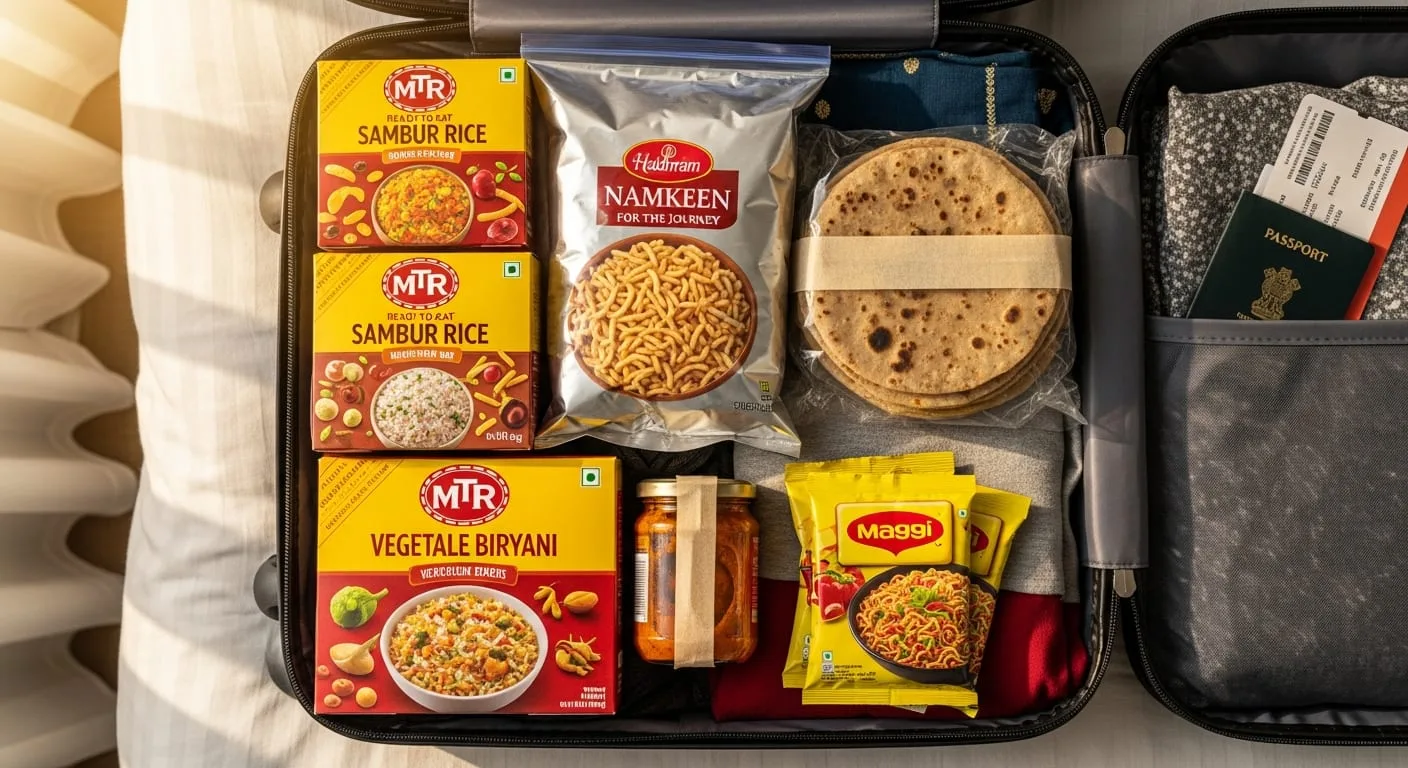
- MTR/Gits/Kohinoor ready-to-eat packets — these are the gold standard for Indian travelers. Sealed retort pouches, long shelf life, no refrigeration needed. I've carried MTR Alu Mutter and Paneer Butter Masala to 11 countries without a single issue. Pack 6-8 packets and you're sorted for a week.
- Instant noodles (Maggi, Yippee, Knorr) — lightweight, universally accepted. The 4-pack of Maggi weighs nothing and saves you on those nights when you can't find anything to eat at 11 PM in a random European town.
- Haldiram/Bikaji namkeen and snacks — bhujia, mixture, aloo bhujia, sev — all sealed packets are fine. I carry at least two 400g packets on every trip. They're also great gifts for foreign friends who've never tried proper Indian snacks.
- Thepla and khakhra — THE Gujarati travel essential. My mum makes a batch of 40 theplas for every trip. Wrap them tight in cling film, put them in a ziplock, and they last 4-5 days without refrigeration. Khakhra lasts even longer — up to 3 weeks easily.
- Pickles in commercially sealed jars — Mother's Recipe, Priya, Bedekar — anything factory-sealed with ingredients listed. These go in checked luggage because they're technically liquids over 100ml.
- Tea and coffee — Tata Tea bags, Bru instant coffee sachets, chai masala powder. I once carried 50 sachets of Wagh Bakri chai to the UK because the "chai latte" there is an insult to actual chai.
- Spice powders (sealed packets) — MDH, Everest, Catch — all commercially sealed spice packets are fine. Don't carry loose powder in unlabelled bags though. I cannot stress this enough. A ziplock of yellow turmeric powder looks extremely suspicious on an X-ray.
- Papad (roasted/dried) — Lijjat papad, any brand. Weighs nothing, lasts forever, and you can roast them on a gas stove or even microwave them abroad.
Foods That Will Get Confiscated (or Get You Fined)
- Fresh fruits and vegetables — absolute no everywhere. Don't even think about it. Even one banana in your bag can trigger a fine in Australia.
- Homemade food without labels — this is where it gets tricky. Technically, many countries allow homemade cooked food. But customs officers have zero way to verify what's in your unmarked dabba. I've had homemade laddoos questioned in Singapore (they let them through) and homemade pickle confiscated in New Zealand (they didn't).
- Raw/dried meat, fish, or seafood — no dried Bombay duck, no fish pickle with visible fish chunks, no beef jerky for the US-bound crowd.
- Fresh dairy products — paneer, curd, fresh milk, fresh cheese. Some countries are relaxed about this, but Australia, NZ, USA, and most of Europe will confiscate.
- Honey (sometimes) — Australia and NZ specifically ban it. Other countries usually don't care.
Customs Rules by Country — Where It's Chill vs Where They'll Search Your Bag
Not all customs checkpoints are created equal. Some countries couldn't care less about your thepla stash. Others treat a forgotten orange like a national security threat. I've personally experienced both extremes.
Strictest Countries (Declare EVERYTHING)
Australia and New Zealand are in a league of their own. Both are island ecosystems that take biosecurity extremely seriously. You must declare ALL food on your arrival card — even sealed packaged stuff. The fine for not declaring food in Australia runs to 12 penalty units, which is AUD $4,368 (roughly ₹3 lakh) since 1 July 2026. They have sniffer dogs at the airport trained to detect food. I'm not exaggerating — a beagle sniffed out a packet of Parle-G biscuits in my friend's jacket pocket at Melbourne airport. Declare it, let them inspect it, and they'll usually let sealed commercial food through. Homemade stuff is a coin flip.
USA customs prohibits meat, poultry, dairy from most countries, and some spices. But sealed vegetarian ready-to-eat meals, snacks, tea, and spice packets are generally fine. You have to check "Yes" on the customs declaration form where it asks about food. Don't be clever and check "No" — if they find food you didn't declare, there's a $300 fine first time, $500+ for repeat offenses.
Moderate Countries
UK and Europe (Schengen) are moderate. The EU food safety regulations restrict meat and dairy from non-EU countries, but packaged vegetarian food, snacks, spices, and ready-to-eat meals are fine. I've never been questioned about food at Heathrow, Schiphol, or Frankfurt — though I always declare it just in case.
Canada is similar to the US. Declare all food, avoid fresh produce and meat products, and sealed packaged food usually passes without issues. The CBSA officers at Toronto Pearson are actually quite friendly about it in my experience.
Relaxed Countries (Basically Nobody Cares)
Southeast Asia — Thailand, Singapore, Malaysia, Indonesia, Vietnam — nobody's checking your MTR packets. I've walked through Singapore Changi with a suitcase that was basically 40% food and nobody blinked, though Singapore does set a formal limit: the Singapore Food Agency allows processed food for private consumption only up to 5 kg or 5 litres and SGD 100 in value per traveller. Malaysia in particular has so much Indian food available that you don't even need to carry much. The vegetarian food situation in Malaysia and Singapore is honestly great for Indian travelers.
Middle East — Dubai, Doha, Oman, Bahrain — extremely relaxed about Indian food. The irony is that half the population in these countries is South Asian, so Indian food is everywhere anyway. But if you want your specific brand of achar or your mum's thepla, go ahead. I've never been stopped once.
How to Carry Indian Food Abroad How to Pack Without Disaster
Packing food isn't just about customs. It's about making sure your clothes don't smell like pickle for the rest of your trip. I learned this the hard way in 2019 when a jar of lime pickle leaked inside my suitcase on a flight to London. Everything — shirts, jeans, underwear — smelled like achaar for a week. My Airbnb host thought something had died in my room.
Here's my system after years of trial and error. If you want to carry Indian food abroad how to pack it properly so nothing leaks, breaks, or raises suspicion.
The Ziplock Method (Non-Negotiable)
Every single food item goes into a ziplock bag. Every. Single. One. Even sealed MTR packets — because if one punctures under cabin pressure, you want the leak contained. For pickle jars, I do a triple layer: cling film around the lid (sealed with rubber band), then the jar goes into a ziplock, then that ziplock goes into a second ziplock. Paranoid? Maybe. But I haven't had a leak since 2019.
Check-In vs Carry-On Rules
- Pickles, chutneys, any liquid/semi-liquid — ALWAYS checked luggage. These count as liquids under the 100ml carry-on rule. I've seen people argue with security about whether pickle is a liquid. It is. Don't be that person.
- Dry snacks, thepla, khakhra, papad — can go in carry-on. Actually, I prefer carry-on for thepla because checked luggage goes through rough handling and they can get crushed.
- MTR/ready-to-eat packets — technically these contain liquid (gravy), so checked luggage is safer. Some airports might let them through carry-on screening, but don't risk it.
- Spice powders — here's where it gets awkward. Carry-on with spice powders means they show up on X-ray as unidentified powder. I've been pulled aside twice for MDH Chana Masala looking "suspicious" on the scanner. Keep spice packets in checked luggage with the original packaging visible through the ziplock.
Pro Packing Tips I've Learned the Hard Way
Keep all food items together in one section of your suitcase, preferably in a separate packing cube or large ziplock. If customs wants to inspect, you can just pull out that one section instead of them rifling through your entire bag. Also — and this sounds silly but it matters — keep food near the top of your checked bag. Some countries X-ray checked luggage and if they see something suspicious, they'll open your bag. Having food accessible means they don't destroy your careful packing to find it.
One more thing: bring a small packing list or note listing what food you're carrying. When the customs officer asks "what food items are you bringing in?" you can just read the list. Sounds extra, but it makes you look organized and honest, which goes a long way.
Cooking Indian Food Abroad — Your Airbnb Is Your Best Friend
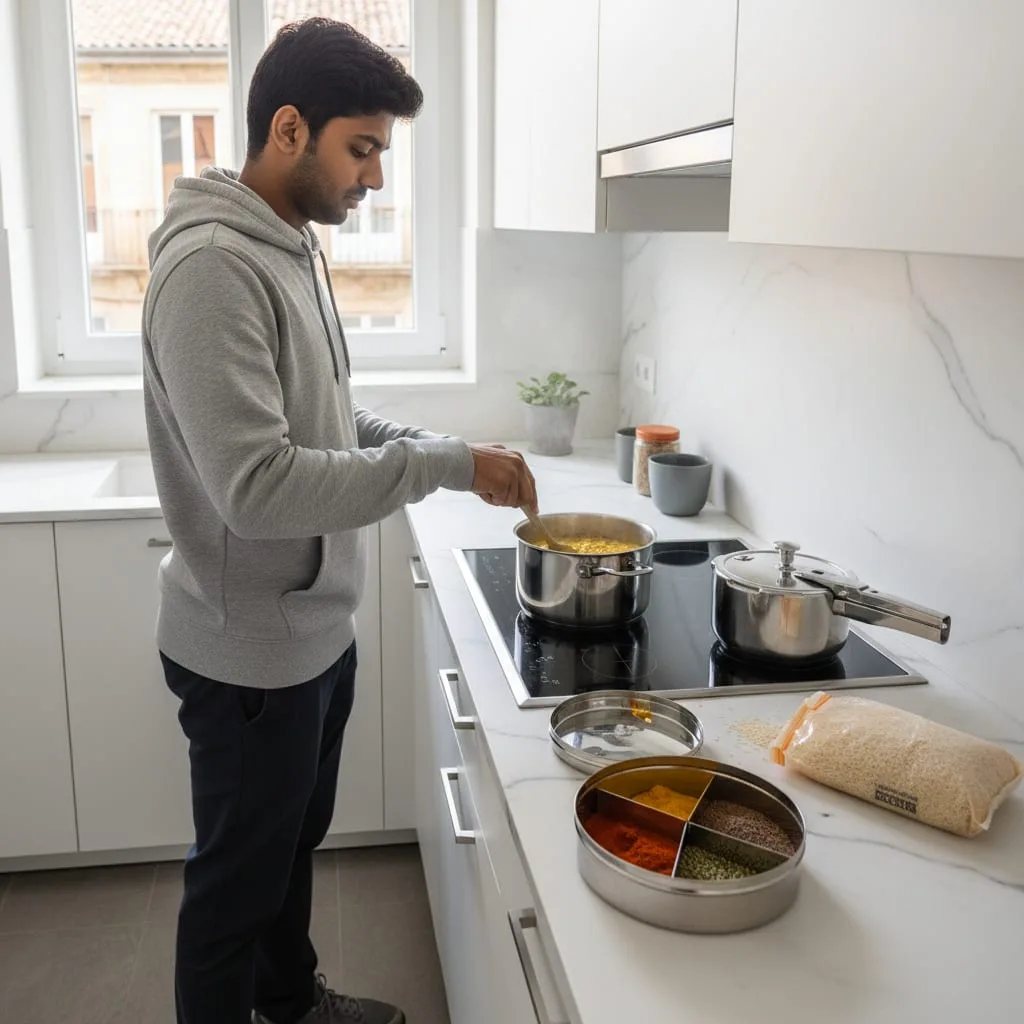
Hotels are fine for 3-4 day trips. But anything longer than a week and I'm booking accommodation with a kitchen. Full stop. The difference between a hotel trip and an Airbnb trip — food-wise — is the difference between spending ₹2,000/day eating out and spending ₹400/day cooking your own dal-chawal. The math is obscene.
I spent a month in Lisbon in 2023 and cooked roughly 70% of my meals. Breakfast was always chai + toast. Lunch was usually something local and cheap — a bifana sandwich or a plate of grilled fish for €5-7. Dinner was almost always home-cooked — dal, rice, sabzi with whatever vegetables looked familiar at the supermarket. My total food budget for 30 days? About €450 (₹49,500). That's ₹1,650 per day. In Lisbon. During summer. Try doing that eating out three times a day.
The Travel Cooking Kit
You don't need to carry your entire kitchen. But a few key items make cooking Indian food abroad infinitely easier.
- Small spice dabba or spice box — a stainless steel masala dabba with 7 compartments is perfect. Fill with: haldi, red chili powder, jeera (whole), rai (mustard seeds), dhania powder, garam masala, and salt. This weighs maybe 300 grams and transforms any kitchen into an Indian one.
- Chai kit — loose tea leaves (Wagh Bakri or Tata Gold), a small box of chai masala, and a strainer. Most Airbnbs have a saucepan. That's all you need for proper kadak chai. The "tea" they serve abroad — that pale, watery, milk-optional nonsense — isn't chai. It's hot disappointment.
- Portable pressure cooker (optional but game-changing) — a 2-litre Hawkins or Prestige fits in checked luggage. Yes, it adds 1.5 kg. But if you're traveling for more than 2 weeks, the ability to make dal, rajma, chole, and khichdi at the press of a whistle is worth the weight. I've carried mine to 6 countries.
- Tadka spoon — most Airbnb kitchens don't have a small enough pan for tadka. A small tadka ladle weighs nothing and makes the difference between bland dal and proper restaurant-level dal.
What to Buy Locally (Don't Carry Everything)
Rice, onions, tomatoes, potatoes, garlic, ginger, cooking oil, and basic vegetables are available literally everywhere in the world. Don't waste luggage space carrying rice — you can buy basmati at most Asian grocery stores abroad, and regular rice is at every supermarket. Same with lentils — toor dal and moong dal are available at Indian stores in most major cities. Carry the spices, not the staples.
The rice cooker hack deserves its own mention. Most Airbnbs and even some hostels have a rice cooker or at least a microwave. You can make perfectly acceptable khichdi in a rice cooker — just throw in rice, moong dal, salt, haldi, and water. It won't win any cooking competitions, but at 10 PM in a random Polish town when everything is closed, it's a warm hug in a bowl.
Finding Indian Grocery Stores Abroad — City by City
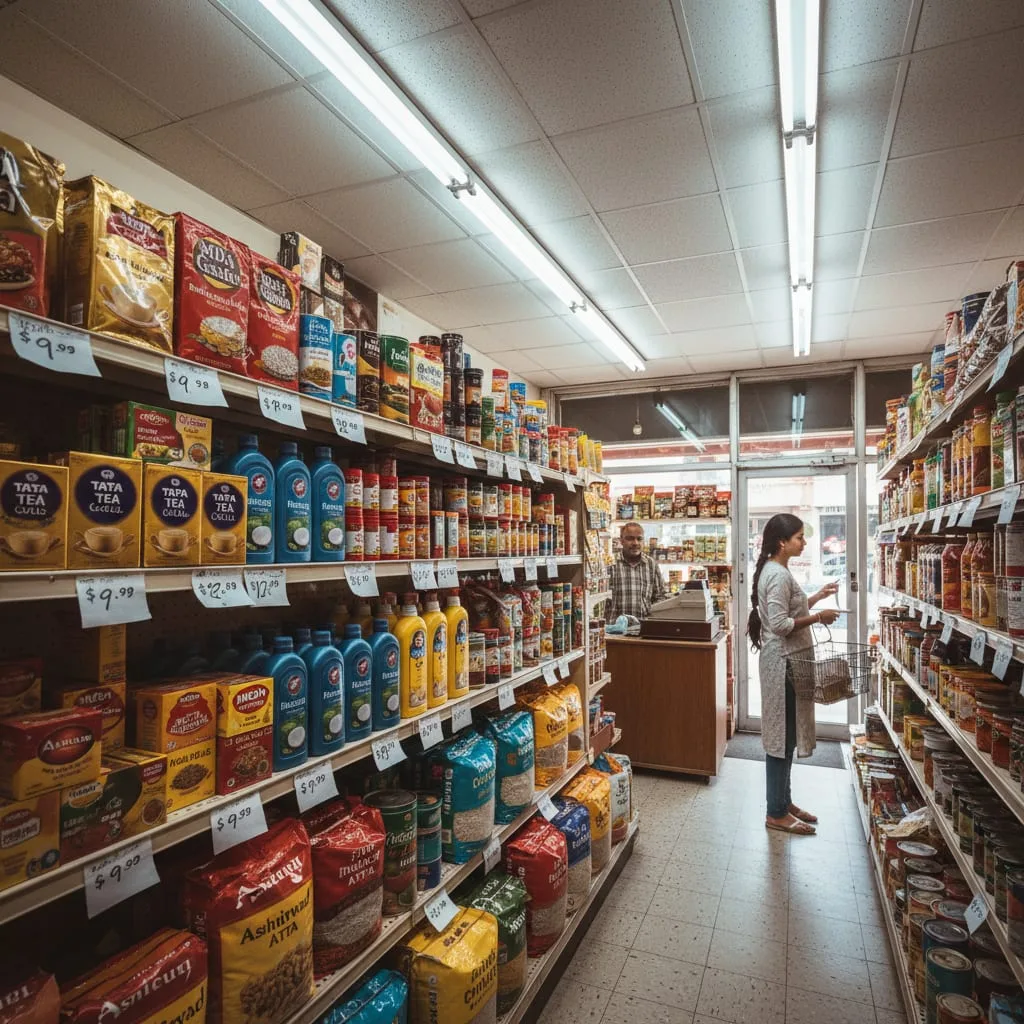
The Indian diaspora has done god's work when it comes to setting up grocery stores in every major city on the planet. Wherever Indians have migrated, a desi grocery store has followed within approximately 18 months. Here's where to find them in the places Indians travel most.
- London, UK — Southall (aka Little Punjab) is the motherland of Indian groceries abroad. Literally every Indian brand you can think of — from Lijjat papad to Haldiram namkeen to frozen parathas. Also try Drummond Street near Euston station. You won't just find groceries — you'll find entire restaurants serving thali for £8-10.
- New York/New Jersey, USA — Edison and Iselin in New Jersey have more Indian stores than some Indian towns. Patel Brothers is the big chain — they're in multiple US cities. Jackson Heights in Queens also has a strong Indian grocery presence.
- Toronto, Canada — Gerrard Street East (Little India) and Brampton. Brampton is basically an Indian suburb at this point — grocery stores, sweet shops, chaat stalls, everything.
- Singapore — Little India (Tekka Market area) has multiple Indian grocery stores. Mustafa Centre in Farrer Park is open 24/7 and stocks everything from Parle-G to fresh curry leaves.
- Dubai, UAE — Al Karama, Bur Dubai, Meena Bazaar — Indian grocery stores on every other street. Prices are actually comparable to India. You really don't need to carry much food to Dubai.
- Sydney/Melbourne, Australia — Harris Park in Sydney is your Little India. Indian grocery stores everywhere. Melbourne has a good cluster around Dandenong. Brands you'll find: MTR, Shan, National, Haldiram, and surprisingly good frozen Indian food sections.
Once you know how to carry Indian food abroad how to pack the essentials, the next step is finding local supplies. Google Maps is your best friend here. Search "Indian grocery store" near your accommodation the day you arrive. In most major cities, you'll find one within a 20-minute commute. Some even deliver — Amazon Fresh in the US and UK has a dedicated "International Foods" section with Indian brands.
When There's Zero Indian Food Available — Survival Mode
Okay, let's talk about the worst-case scenario. You're in a small town in rural Japan, or central Iceland, or somewhere in Eastern Europe where "Indian restaurant" returns zero Google results and the nearest grocery store thinks cumin is exotic. What do you do?
This is exactly why you carry Indian food abroad how to pack becomes critical for these off-the-beaten-path trips. My survival strategy has three levels.
Level 1: MTR packets + microwave. If your accommodation has a microwave — and most do — you can heat up MTR packets in 2 minutes. Pair with plain rice (available everywhere) or even bread. Not glamorous, but it works. I survived 5 days in rural Iceland entirely on MTR Pav Bhaji heated up in the hostel microwave, eaten with local bread. The Icelandic guy at the next table was curious, I offered him a bite, and he said it was the best thing he'd eaten all week. Take that, fermented shark.
Level 2: Basic cooking with available ingredients. Most supermarkets worldwide stock rice, lentils (often labelled "red lentils" which is basically masoor dal), onions, tomatoes, garlic, potatoes, and some form of chili. With your travel spice box, you can make a passable dal, aloo sabzi, or tomato rice. The dal won't taste like home — it never does — but it's warm, filling, and reminds your stomach that you're still Indian.
Level 3: Adapt and accept. Sometimes you just have to eat local. And honestly? That's part of traveling. I draw the line at about 5 days — after that, even I need a break from pasta/bread/potato and crave something with haldi and jeera in it. But for the first few days, trying local food IS the experience. The best meals of my life have been things I'd never have ordered if Indian food was available — a bowl of pho in Hanoi, ceviche in Lima, pierogi in Krakow. Don't let food anxiety stop you from tasting the world.
Indian Temples Abroad — The Free Meal Secret Nobody Talks About
Here's something I discovered by accident on my first trip to the UK. Gurdwaras serve free langar everywhere. Everywhere. London, Toronto, New York, Melbourne, Singapore, Nairobi — if there's a Gurdwara, there's free langar. And it's not just roti and dal — some Gurdwaras abroad serve full meals with rice, sabzi, raita, and halwa. The one in Southall, London serves langar to 5,000+ people every weekend.
Hindu temples also often serve prasad after aarti. ISKCON temples abroad serve excellent vegetarian thalis — the ISKCON temple in London (Bhaktivedanta Manor) has a restaurant called Govinda's. And many South Indian temples in Singapore, Malaysia, and the UK serve anna daanam on weekends.
This isn't just about free food — though let's be real, free food is amazing when you're on a budget. It's about community. Walking into a Gurdwara in Toronto and sitting down to langar after two weeks of eating sandwiches and pizza — that emotional hit is real. You feel connected to home in a way that no restaurant replicates. Don't be shy about it. That's literally what langar is for.
Honest Ranking: Indian Restaurant Quality by Country
Not all Indian food abroad is created equal. After eating at Indian restaurants in 19 countries, here's my brutally honest ranking. Fight me in the comments.
- Best abroad (UK, Malaysia, Singapore): UK, Malaysia, Singapore — British curry houses are legendary for a reason. Brick Lane in London, Curry Mile in Manchester. Malaysian and Singaporean banana leaf meals are genuinely better than most restaurants in India. The duty-free allowance when returning to India will be the least of your worries — you'll be too full to shop.
- Solid options (UAE, Canada, USA, Australia): UAE, Canada, USA (major cities), Australia — large Indian diaspora means authentic food is available. Not on every corner, but within reasonable distance. Patel Brothers and Indian restaurants in the US are legit.
- Mixed results (Thailand, Europe): Thailand, Europe (Germany, Netherlands, France) — restaurants exist but quality varies wildly. Some are run by Bangladeshi/Pakistani/Nepali chefs who cook differently. The "butter chicken" in Paris once tasted like tomato soup with cream. I'm still recovering.
- Rough territory (Japan, Korea, Eastern Europe): Japan, South Korea, Eastern Europe, South America — Indian restaurants are rare, expensive, and often adapted to local palates (read: not spicy at all). The "Indian curry" I had in Tokyo was sweet. SWEET. That's a crime against humanity.
Quick Budget: How Much Food Costs Abroad for Indian Travelers
| Food Strategy | Daily Cost (approx) | Best For |
|---|---|---|
| Eating out every meal (no Indian food) | ₹2,500-5,000 | Short trips, 3-5 days |
| Eating out + MTR packets for dinner | ₹1,500-3,000 | Week-long trips |
| Cooking 50% meals in Airbnb | ₹800-1,500 | Trips longer than 1 week |
| Cooking 80% meals (full kitchen mode) | ₹400-800 | Month-long stays, budget trips |
| Carrying food from India (one-time cost) | ₹1,500-3,000 total | Any trip length |
The sweet spot for most Indian travelers on a 7-10 day trip is carrying a stash of MTR packets and snacks from India (₹2,000 investment), eating local for lunch, and having desi dinner every 2-3 nights. This keeps you under ₹2,000/day food budget in most countries while still experiencing local cuisine. Balance, yaar. Knowing how to carry Indian food abroad how to pack smartly is half the battle — the other half is eating local with an open mind.
My Personal Indian Food Travel Kit — What I Actually Pack
After 14 trips, I've optimized my food luggage down to a science. This is what goes into every international trip, every single time. Total weight: about 3.5 kg. Total cost: roughly ₹2,800.
- 8 MTR ready-to-eat packets (₹480) — 4 Alu Mutter, 2 Paneer Butter Masala, 2 Dal Fry
- 4 packets of Maggi (₹56) — because some nights you just need Maggi
- 2 packets Haldiram Aloo Bhujia (400g each) (₹360) — snack + emergency meal
- 30 theplas from mum (₹0, technically priceless) — wrapped in cling film + ziplock
- 1 jar Mother's Recipe pickle (₹180) — triple-sealed in ziplocks
- Spice dabba (₹0, reused every trip) — 7 essential spices
- 30 Wagh Bakri chai sachets (₹150) — one per morning, non-negotiable
- 1 packet chai masala (₹60) — the sachets don't have enough masala for proper chai
- 2 packets khakhra (₹140) — plain + methi flavour
- 1 small pack instant upma/poha mix (₹80) — breakfast sorted
- Tea strainer (₹0, always in my bag) — because chai through a paper tea bag is sacrilege
This kit has kept me fed, happy, and homesickness-free on trips from 5 days to 30 days. Adjust quantities based on your trip length, but the core items stay the same. The question of how to carry Indian food abroad how to pack it will depend on your destination — pack more for places with fewer Indian stores (Japan, Iceland, Eastern Europe), less for places where Indian food is already everywhere (UK, Singapore, Dubai, Malaysia).
Frequently Asked Questions
Can I carry homemade thepla and pickle on an international flight?
Yes, homemade thepla is fine on almost all international flights — it's dry, cooked flatbread with no biosecurity risk. Pickle should be in your checked luggage since it counts as a liquid. Wrap thepla in cling film and ziplock bags. I've carried mum's thepla to 11 countries without issues. Just make sure pickle jars are sealed tight — triple-bag them to prevent leaks.
Will customs take my MTR packets and Maggi noodles?
No. Commercially sealed, packaged vegetarian food like MTR ready meals, Maggi noodles, Haldiram snacks, and sealed spice packets are allowed in virtually every country. The exception is if you don't declare food in strict countries like Australia (fine up to AUD $4,368). Always declare food on your customs form and keep original packaging intact.
How many kg of food can I carry in my checked luggage internationally?
There's no specific "food weight limit" — it counts toward your total checked luggage allowance (usually 23-30 kg depending on your airline and route). Most Indian food travel kits weigh 3-4 kg. The bigger concern is whether the food type is allowed in your destination country, not the weight. Check your airline's baggage policy and your destination's biosecurity rules before packing.
Where can I find Indian grocery stores in Europe and the USA?
Every major Western city has Indian grocery stores. Try Southall in London and the Curry Mile area in Manchester for UK shopping. Across the US, Patel Brothers has stores in 20+ cities, and Edison/Iselin NJ is India outside India. For Europe, search Google Maps for "Indian grocery" near your hotel — Berlin, Amsterdam, Paris, and Frankfurt all have multiple options. Most stock MTR, Haldiram, MDH spices, and frozen items.
Is it cheaper to carry food from India or buy Indian food abroad?
Carrying from India is significantly cheaper. A packet of MTR Paneer Butter Masala costs ₹60 in India but $3-4 (₹290-385) at an Indian store in the US or UK. Haldiram namkeen is 3-4x more expensive abroad. A ₹2,500 food kit from India saves you ₹8,000-10,000 compared to buying the same items overseas. The only exception is countries like Malaysia and Singapore where Indian food prices are comparable to India.