

Vietnam 2-Week Itinerary: Hanoi to Ho Chi Minh City for Indian Travelers
In this guide (10)
- Days 1-3: Hanoi — Controlled Chaos and the Best Food You'll Eat
- Days 4-5: Ha Long Bay — Those Limestone Karsts You've Seen Everywhere
- Day 6: Ninh Binh — Ha Long Bay on Land
- Days 7-8: Hue — The Reunification Express and an Imperial City
- Days 9-11: Hoi An — Lanterns, Tailors, and the Best Banh Mi on Earth
- Days 12-14: Ho Chi Minh City — History, Tunnels, and the Mekong Delta
- Vietnam 2-Week Budget Breakdown for Indian Travelers
- Practical Tips and Transport Hacks for Your Vietnam Itinerary From India
- Vegetarian Survival Guide for Vietnam
- What to Pack and Final Logistics
I blew my entire month's eating-out budget on a single bowl of bun cha in Hanoi. It cost me 60,000 Vietnamese Dong — roughly ₹200. That should tell you everything about why a vietnam itinerary from india makes so much financial sense right now. Vietnam is, hands down, the best-value country in Southeast Asia, and nobody back home seems to know about it yet. While everyone's doing Singapore for the fifth time, Vietnam sits there with its jaw-dropping landscapes, absurd food, and prices that make even Goa look expensive.
This is the route I've done twice now: north to south, Hanoi to Ho Chi Minh City, over 14 days. It's the most logical direction because you're following the country's natural geography — and honestly, ending in Saigon's chaos feels like a proper crescendo after the quieter north. I'm laying out every day, every cost in INR, every transport hack, and every food spot worth your time. No fluff. If you want a broader Vietnam travel guide for Indians, we've got that covered too. This is the day-by-day playbook for your vietnam itinerary from india.
Days 1-3: Hanoi — Controlled Chaos and the Best Food You'll Eat
Hanoi hits you in the face the second you step outside Noi Bai Airport. The humidity, the honking, the sheer wall of motorbikes — it's sensory overload in the best possible way. Grab a Grab (Vietnam's version of Ola/Uber — download it before you land) from the airport to the Old Quarter for about ₹500-700. Don't even think about negotiating with taxi touts outside. Just don't.
The Old Quarter is where you want to base yourself. It's 36 streets, each historically named after the goods they sold — Silk Street, Silver Street, Paper Street. Today it's a glorious mess of street vendors, tiny plastic-stool restaurants, and motorbikes weaving through pedestrians like they're playing a video game. Your hotel here should cost ₹800-1,500 per night for a clean room with AC and breakfast.
Day 1: Start at Hoan Kiem Lake early morning. And I mean early — 6 AM early. That's when locals do tai chi by the water, and the light is soft and golden before the heat kicks in. Walk across the red Huc Bridge to Ngoc Son Temple (₹150 entry). After that, lose yourself in the Old Quarter streets. No map, no plan. Just walk. You'll find the best stuff by accident — a woman grilling corn on a corner, a tiny shop selling the crispiest banh mi you've ever eaten for ₹80.
For lunch, go straight to Bun Cha Huong Lien on Le Van Huu Street. Yes, it's where Obama ate with Anthony Bourdain. Yes, it's touristy now. But the bun cha is still genuinely excellent — smoky grilled pork patties with rice noodles, herbs, and a dipping broth that'll make you question every meal you've had before. About ₹250 for a full meal. In the evening, head to Ta Hien Street — Hanoi's "beer corner." A glass of bia hoi (fresh draft beer brewed daily) costs ₹25-30. Twenty-five rupees. For a beer. I still can't believe it.

Day 2: Morning at the Ho Chi Minh Mausoleum (free entry, closed Mondays and Fridays, dress modestly — no shorts). The queue moves fast. Then visit the Temple of Literature — Vietnam's first university, built in 1070. It's peaceful, beautiful, and gives you a break from the streets outside. After lunch, do something you'll never forget: visit Train Street. This narrow alley in the Old Quarter has an actual train passing through twice daily, centimetres from the cafes lining both sides. Grab a ca phe trung (egg coffee) at one of the trackside cafes and wait. When that train rolls through, you'll feel the rush of air on your face. Genuinely thrilling.
Egg Coffee, Ethnology Museum, and Water Puppets
Day 3: Visit the Vietnam Museum of Ethnology in the morning (₹300, worth every paisa for understanding Vietnam's 54 ethnic groups). Then get your first ca phe trung at Cafe Giang, the place that invented egg coffee in the 1940s. It tastes like a warm, creamy tiramisu crossed with strong Vietnamese coffee. Catch the Water Puppet show at Thang Long Theatre in the evening (₹250-400). It sounds weird — puppets on water — but it's strangely mesmerizing and deeply Vietnamese.
Pho for breakfast every single morning in Hanoi. Non-negotiable. A steaming bowl from a street vendor costs ₹100-200 and it will ruin every pho you've had back home. My favourite spot was a nameless stall on Bat Dan Street where the broth had clearly been simmering since the previous century.
Days 4-5: Ha Long Bay — Those Limestone Karsts You've Seen Everywhere
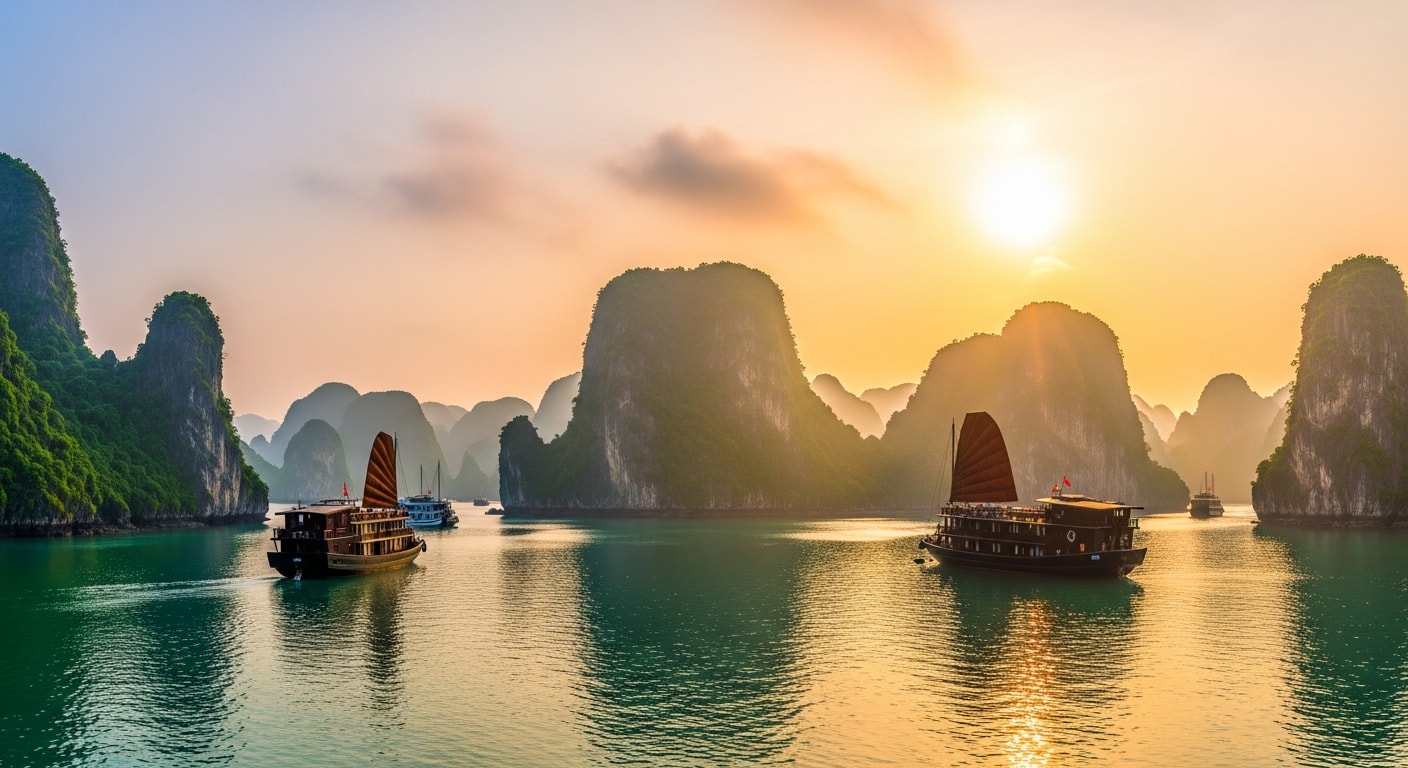
This part of the vietnam itinerary from india is what most people plan their entire trip around. Ha Long Bay needs no introduction — you've seen it on every "places to visit before you die" list ever published. But here's the thing: the photos don't lie. It really is that spectacular. Over 1,600 limestone karsts and islands rising from emerald waters, draped in jungle, disappearing into morning mist. It's the kind of place that makes you go quiet.
Book an overnight cruise. A day trip doesn't do it justice — you need to wake up surrounded by those karsts at sunrise with nothing but silence and water. Budget cruises run ₹4,000-6,000 for a 2-day/1-night trip including meals, kayaking, and cave visits. Mid-range options go for ₹8,000-15,000. I'd recommend spending at least ₹6,000-8,000 to avoid the cattle-car boats that pack 50 tourists onto a rusty vessel with questionable food.
Most cruises include a visit to Sung Sot Cave (Surprise Cave) — massive chambers with dramatic stalactites lit up in colours. You'll also kayak through lagoons, swim in the bay, and visit Titop Island for a hilltop viewpoint. The kayaking through hidden lagoons is the highlight for me — paddling into a cave opening and emerging into a secret lake surrounded by sheer karst walls.
Budget tip: Skip Ha Long Bay proper and go to Lan Ha Bay instead. It's the southern section of the same geological formation but far less crowded, equally beautiful, and cheaper. Base yourself on Cat Ba Island and book a day cruise from there for ₹2,500-4,000. Fewer tourists, same jaw-dropping scenery. I did this on my second trip and honestly preferred it.
Getting there: buses from Hanoi's My Dinh bus station take about 4 hours (₹400-600). Most cruises include hotel pickup from Hanoi, so check before booking separately. For cheap flights from India into Hanoi, VietJet and IndiGo often have deals under ₹15,000 return.
Day 6: Ninh Binh — Ha Long Bay on Land
No vietnam itinerary from india is complete without a stop at Ninh Binh. If Ha Long Bay is karsts in water, Ninh Binh is karsts in rice paddies. Same dramatic limestone formations, but surrounded by lush green fields and winding rivers instead of ocean. It's about 2 hours south of Hanoi by bus (₹300-400) and works perfectly as a day trip, though staying one night is even better.
The Tam Coc boat ride is the main event — a rowboat takes you along the Ngo Dong River through three caves and past flooded rice paddies. The boatwoman rows with her feet (seriously), and the whole thing costs about ₹300. Go early morning when mist hangs over the paddies. Then climb Mua Cave viewpoint — 500 steep stone steps to a dragon statue perched on a mountain peak. The panorama from the top is arguably the most spectacular view in northern Vietnam. Your legs will hate you. Your camera roll will thank you.
Alternatively, do the Trang An Grottoes boat tour (₹400) — longer route, with more caves and a stop at a temple. Both are excellent; I slightly prefer Tam Coc for the rice paddy scenery. Rent a motorbike (₹400/day) or bicycle (₹100/day) to get around Ninh Binh — it's flat and easy cycling.
Days 7-8: Hue — The Reunification Express and an Imperial City
Here's where the vietnam itinerary from india gets properly adventurous. Take the overnight Reunification Express train from Hanoi to Hue. It's 13 hours, and it's one of the great train journeys in Southeast Asia. Book a soft sleeper berth (4-berth cabin) for ₹1,500-2,500 or a hard sleeper (6-berth, open) for ₹1,000-1,500. You'll spend the night on a rocking train with strangers. And it's brilliant.
The train chugs through rice paddies, mountains, and tiny villages you'd never see from a plane. Pack snacks, though vendors walk through the carriages selling banh mi, fruit, and instant noodles. I slept surprisingly well — the rhythmic clacking is nature's white noise machine. Book through the official Vietnam Railways website or at Hanoi station directly (avoid third-party markup sites).

Hue was the imperial capital of Vietnam for 143 years, and it wears that history on its sleeve. The Imperial City is essentially Vietnam's Forbidden City — a massive walled citadel with palaces, temples, and gardens. Entry is ₹600, and you'll need 2-3 hours minimum. Much of it was destroyed during the Vietnam War and is still being restored, which gives it an atmospheric, melancholy beauty that Beijing's polished version lacks entirely.
Visit Thien Mu Pagoda on the Perfume River (free, and easily the most photogenic temple in central Vietnam). Then explore the royal tombs scattered around the countryside — Khai Dinh Tomb is the most dramatic, blending Vietnamese and European architecture on a hillside. Rent a motorbike (₹350/day) to tomb-hop efficiently.
Hue's food scene is fiercely local and criminally underrated. Bun Bo Hue — spicy beef noodle soup with lemongrass and shrimp paste — originated here, and the Hue version is leagues better than anywhere else in Vietnam. Try com hen (clam rice) at Hang Me restaurant near Dong Ba Market for about ₹150. The market itself is worth a wander for the sensory bombardment alone.
Days 9-11: Hoi An — Lanterns, Tailors, and the Best Banh Mi on Earth
The Hue-to-Hoi-An leg might be the prettiest transition on any vietnam itinerary from india. Take the train from Hue to Da Nang (3 hours, ₹500-800) — this stretch crosses the Hai Van Pass, and the coastal views from the train window are spectacular. From Da Nang, it's a 30-minute Grab ride to Hoi An (₹300-400). You could also do the Hai Van Pass by motorbike if you're feeling adventurous, but that's a full-day commitment.
Hoi An is the town that makes everyone fall in love with Vietnam. The Ancient Town (a UNESCO World Heritage Site) is a perfectly preserved trading port from the 15th-19th centuries, with Japanese, Chinese, and French colonial architecture lining the Thu Bon River. At night, the entire town glows with hundreds of silk lanterns in every colour imaginable. It's absurdly photogenic. Every corner looks like a postcard.
Day 9: Start by exploring the Ancient Town on foot. Visit the Japanese Covered Bridge (the symbol of Hoi An), the Chinese Assembly Halls, and the old merchant houses. Buy an Old Town ticket (₹500) that gives you access to 5 heritage sites. Wander without a rigid plan — the charm is in getting lost down narrow alleys and stumbling on tiny cafes. In the evening, walk along the riverfront when the lanterns come alive. Full moon nights (the 14th of each lunar month) are particularly magical — the town switches off electric lights entirely and uses only candles and lanterns.
Day 10: This is your tailor day. Hoi An is world-famous for its tailors — there are literally hundreds of shops that'll make you a custom suit, dress, shirt, or coat in 24-48 hours. A tailored men's suit starts at ₹3,000 for basic fabric and goes up to ₹8,000-12,000 for premium wool. Get measured in the morning, pick up the next day. Yaly Couture and BeBe Tailor are reliable choices, but honestly, walk around and compare fabric quality before committing. Afternoon: head to An Bang Beach (4 km from town, ₹100 by bicycle). It's a gorgeous stretch of sand with beach bars and seafood shacks. Grab a sun lounger for ₹100-200 and do absolutely nothing.
Day 11: Morning cooking class — this is non-negotiable in Hoi An. You'll visit the market to buy ingredients, then learn to cook Vietnamese dishes in a beautiful countryside setting. Expect to pay ₹1,500-2,500. Red Bridge Cooking School is probably the most well-known, but smaller local-run classes are often more intimate and cheaper. In the afternoon, do a basket boat ride in the coconut palm-lined waterways of Cam Thanh village (₹500-800 including transport). The guides spin the circular boats while you try not to fall in. It's silly and fun.

And the food. Oh, the food. Banh Mi Phuong (also called "Banh Mi Queen" after Anthony Bourdain's endorsement) serves what many consider the best banh mi in all of Vietnam. Crispy baguette, pate, pork, pickled vegetables, fresh herbs, chili — for ₹100. One hundred rupees. I ate three in one sitting and felt zero regret. Also try cao lau (thick noodles with pork, unique to Hoi An), white rose dumplings, and mi quang (turmeric noodle soup). Rent a bicycle (₹100/day) and explore the rice paddies and fishing villages outside town — that's the Hoi An most tourists miss.
Days 12-14: Ho Chi Minh City — History, Tunnels, and the Mekong Delta
The final stretch of your vietnam itinerary from india brings you south. Fly from Da Nang to Ho Chi Minh City — VietJet and Bamboo Airways have multiple daily flights, usually ₹2,000-4,000 if booked a week ahead. The flight takes 80 minutes. Welcome to the other Vietnam — faster, louder, more modern, and completely different from the north.
Day 12: Start at the War Remnants Museum. I'm going to be honest: this place is heavy. Photographs of napalm victims, Agent Orange deformities, and war equipment will stay with you for a long time. It's told entirely from the Vietnamese perspective, which is powerful precisely because it's the side most of us never hear. Give it 2-3 hours. Entry is about ₹150. Afterward, walk to the Central Post Office (a beautiful French colonial building still functioning as a post office) and the nearby Notre-Dame Cathedral Basilica (currently under renovation but still worth seeing from outside). Evening: hit Bui Vien Walking Street in District 1, the backpacker party street. Cheap beer, loud music, street food carts — it's messy and fun.
Cu Chi Tunnels and Ben Thanh Market
Day 13: The Cu Chi Tunnels are about 70 km from central HCMC and make for a fascinating half-day trip (₹1,500-2,500 for a guided tour including transport). The Viet Cong built an incredible 250-km network of underground tunnels used during the war — kitchens, hospitals, command centres, all underground. You'll crawl through a section yourself. It's tight, hot, dark, and absolutely claustrophobic, but it gives you visceral understanding of what the war was actually like. If you're planning more of Southeast Asia, our guide on Southeast Asia backpacking routes from India covers how Vietnam connects to neighbouring countries.
Afternoon: head to Ben Thanh Market. Bargain hard — start at 40% of the asking price and work up. The market is touristy, sure, but the food stalls in the back section are legitimate. Try banh xeo (crispy Vietnamese crepe) and goi cuon (fresh spring rolls). In the evening, splurge on rooftop drinks at Saigon Saigon Bar at the Caravelle Hotel or Chill Skybar for panoramic views of the city lights.
Mekong Delta Day Trip
Day 14: End your trip with a Mekong Delta day trip. Tours run ₹1,500-3,000 and take you about 2 hours south to the river delta. You'll ride sampan boats through narrow mangrove channels, visit floating markets (Cai Be or Cai Rang), watch coconut candy being made, taste local tropical fruits you've never seen before, and have lunch at a riverside restaurant. The Mekong Delta feels like a completely different country from Saigon — lush, slow, green, water everywhere. It's the perfect bookend to two weeks of sensory overload.
Vietnam 2-Week Budget Breakdown for Indian Travelers
So what does this vietnam itinerary from india actually cost? Here's the honest breakdown. I'm giving budget and mid-range figures because most Indian travellers fall somewhere in between.
- Return flights (India to Hanoi): ₹15,000-30,000 (VietJet, IndiGo, or AirAsia with a Bangkok/KL stopover)
- Internal flights (Da Nang to HCMC): ₹2,000-5,000
- Reunification Express (Hanoi to Hue): ₹1,000-2,500
- Hue to Da Nang train: ₹500-800
- Accommodation (13 nights): ₹10,000-40,000 (hostels ₹400-800/night, hotels ₹1,200-3,000/night)
- Food (14 days): ₹4,200-11,000 (₹300-800/day — street food vs. restaurants)
- Ha Long Bay cruise (2D/1N): ₹4,000-15,000
- Activities and entry fees: ₹5,000-10,000
- Local transport (Grab, buses, boats): ₹3,000-6,000
- E-visa: ~₹2,100 (USD 25)
- Travel insurance: ₹1,000-2,000
- SIM card/eSIM: ₹300-500 (check our eSIM guide for Indian travelers for the best options)
Total budget estimate: ₹48,000-75,000 (excluding international flights)
Total mid-range estimate: ₹75,000-1,20,000 (excluding international flights)
Grand total with flights: ₹60,000-1,50,000 all-in
That's two full weeks in one of the most fascinating countries on the planet. For context, a decent weekend trip to Goa costs ₹15,000-20,000. Vietnam is absurd value.
Practical Tips and Transport Hacks for Your Vietnam Itinerary From India
The Reunification Express runs the entire length of Vietnam — Hanoi to HCMC in about 33 hours. You don't need to do the whole thing in one shot (please don't). Use it in segments: Hanoi to Hue (13 hrs overnight), Hue to Da Nang (3 hrs scenic daytime), and fly the rest. Book at Vietnam Railways official site or at the station.
Grab is essential. Download it before you land. It works for cars, motorbikes (Grab Bike — cheaper and faster in traffic), and food delivery. Way cheaper and safer than negotiating with random taxi drivers. Accept no substitutes here.
Vietnamese Dong (VND) is the only currency you need. ATMs are everywhere, and most accept Indian debit cards (check with your bank about international withdrawal fees first). Carry some USD for emergencies — easy to exchange anywhere. Don't bother with money changers at the airport; rates are terrible.
The e-visa costs USD 25 (~₹2,100), is valid for 90 days with multiple entries, and processes in 3-5 working days. Apply at the official Vietnam Immigration Portal. Don't use "visa agencies" that charge ₹5,000+ for the same service. For more tips on budget travel logistics, our hostel guide for Indian international travelers covers booking strategies and packing tips too.
Vegetarian Survival Guide for Vietnam
One concern I hear constantly about any vietnam itinerary from india: what do vegetarians eat? Let's be real — Vietnam is harder for vegetarians than Thailand or Malaysia. Fish sauce goes into practically everything. But it's absolutely doable with some preparation. The magic word is "chay" — it means vegetarian. "Toi an chay" means "I eat vegetarian." Write it on your phone, show it to every restaurant, and you'll manage just fine.
Every Vietnamese city has com chay restaurants — Buddhist vegetarian eateries that serve full meals for ₹100-200. They're usually near temples and are easy to spot (look for the "chay" sign). The food is surprisingly good — mock meat dishes, tofu stir-fries, vegetable curries, and pho chay (vegetarian pho with mushroom broth). Hoi An is the most vegetarian-friendly town on this route, with several dedicated veg restaurants in the Ancient Town. In HCMC, Hum Vegetarian is a proper upscale vegetarian restaurant if you want something fancy.
Pack some familiar snacks from India — thepla travels well internationally, as every Gujarati traveller already knows. Instant noodles are available everywhere if you're truly stuck. And banh mi chay — vegetarian banh mi — exists at most banh mi stalls. Just ask for it.
What to Pack and Final Logistics
- Best time to visit: October to April (dry season for most regions). Avoid July-September in central Vietnam (typhoon season).
- Pack light: You'll buy clothes in Hoi An anyway. Quick-dry clothes, rain jacket, comfortable walking shoes, sunscreen, insect repellent.
- Power: Vietnam uses Type A, C, and F plugs. Carry a universal adapter.
- Language: English is limited outside tourist areas. Google Translate's camera feature (point at Vietnamese text) is a lifesaver for menus and signs.
- Health: No mandatory vaccinations, but Hepatitis A/B and Typhoid are recommended. Drink only bottled water (₹15-20 per bottle).
- Traffic: Crossing the road in Hanoi or HCMC looks impossible. The trick is to walk slowly and steadily — motorbikes will flow around you. Don't stop, don't run, don't make sudden moves. Trust the process.
Two weeks in Vietnam changed how I think about travel value entirely. It's not about finding the cheapest option — it's about finding places where your money buys extraordinary experiences. A ₹200 meal that rivals anything at a ₹2,000 restaurant in Bangalore. A ₹6,000 cruise through one of the world's most stunning landscapes. A ₹3,000 custom suit stitched overnight. Vietnam delivers all of this with warmth and chaos that feels genuinely alive. If TripCabinet handles the bookings and logistics for you, all you need to worry about is which bowl of pho to eat next. And honestly, that's the only decision worth stressing about.