

What Indians Actually Get Wrong About Tipping Abroad: Country-by-Country Guide
In this guide (10)
- Why Every Tipping Guide Abroad Indian Travelers Read Gets It Wrong
- Tipping Guide for Indian Travelers in the USA: Yes, It's Basically Mandatory
- Tipping in Europe: Every Country Has Different Rules (And Yes, It's Confusing)
- Tipping in Japan: The Country Where Tips Are an Insult
- Tipping in Southeast Asia and the Middle East for Indian Travelers
- Tipping in Australia, South America, and Other Destinations
- Quick Tipping Guide Abroad Indian Travelers Can Screenshot
- Pro Tips That'll Save You from Embarrassment
- Tipping at Indian Restaurants Abroad — The Weird Situation
- Frequently Asked Questions
I left a ₹200 tip at a ramen shop in Osaka last year. The waiter chased me down the street — literally ran after me holding the money — because I'd accidentally insulted him. Meanwhile, three months earlier in New York, a bartender gave me the dirtiest look of my life because I tipped $2 on a $45 tab. Same gesture, two continents, completely opposite reactions. That's the thing about tipping — as Indians, we're basically playing a game where nobody gave us the rulebook. This tipping guide abroad Indian travelers actually need is the rulebook I wish I'd had before embarrassing myself across four continents.
Look, tipping doesn't really exist back home. We have chai paani, sure, but that's a ₹10-20 thing at a dhaba, not a mandatory 20% surcharge on your dinner bill. And that mental gap is exactly why Indians consistently mess this up abroad. I've watched fellow desis leave coins on tables in New York (where that's practically a slap in the face) and hand over fat tips in Tokyo (where the server looked like they'd been handed a live grenade). The rules change every time you cross a border, and getting it wrong ranges from mildly awkward to genuinely offensive.
So here's the tipping guide abroad Indian travelers actually need, built from 11 years of international travel, plenty of unexpected charges abroad, and more than a few uncomfortable restaurant exits. Every country below comes with exact amounts, not vague "leave whatever feels right" nonsense.
Why Every Tipping Guide Abroad Indian Travelers Read Gets It Wrong
Here's the honest truth — India doesn't have a tipping culture. We have a "keep the change" culture, which is completely different. When you tell a rickshaw driver to keep ₹7 change, that's not a tip. That's you not wanting coins. The mental math Indians do abroad goes something like: "The bill is ₹4,000... so a ₹100 tip seems generous?" Except that ₹100 in American terms is about $1.20, and your server just served four people for ninety minutes. They're not impressed.
The other problem? Indians tend to think of tips as a bonus — a reward for exceptional service. In many countries, tips aren't a bonus at all. They're wages. In the US, servers earn $2.13/hour base pay. Your tip literally puts food on their table. Once you understand that distinction, the whole thing clicks differently. But nobody explains this before your first international trip, right?
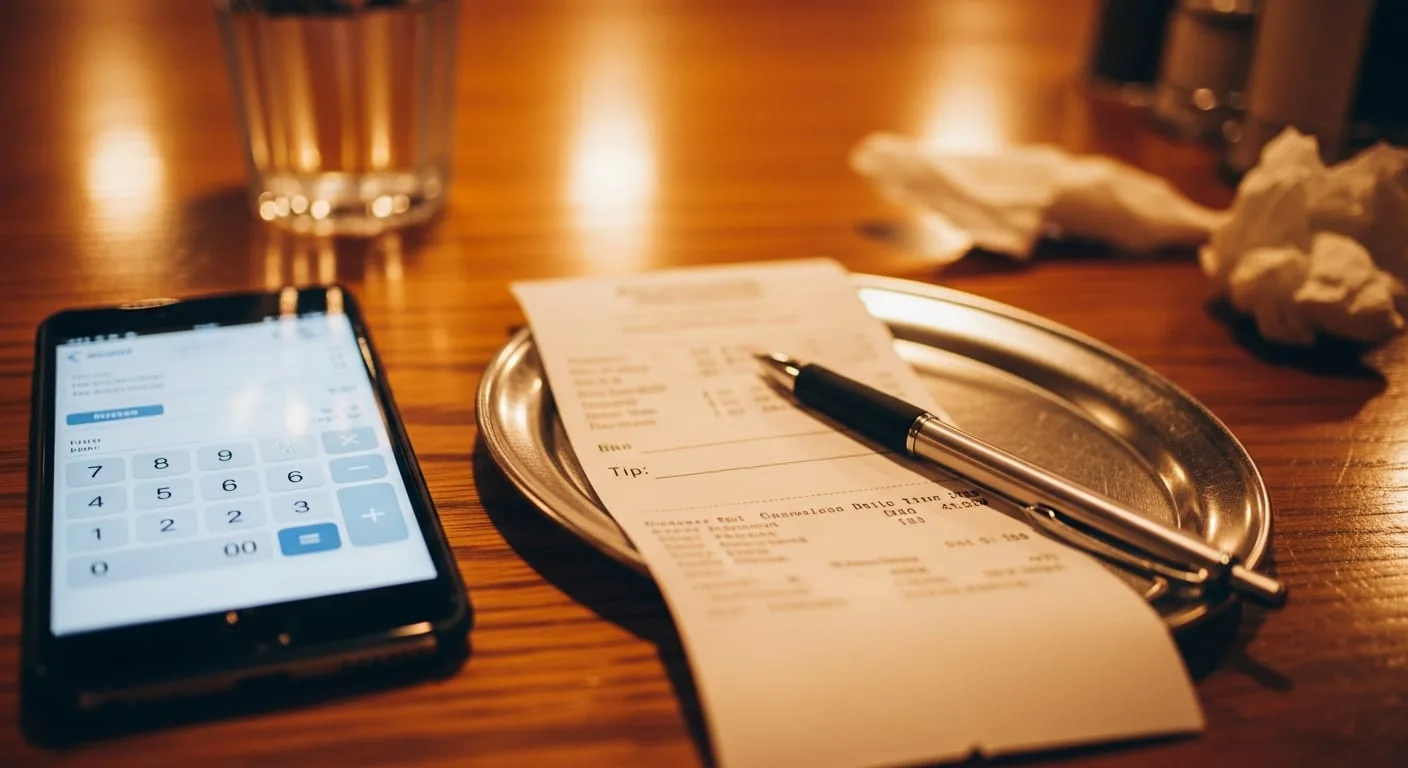
And then there's the calculation panic. You're already converting rupees to dollars in your head, the bill arrives, and suddenly you need to compute 18% of $67.40 while your family stares at you. I've seen my dad pull out a calculator at a restaurant in San Francisco. The server 100% noticed. Your phone calculator works fine, by the way — there is zero shame in using it.
Tipping Guide for Indian Travelers in the USA: Yes, It's Basically Mandatory
I'm starting with America because this is where Indians mess up the most, and the consequences are the worst. Tipping in the US is not optional. I repeat — not optional. It's a social contract baked into the economy. Servers, bartenders, valets, hotel staff — they all depend on tips to survive. If you're planning a USA trip from India, budget an extra 20% on top of every meal. Seriously.
Restaurants and Cafes
- Sit-down restaurants — 18-20% of the pre-tax bill. Under 15% means you hated the service. 25% means it was outstanding. I usually do a flat 20% because the math is easy — just move the decimal and double it.
- Fast food / counter service — $1-2 if there's a tip jar, but truly optional here. Those iPad tip screens that flip around asking for 20%? You can hit "no tip" without guilt. Everyone does.
- Buffet restaurants — 10-15%. Yes, even at a buffet. Someone is clearing your plates and refilling drinks.
- Coffee shops — $1 per drink, or round up. Not mandatory but appreciated.
Hotels and Transport
- Housekeeping at hotels — $2-5 per night, left on the nightstand with a note saying "thank you." Most Indians skip this entirely. Don't.
- Porter/bellhop at your hotel — $2-3 per bag. If you wave them off and carry your own bags, no tip needed.
- Uber/Lyft — 15-20% through the app. Yes, really. I used to think the fare covered everything. It doesn't.
- Taxi drivers — 15-20% of the metered fare
- Valet parking — $3-5 when they return your car
Other Services Americans Expect Tips For
This is the part that shocks most Indians. Your barber/hairstylist expects 15-20%. Spa treatments get 15-20% too. Tour guides expect ($5-10 per person). Food delivery drivers expect $3-5 or 15-20%. Airport shuttle drivers get $2-3. My cousin who lives in New Jersey says the average American family spends $3,000-4,000 per year just on tips. That's nearly ₹3.3 lakh. Just on tips. Let that sink in.
Tipping in Europe: Every Country Has Different Rules (And Yes, It's Confusing)
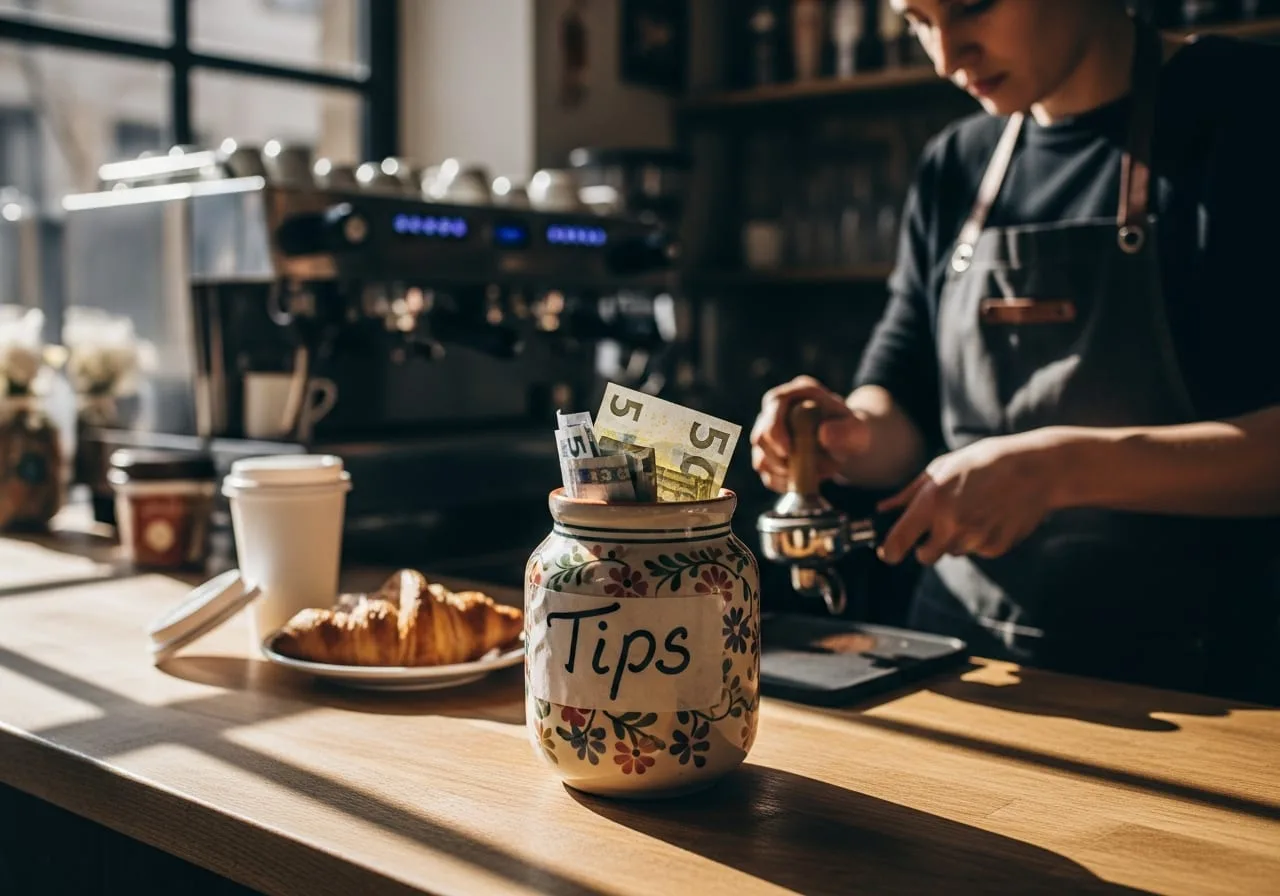
Europe is the continent where Indians either over-tip or under-tip, depending on the country. There's no single "European" rule, which makes it messy. But here's the general principle: in most of Western Europe, service charge is already included in the bill. You're paying for it whether you see it itemized or not. So the tip is just a small gesture on top. If you're doing a first Europe trip from India, save yourself some confusion and bookmark this section.
France
"Service compris" means service is already in the price. Legally, every restaurant in France includes a 15% service charge in menu prices. So that €18 steak? €2.70 of that is already going to the server. You don't need to add anything. But rounding up is a nice gesture — if the bill is €37, leave €40. That's it. Leave €45 and you'll look like a confused tourist (which, fair, you might be). Don't tip at cafes for just a coffee. Nobody does.
Germany
Round up to the nearest Euro or add 5-10%. The key German detail: you tell the server the total when paying, not leave money on the table. So if the bill is €28.50, you say "dreißig" (thirty) and hand over the cash. Walking away from the table with cash sitting there is weird in Germany. Also, always carry cash for tipping — many German restaurants are still cash-heavy, and card tipping options are unreliable.
Italy
Look for "coperto" or "servizio" on the bill. Coperto is a cover charge (€1-3 per person) that's standard and NOT a tip — it covers bread and table setting. Servizio is the service charge (10-15%), and if it's there, you're done. If neither appears, leave 5-10% or round up. Italy is one of the most relaxed countries for tipping. Leave nothing and nobody bats an eye. Leave something small and you get a genuine "grazie."
Spain
Incredibly relaxed. Drop your coins on the plate — literally just the change from paying. At a sit-down restaurant, rounding up by €1-2 is plenty. Leaving 10% would mark you as American (or confused). In tapas bars, nothing expected. Spain is gloriously simple.
UK
Check if "service charge" is added to the bill — many restaurants add 12.5% automatically, especially in London. If it's already there, you're done. Don't double-tip. If there's no service charge, leave 10-12.5%. At pubs, you never tip for drinks at the bar. Never. You can offer to "buy one for yourself" to the bartender, but that's different and very British. Black cabs: round up to the nearest pound. Uber: tip through the app if you want, but it's not expected.
Scandinavia (Norway, Sweden, Denmark, Finland)
Don't tip. Honestly, just don't. Service workers in Scandinavia earn excellent wages — a Swedish waiter makes about SEK 27,000/month (roughly ₹2.2 lakh). They don't need or expect tips. Rounding up by a few kronor is fine if you had excellent service, but leaving 15-20% like you would in America would genuinely confuse people. I left 200 NOK extra at a restaurant in Bergen once, and the waiter came back to ask if I'd made a mistake.
Tipping in Japan: The Country Where Tips Are an Insult
This deserves its own section because the consequences of tipping in Japan are uniquely awkward. According to Japan's official tourism guide, tipping is not part of Japanese culture and can actually cause offence. The philosophy is simple — excellent service is the baseline, not something extra you're paying for. Your server takes professional pride in doing their job well. Leaving money implies they need a bribe to provide good service.
I've heard stories from other Indian friends who've traveled to Japan and tried to tip at sushi restaurants. The reactions range from politely returning the money to outright confusion — servers staring at the coins like you left trash on the table. One friend told me his ryokan host chased him to the lobby to return a ¥1,000 tip he'd left on the futon.
The only exception? High-end ryokans and traditional Japanese inns sometimes accept "kokorozashi" — a monetary gift in an envelope. But you hand it at check-in, in a proper envelope, with a slight bow. It's a ritual, not a casual afterthought. Skip this unless you really know what you're doing. The safe default in Japan is: tip absolutely nothing, anywhere, ever.
Tipping in Southeast Asia and the Middle East for Indian Travelers
Thailand
Thailand is a "round up and add a bit" country. At restaurants, if the bill is 487 baht, leave 500 baht. At nicer restaurants, 10% is appreciated but not mandatory. The one place you should always tip is after a Thai massage — 50-100 baht (₹120-240) depending on the duration. For street food? Never. Handing a tip to a pad thai vendor would be bizarre. Taxi drivers: round up. Tuk-tuk drivers: already overcharging you, so no additional tip needed (half kidding).
Bali / Indonesia
Check the bill for "service charge" — many Bali restaurants add 10-15% plus 11% tax (written as "++"). If you see that, no additional tip needed. At local warungs, round up by 5,000-10,000 IDR (₹27-55). For drivers and guides hired for the day, 50,000-100,000 IDR (₹275-550) is standard. Spa therapists: 20,000-50,000 IDR. Bali is one of the easier places for tipping — small amounts go a long way, and Balinese people are genuinely grateful without being expectant.
UAE (Dubai, Abu Dhabi)
Most restaurants add a 10% service charge to the bill. Check before tipping on top. If there's no service charge, 10-15% is standard at restaurants. Hotel porters: AED 5-10 per bag. Taxi drivers: round up to the nearest AED 5. Here's an Indian-specific tip (no pun intended) — in the older parts of Dubai like Deira and Bur Dubai, where shop owners and restaurant staff are often from South Asia, the tipping norms feel more like home. A small gesture is appreciated, nothing is expected.
Singapore and Malaysia
Singapore: most restaurants add a 10% service charge plus 9% GST. If you see "++", you're done. No additional tip expected. At hawker centres? Absolutely not — you'd get laughed at. Malaysia is similar. Service charge is common at mid-range and upscale restaurants. At mamak stalls and local eateries, nobody tips and nobody expects it. Both countries make this easy for Indians because the culture is close enough to ours that the "keep the change" approach works fine.
Tipping in Australia, South America, and Other Destinations
Australia and New Zealand
Not expected. Australian service workers earn AUD $23-27/hour minimum (₹1,280-1,500/hour!), so tipping isn't a wage supplement. That said, rounding up at a nice restaurant or leaving 10% for exceptional service is becoming more common, especially in Sydney and Melbourne. But the pressure is zero. You can walk out after paying exactly what's on the bill and nobody will think twice. After the stress of American tipping, Australia feels like a vacation from the vacation. Any tipping guide abroad Indian travelers bookmark should highlight this relief.
South America
Rules vary. In Peru, 10% is standard — some places add it as "servicio," some don't. Check the bill. In Colombia, a 10% "propina" is suggested on the bill and the waiter will ask "Desea incluir el servicio?" (Do you want to include service?). You can say no, but most people say yes. In Argentina, 10% is customary. Brazil is similar — a 10% "serviço" is usually already on the bill. Across South America, the rule of thumb is: look at the bill first, then add 10% only if nothing's already included.
South Korea
Similar to Japan — tipping is not customary and can create awkward situations. Service charge is built into restaurant prices. At high-end hotels, a 10% service charge is added automatically. Taxi drivers don't expect tips — just pay the meter. The only place tipping is normal is in Western-style bars in Itaewon where the clientele is international. Otherwise, save your won.
Quick Tipping Guide Abroad Indian Travelers Can Screenshot
| Country | Restaurant | Taxi | Hotel Porter | Key Rule |
|---|---|---|---|---|
| USA | 18-20% | 15-20% | $2-5/bag | Always tip. Not optional. |
| UK | 10-12.5% | Round up | £1-2/bag | Check if service charge is added |
| France | Round up | Round up | €1-2/bag | Service already included in prices |
| Germany | 5-10% | Round up | €1-2/bag | Tell server the total, don't leave on table |
| Italy | Round up / 5% | Round up | €1-2/bag | Check for coperto/servizio on bill |
| Spain | Small change only | Round up | €1/bag | Super relaxed. Coins are plenty. |
| Japan | NEVER | NEVER | NEVER | Tipping is offensive. Skip completely. |
| Thailand | Round up / 10% | Round up | 20-50 THB | Always tip massage therapists |
| Bali | Check for ++ | Round up | 10-20K IDR | Check bill for service charge first |
| UAE | 10-15% | Round up | AED 5-10 | Check for service charge on bill |
| Australia | Optional 10% | Not expected | Not expected | High wages = no pressure to tip |
| Singapore | Included (++) | Not expected | Not expected | Service charge is standard everywhere |
| South Korea | Not expected | Not expected | Included | Similar to Japan — don't tip |
Pro Tips That'll Save You from Embarrassment
The best tipping guide abroad Indian travelers can follow starts with this: carry small denominations of local currency everywhere. Sounds obvious, but I can't tell you how many times I've had a tip-worthy moment and only had a ₹5,000 equivalent bill. You're not going to tip $50 on a $30 meal. ATMs give you large notes. Break them at a convenience store first thing. I make it a habit to get change on day one of every trip.
When in doubt, ask the hotel concierge. Seriously. "What's the normal tip at restaurants here?" is a perfectly acceptable question. They deal with international guests daily and won't judge you. I asked this at a hotel in Lisbon and the concierge laughed and said "Nothing, this is Portugal." Saved me from over-tipping all week.
Watch what locals do. At a restaurant in Bangkok, I noticed the Thai couple next to me left about 20 baht on a 350 baht bill. That told me more than any blog post. When you're genuinely navigating language barriers abroad, observing local behaviour is your best research tool.
No tipping guide abroad Indian travelers should ignore this one: don't double-tip. It's the most common Indian tourist mistake in my experience. The bill has a 12.5% service charge, you don't notice it, and you add another 15% on top. That's a 27.5% tip. The restaurant loves you, your wallet doesn't. Always check the bill line by line. The words to look for: "service," "servicio," "Trinkgeld," "pourboire," "serviço," or just the "++ " symbol.
Card tipping is fine in most developed countries, but cash tips are universally preferred. In many places — especially Southeast Asia and South America — card tip systems either don't exist or the tip gets taxed before reaching the server. When possible, hand cash directly to the person who served you. It's also just a nicer human moment than tapping a screen.
Tipping at Indian Restaurants Abroad — The Weird Situation
Any honest tipping guide abroad Indian travelers read should cover this, because it catches people off guard. You're in Edison, New Jersey, eating at Dosa Hut, and the waiter is from Hyderabad. Do you tip like you're in India or like you're in America? Always tip like a local. That server lives in America, pays American rent, and depends on American tips. Leaving ₹100-equivalent because "it's Indian food and the waiter is Indian" is genuinely unfair to them. 18-20% applies regardless of cuisine or the nationality of the person serving you.
I've seen this happen at Dishoom in London, Babu Ji in Melbourne, and Bukhara in New York. Indian diners regularly under-tip at Indian restaurants abroad, and the staff notice. A friend who waited tables at an Indian restaurant in Toronto told me Indian customers were consistently their lowest tippers. That stung to hear, honestly. Let's not be that stereotype.
Frequently Asked Questions
Is tipping mandatory in the USA for Indian tourists?
Yes, practically mandatory. While not legally required, tipping 18-20% at sit-down restaurants is a strong social expectation in America. US servers earn as little as $2.13/hour in base pay and depend on tips for their income. Not tipping is considered extremely rude and will get you terrible service if you return.
Why is tipping considered rude in Japan?
Japanese culture views excellent service as a professional duty, not something requiring extra payment. Leaving a tip implies the server needs a financial incentive to do their job well, which is considered disrespectful. Staff may chase you down to return the money, as documented by Japan National Tourism Organization.
How do Indian travelers calculate tips quickly abroad?
The easiest method: move the decimal point one place left to get 10%, then double it for 20%. For a $67 bill: 10% = $6.70, doubled = $13.40 (roughly 20%). Using your phone calculator is completely normal and nobody judges you for it. Many restaurants also suggest tip amounts on the bill itself.
Do you tip at Indian restaurants when traveling abroad?
Always tip based on the country you are IN, not the cuisine you are eating. An Indian restaurant in London, New York, or Sydney follows local tipping norms. The staff live locally and depend on local tip customs for their income. Tip 18-20% in the USA, 10-12.5% in the UK, regardless of the restaurant's cuisine.
Which countries should Indian travelers never tip in?
Japan, South Korea, and China are the main countries where tipping is not customary and may cause confusion or offence. In Scandinavia (Norway, Sweden, Denmark, Finland), tipping is unnecessary due to high service wages. Singapore and Australia also don't have strong tipping expectations, though small gestures for exceptional service are accepted.