
Cebu & Bohol from India: Whale Sharks, Chocolate Hills & Waterfalls That Wrecked My Itinerary
In this guide (12)
- Getting to Cebu and Bohol from India: Flights, Routes & Real Costs
- Cebu Adventures: The Stuff That'll Make Your Instagram Followers Actually Jealous
- Making the Jump: Cebu to Bohol Ferry Guide
- Bohol: Where Nature Got Weird in the Best Way
- Where to Stay in Cebu and Bohol: Budget to Mid-Range Picks
- Cebu Bohol from India Food Guide: Lechon Is Life
- Cebu Bohol from India Travel Guide: 5-Day Itinerary That Actually Works
- Cebu Bohol from India Budget: What 5 Days Actually Cost
- Getting Around on Your Cebu Bohol from India Trip
- Best Time to Visit Cebu Bohol from India
- Cebu Bohol from India: Practical Tips I Wish Someone Told Me
- Frequently Asked Questions
I was supposed to spend three days in Cebu. I stayed for six. And then I missed my ferry to Bohol because I was eating lechon at a roadside stall in Carcar — a whole roast pig that cost me ₹350 and ruined every other pork dish for the rest of my life. That's what Cebu does to your plans. If you're looking at a cebu bohol from india travel guide, here's the honest version — the one that tells you your meticulously planned 5-day itinerary will fall apart, and you'll love every second of it.
The Philippines became visa-free for Indians in June 2025, and the direct Air India flights from Delhi to Manila changed everything. Suddenly, a country that felt complicated to reach was just 6 hours and 50 minutes away. But here's what nobody preparing their Philippines trip realizes — Manila is just the airport. The real magic is in the Visayas region, specifically Cebu and Bohol, two islands sitting next to each other in the central Philippines like an adventure playground someone forgot to put a price tag on.
I spent 8 days between these two islands in January 2026, and what I experienced — swimming next to whale sharks the size of school buses, jumping off cliffs into turquoise canyon pools, staring at 1,268 hills that looked like a giant's chocolate collection, and holding eye contact with the world's tiniest primate — genuinely changed how I think about budget travel from India. Let me break it down from getting there to getting back, with actual prices and the stuff I wish someone had told me before I went.
Getting to Cebu and Bohol from India: Flights, Routes & Real Costs
Your first decision when planning cebu bohol from india is simple: fly into Cebu directly or route through Manila? I actually recommend flying into Manila first if you're coming from India, because the Philippines trip cost from India drops significantly when you book the international and domestic legs separately.
International leg: Air India flies Delhi to Manila 5 times a week. I paid ₹22,400 for a return ticket booked 6 weeks in advance. If you're flying from Mumbai or Bangalore, you'll connect through Delhi or route via Singapore/Kuala Lumpur — expect ₹25,000-38,000 return depending on when you book.
Manila to Cebu: Cebu Pacific and AirAsia Philippines run multiple daily flights. The flight is 1 hour 25 minutes. I paid ₹2,200 one-way with 20kg baggage on Cebu Pacific. Pro tip — book Cebu Pacific's PISO sale tickets if your dates are flexible. They literally sell ₹1 base fare tickets (plus taxes, so about ₹800 total) every few months.
There's also a direct option that not many Indians know about: Cebu Pacific flies Singapore to Cebu three times a week. If you're in South India, a Singapore stopover route can actually work out cheaper and more interesting. Check the Philippines island guide for Boracay, Palawan, Cebu for routing strategies between islands.
Visa Situation for Indians (2026)
Good news for anyone planning cebu bohol from india — Indians get 14-day visa-free entry into the Philippines. No advance application, no embassy visit, nothing. You just need a valid passport (6+ months), return ticket, and completed eTravel registration (free, takes 10 minutes online). I filled mine out at the Delhi airport Starbucks before boarding. Immigration at Manila took 12 minutes — the officer asked where I was staying, I showed my Cebu hotel booking, and that was it.
One important thing: the 14-day visa is non-extendable for Indians. Count your days carefully. I arrived on January 4th and had to fly out by January 17th midnight. Plan accordingly.
Cebu Adventures: The Stuff That'll Make Your Instagram Followers Actually Jealous
Once you arrive for your cebu bohol from india adventure, you'll find Cebu is essentially two things mashed together — a proper city (Cebu City, Philippines' second largest) and a wild adventure coastline stretching south. Most Indian travelers will spend one night in Cebu City for the heritage stuff, then head south to Oslob, Moalboal, and Kawasan Falls. That's exactly what I did, and it was the right call.
Oslob Whale Shark Watching — The ₹2,800 Experience That Changes You
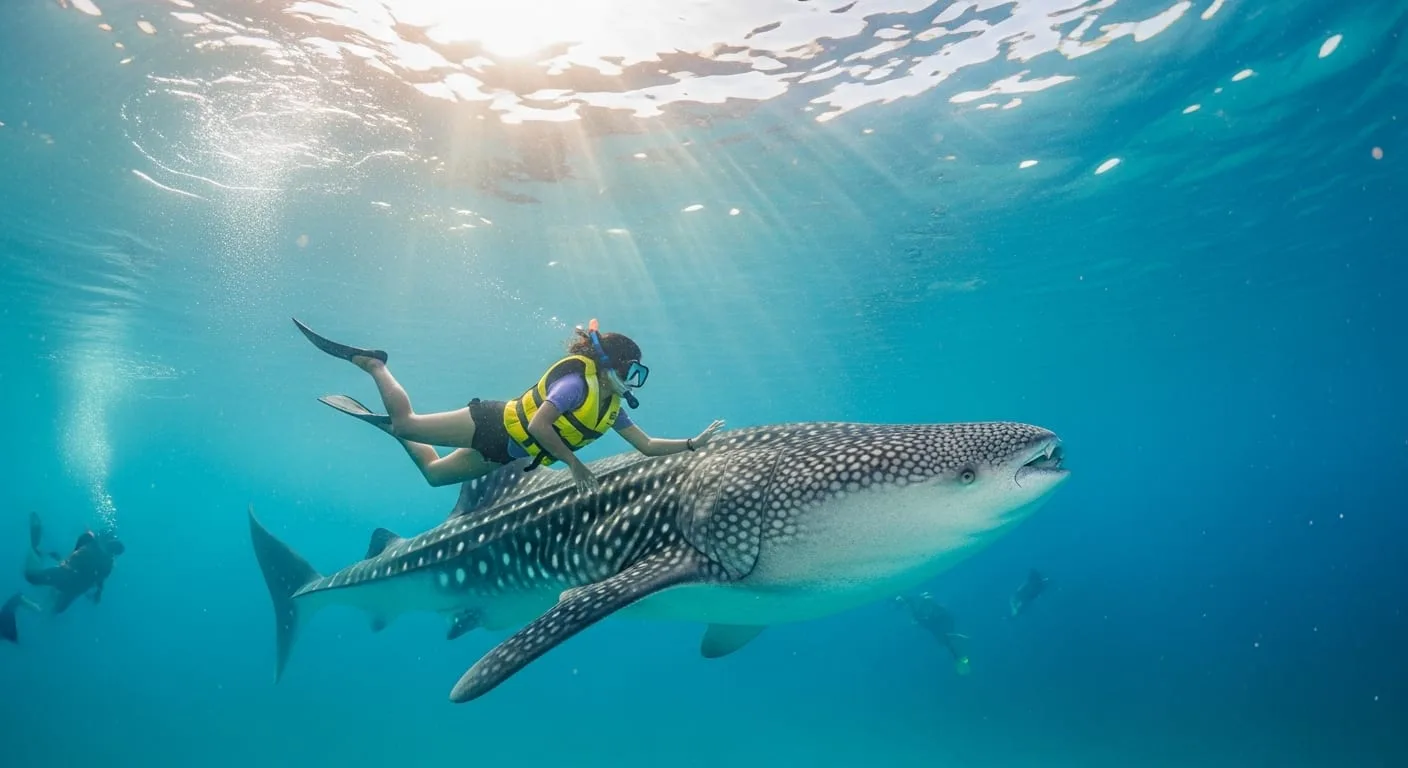
I need to address the elephant in the room. Well, the whale shark in the room. Oslob's whale shark encounter is controversial. The sharks are fed by local fishermen to keep them near the shore, which means they're not behaving naturally. Marine biologists have raised valid concerns. I wrestled with this for weeks before going.
Here's my honest take: I went, and it was the single most overwhelming animal encounter of my life. Swimming next to a 30-foot whale shark at 6 AM, watching its mouth open wide enough to fit a motorcycle — my brain genuinely could not process the scale. The water was 15 feet deep, impossibly clear, and there were 6 sharks that morning. I cried in my snorkel mask. I'm not embarrassed about it.
But I also think you should make your own informed decision. The whale shark feeding practice keeps these migratory animals in one spot year-round, which isn't natural. If that bothers you, skip Oslob and do the Donsol whale shark encounter instead (Sorsogon province, further south — wild encounters, seasonal Nov-June, less predictable but 100% ethical). I'm glad I went to Oslob, but I wouldn't go back a second time.
Practical details: Get there by 5:30 AM — the interaction runs 6-11 AM. I hired a habal-habal (motorcycle) from my hostel in Oslob town for ₹200. Entry plus 30-minute swim session costs ₹2,800 (1,500 PHP). They provide snorkel and life vest. No sunscreen allowed — it harms the sharks. Waterproof phone pouch is essential, or rent their underwater camera for ₹500.
Kawasan Falls Canyoneering — Hands Down the Best Adventure Activity in the Philippines
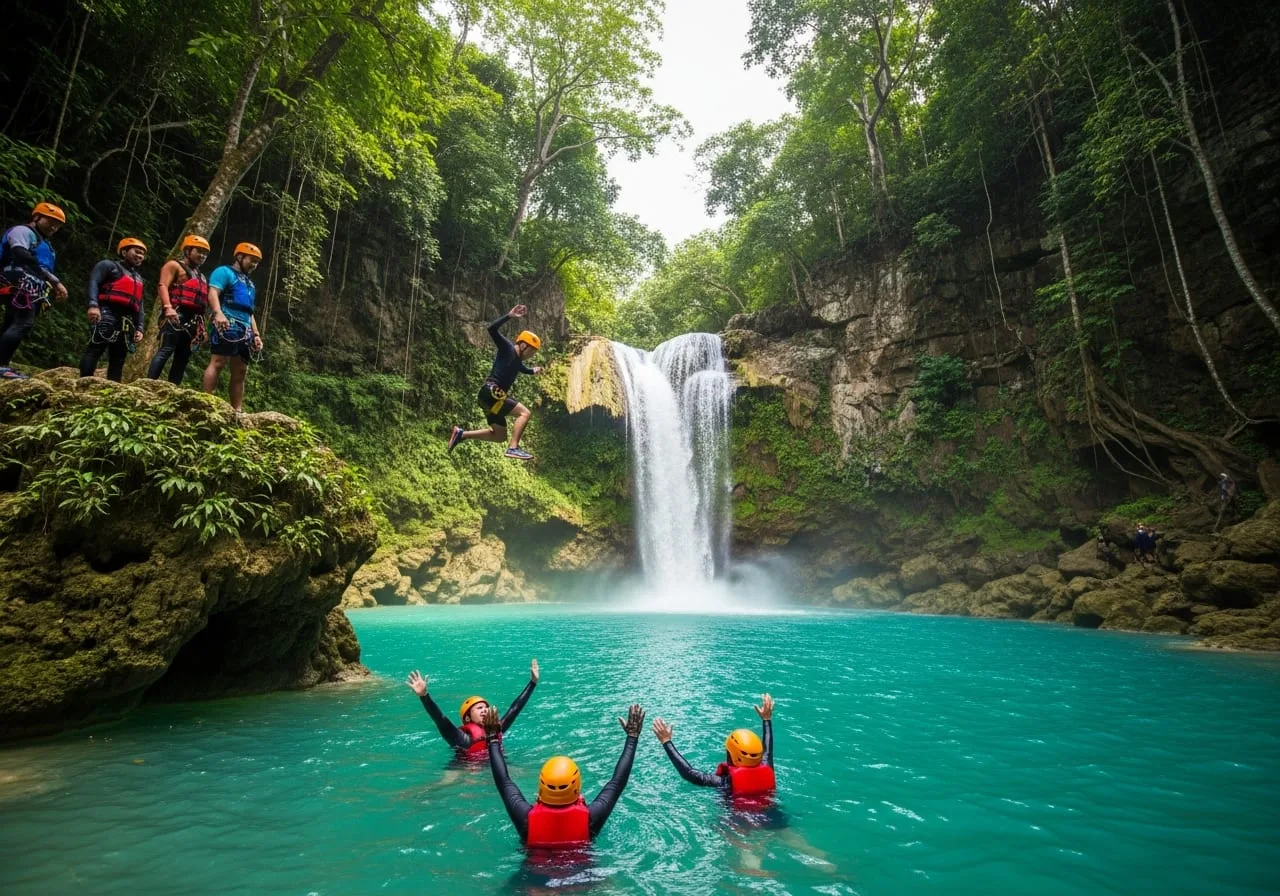
If Oslob was emotional, Kawasan Falls canyoneering was pure adrenaline. This 4-hour trek through Badian's canyons is, and I will die on this hill, the best adventure activity in all of Southeast Asia. Better than Bali's white water rafting. Better than Thailand's zip-lining. Fight me.
Here's what happens: you start upstream and work your way down through a series of canyons. Your guide has you jumping off cliff edges into natural pools — 15 feet, 25 feet, at one point 40 feet into water so blue it looks Photoshopped. You swim through narrow limestone passages, rappel down a waterfall face while water pounds your helmet, and float on your back through calm stretches staring up at the jungle canopy. The grand finale is Kawasan Falls itself — a massive three-tier waterfall dumping into a pool that's the exact color of Blue Curacao.
Cost: ₹2,200-3,000 (1,200-1,600 PHP) through a local tour operator. This includes guide, helmet, life vest, and someone following you with a GoPro to record your terrified screaming. I booked through my hostel in Moalboal the night before. Don't bother with Manila-based tour agencies charging double.
What to know: You need basic swimming ability. The jumps are technically "optional" but your guide will lovingly peer-pressure you. I skipped the 40-foot one (I have limits, yaar) and felt zero shame. Wear water shoes — not flip-flops, not bare feet. The rocks are sharp. I saw two people slip and cut their feet in the first hour.
Moalboal Sardine Run — The Free Thing That's Better Than the Paid Things
Moalboal is a sleepy beach town where backpackers come to dive, and the main attraction literally costs nothing. Walk to Panagsama Beach, wade in waist-deep, put on a snorkel mask, and swim about 20 meters from shore. What you'll see is millions — genuinely millions — of sardines forming a swirling tornado underwater. They move as one organism, shifting and pulsating like a living silver cloud. It's maybe 10 feet below you. Completely free. Available year-round.
I went back three times in two days because I couldn't believe it was real. The sardine run is also where you'll spot sea turtles — I counted four in a single 40-minute snorkel session. They were just... resting on the coral. Unbothered. If you want even better diving, Pescador Island is a ₹500 boat ride away and has one of the best wall dives in the Philippines. Our scuba diving certification guide for Indians covers the cost of getting certified here versus Bali or Thailand.
Cebu City Heritage Walk (Half-Day Is Enough)
Look, I'll be honest — Cebu City itself isn't particularly beautiful. It's loud, traffic is horrible (makes Bangalore's Silk Board look organized), and the air quality isn't great. But there's a concentrated colonial heritage zone worth half a day.
Magellan's Cross is where Ferdinand Magellan planted a wooden cross in 1521 when he arrived in Cebu — basically the spot where the Philippines' 333-year Spanish colonial period kicked off. Right next door is Basilica del Santo Nino, the oldest Catholic church in the Philippines. Fort San Pedro is a small triangular Spanish fort (₹100 entry) that takes 30 minutes to walk through. And Carbon Market is Cebu's chaotic main market where you can buy mangoes, dried fish, and knock-off everything.
Total time: 3-4 hours. Total cost: under ₹500. Do it on your first afternoon before heading south the next morning.
Making the Jump: Cebu to Bohol Ferry Guide
Bohol is a 2-hour ferry ride from Cebu City. Two companies run the route: OceanJet and Lite Ferries. OceanJet is faster (1 hour 50 minutes), more comfortable, and costs ₹400-800 (open air vs. AC tourist class). Lite Ferries is cheaper (₹300) but slower (2.5 hours) and less reliable.
I took OceanJet both ways and it was painless. The ferry terminal is at Pier 1 in Cebu City — arrive 45 minutes before departure. Ferries run roughly every 2 hours from 6 AM to 6 PM. You arrive at Tagbilaran Port in Bohol. Book online the night before through OceanJet's website, especially during December-May peak season. I've heard stories of walk-up passengers getting turned away on busy mornings.
From Tagbilaran, you'll need transport to wherever you're staying. Panglao Island (connected by bridge) is 30 minutes by tricycle (₹200) or Grab if the app works — it's spotty outside Cebu City.
Bohol: Where Nature Got Weird in the Best Way
Bohol is the calmer, weirder sibling to Cebu's adventure-bro personality. The pace drops noticeably the moment you step off the ferry. The roads are quieter, the beaches are less crowded, and the main attractions are geological oddities and absurdly cute animals. I spent 3 days here and genuinely didn't want to leave.
Chocolate Hills — 1,268 Reasons Your Geography Teacher Lied to You
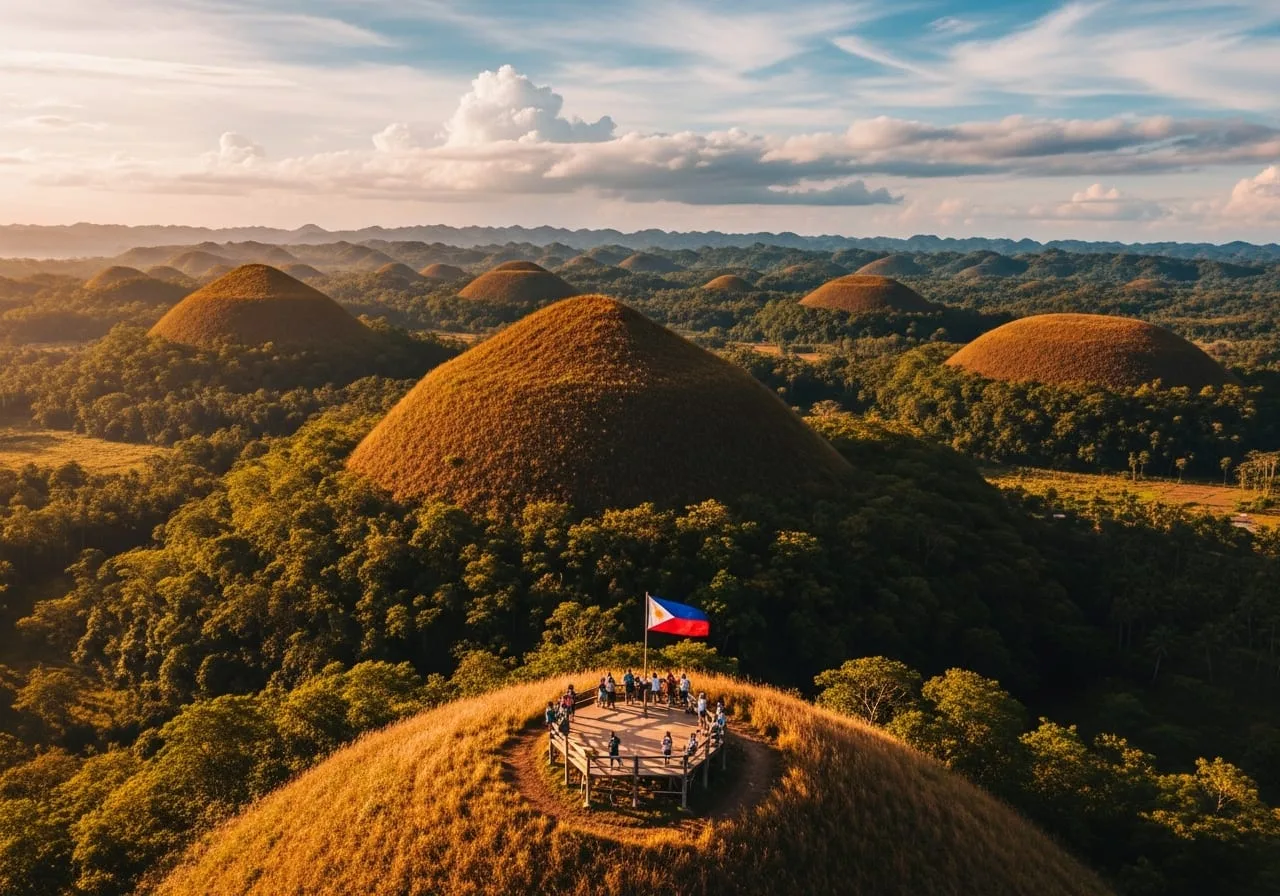
Nothing prepares you for the Chocolate Hills. You've seen the photos. You think you get it. You don't. Standing on the viewing deck at the Chocolate Hills Complex and seeing 1,268 perfectly symmetrical cone-shaped hills stretching to every horizon — your brain breaks a little. How are they so uniform? How did nature do this? Geologists still argue about it (coral deposits uplifted by tectonic activity is the leading theory, but nobody's 100% sure).
During dry season (February-June), the grass covering each hill turns brown — hence "chocolate" hills. I went in January and they were still greenish-brown, transitioning. April-May is when they look most chocolate-y. The viewing deck has 214 steps — manageable but sweaty. Entry is ₹100 (50 PHP).
The newer Chocolate Hills Adventure Park (CHAP) nearby has a zip-line across the hills (₹600) and an ATV trail through them (₹800 for 30 minutes). I did the ATV and it was genuinely fun — bouncing through muddy trails with the hills towering on either side. Skip the zip-line though — it's short and overpriced for what it is.
Philippine Tarsier Sanctuary — Meeting the World's Tiniest Primate
The tarsier is objectively the most ridiculous-looking animal alive. It's palm-sized. Its eyes are each larger than its brain. It can rotate its head nearly 360 degrees like an owl. And it looks permanently startled, like it just received an unexpected electricity bill. I love it.
There are two tarsier viewing spots in Bohol — the Philippine Tarsier Sanctuary in Corella (₹200 entry) and various roadside "tarsier attractions" that exploit the animals for selfies. Go to the sanctuary. Only the sanctuary. The roadside ones keep tarsiers in cages under bright light, which is genuinely cruel for a nocturnal animal that stresses so easily it can literally die from it.
At the sanctuary, you walk along a shaded forest path with a guide who whispers. They know exactly which trees the tarsiers are clinging to — I saw four in about 20 minutes. No touching, no flash, keep your voice down. One tarsier was about 3 feet from my face, gripping a bamboo stalk, and its enormous eyes slowly rotated to look at me. I held my breath. It blinked once. Most alien eye contact of my life.
Loboc River Cruise — Touristy but Honestly? Fun
The Loboc River floating lunch cruise is the most touristy thing on Bohol. You board a flat-bottomed boat, eat a mediocre buffet (₹800-1,200 per person), and cruise down a jungle-lined river while a Filipino band plays "My Way" by Frank Sinatra. Every travel snob tells you to skip it.
I'm telling you to go anyway. The river itself is gorgeous — emerald green, palm trees drooping over the water, kids jumping off bridges and waving at every passing boat. The buffet is mid, sure, but the lechon is decent and the mango shake is cold. Sometimes you don't need an authentic off-the-beaten-path experience. Sometimes you need a cold drink on a boat while someone serenades you badly. It's okay to enjoy kitschy things.
Panglao Island Beaches: Bohol's Boracay Without the Crowds
Panglao Island is connected to Bohol by two bridges and has the best beaches in the region. Alona Beach is the main strip — restaurants, dive shops, budget resorts — basically Bohol's version of Goa's Baga Beach. It's nice enough. The sand is white, the water is calm, and there are beach bars where a San Miguel beer costs ₹80.
But the real find is Dumaluan Beach, about 10 minutes east by tricycle (₹100). Wider sand, fewer people, gentler waves. I spent an entire afternoon here reading a book and doing absolutely nothing, and it was one of the best days of the trip. Entry is ₹50.
Hinagdanan Cave is also on Panglao — an underground cave with a natural swimming pool lit by sunlight streaming through holes in the ceiling. Entry ₹100, swimming in the pool is refreshing after the humidity outside. Takes about 45 minutes total.

Where to Stay in Cebu and Bohol: Budget to Mid-Range Picks
Accommodation in the Philippines is absurdly cheap compared to Bali or Thailand. I'm talking proper rooms with AC, hot water, and WiFi for ₹800-1,500 a night. Here's where I'd base yourself:
- Cebu City (1 night) — Stay near Fuente Osmena Circle or IT Park. I paid ₹1,100/night at a clean hostel with a rooftop bar. Grab works well here for getting around.
- Moalboal (2-3 nights) — This is your base for Kawasan Falls, sardine run, and turtle snorkeling. Beachfront hostels on Panagsama Beach start at ₹800. I stayed at a guesthouse for ₹1,400 with a balcony overlooking the water.
- Oslob (skip staying) — Do the whale sharks as a day trip from Moalboal or Cebu City. Oslob itself has nothing else going on. The 3-hour bus from Moalboal to Oslob costs ₹180.
- Panglao, Bohol (2-3 nights) — Alona Beach area for budget (₹1,200-2,500), Dumaluan Beach area for quieter mid-range (₹2,500-5,000). This is your base for Chocolate Hills, tarsier sanctuary, and river cruise day trips.
Book through Agoda or Booking.com — prices are lower than walk-in rates, and you can filter for properties with free cancellation. Filipino homestays on Airbnb are also excellent and come with homemade breakfast.
Cebu Bohol from India Food Guide: Lechon Is Life
Cebu is the lechon capital of the Philippines. Full stop. The whole roast pig here has skin so crispy it shatters like glass, and the meat underneath stays impossibly juicy because they stuff the cavity with lemongrass and star anise. The most famous is Zubuchon (Anthony Bourdain called it "the best pig ever"), but honestly, the roadside stalls in Carcar town (1 hour south of Cebu City) are just as good at half the price. I paid ₹300 for a plate that would've been ₹600 at Zubuchon.
Other food highlights:
- Puso (hanging rice) — Rice steamed in woven coconut leaves. Served with everything. ₹15-20 each. Buy three.
- Dried mangoes — Cebu's famous export. The 7D brand is the best. Buy bags of it from souvenir shops (₹150 per pack). Better than anything you'll find on Amazon back home.
- Sinigang — Sour tamarind soup with pork or fish. Comforting like dal but with more acid. ₹150-250 at local restaurants.
- Halo-halo — Shaved ice dessert with beans, jelly, leche flan, ube ice cream, and condensed milk. Sounds chaotic, tastes incredible. ₹80-120. Get one daily.
Vegetarian options: I'll be straight with you — the Philippines is tough for pure vegetarians. Meat and fish are in everything. But tourist areas in Cebu and Bohol have restaurants with dedicated veg sections (garlic rice, vegetable stir-fry, spring rolls, mango salad). Tell your server "walang karne, walang isda" (no meat, no fish). In Moalboal, the French and Italian restaurants have solid pasta and pizza options. You won't starve, but you won't feast either.
Cebu Bohol from India Travel Guide: 5-Day Itinerary That Actually Works
Based on what I did wrong (too much time in Cebu City) and what I did right (enough time in Moalboal), here's the cebu bohol from india itinerary I'd follow if I did this trip again:
Day 1: Arrive Cebu, Heritage Walk. Land at Mactan-Cebu Airport. Grab to Cebu City (₹300, 45 minutes). Dump bags at hotel. Hit Magellan's Cross, Basilica, Fort San Pedro, Carbon Market. Lechon dinner at a local carinderia. Sleep in Cebu City.
Day 2: Cebu City to Moalboal. Morning bus from South Bus Terminal (₹180, 3.5 hours). Check into beachfront guesthouse. Afternoon: sardine run snorkeling and turtle watching at Panagsama Beach. Sunset beers on the sand.
Day 3: Kawasan Falls Canyoneering + Oslob Whale Sharks. 4 AM wake-up. Habal-habal to Oslob (₹400, 1.5 hours) for 6 AM whale shark slot. Back to Badian by 10 AM for canyoneering (4 hours). Collapse at hotel by 4 PM. You will be destroyed. Eat carbs.
Day 4: Ferry to Bohol, Panglao Beach. Morning bus Moalboal to Cebu City (₹180). OceanJet ferry to Tagbilaran (₹600, 2 hours). Tricycle to Panglao (₹200). Afternoon on Dumaluan Beach. Loboc River cruise if energy permits (evening boats available).
Day 5: Chocolate Hills + Tarsier Day Trip, Return. Hire a motorbike or join a countryside tour (₹1,000-1,500). Hit Tarsier Sanctuary, Chocolate Hills, Man-Made Forest, Blood Compact Monument. Afternoon ferry back to Cebu or stay another night in Panglao. Fly out from Cebu the next morning.
Rather skip the 4 AM habal-habal rides and ferry bookings? Our Cebu and Bohol canyoneering and countryside itinerary covers most of these highlights over six days, with OceanJet ferry tickets, guided Kawasan Falls canyoneering and the Bohol countryside tour arranged. Compare routes on our Philippines holiday options page.
Cebu Bohol from India Budget: What 5 Days Actually Cost
| Expense | Budget | Mid-Range | Comfortable |
|---|---|---|---|
| International flights (Delhi-Manila return) | ₹22,000 | ₹28,000 | ₹38,000 |
| Manila-Cebu domestic flight | ₹2,200 | ₹3,500 | ₹5,000 |
| Cebu-Bohol ferry (return) | ₹600 | ₹1,200 | ₹1,600 |
| Accommodation (5 nights) | ₹4,000 | ₹8,500 | ₹17,500 |
| Whale shark encounter | ₹2,800 | ₹2,800 | ₹2,800 |
| Kawasan canyoneering | ₹2,200 | ₹2,800 | ₹3,500 |
| Bohol countryside tour | ₹1,000 | ₹1,500 | ₹2,500 |
| Food (5 days) | ₹3,000 | ₹5,500 | ₹10,000 |
| Local transport | ₹1,500 | ₹2,500 | ₹4,500 |
| Miscellaneous (entries, tips, snacks) | ₹1,200 | ₹2,000 | ₹3,500 |
| Total | ₹40,500 | ₹58,300 | ₹88,900 |
That cebu bohol from india budget tier is aggressive but doable — I met a solo backpacker from Pune doing it for under ₹35,000 by sleeping in dorm beds, eating at local carinderias, and hitchhiking on habal-habals. The mid-range column is what I actually spent. The comfortable tier gets you proper hotel rooms with pools, private tours, and restaurant meals with cocktails.
Getting Around on Your Cebu Bohol from India Trip
Cebu City: Grab (the Southeast Asian Uber) works great here. Jeepneys are the cheapest option (₹10-20 per ride) but chaotic to navigate without a local. MyBus runs a few fixed routes.
Outside Cebu City: Habal-habal motorcycles are your best friend. These are basically motorcycle taxis — you sit behind the driver, hold on, and pray for the best. ₹200-500 depending on distance. They go everywhere, including places too remote for cars. Bargain before you ride.
Bohol: Tricycles (motorcycle with a sidecar) are the main transport. ₹100-300 per trip. For the countryside tour (Chocolate Hills, tarsier, etc.), you can either hire a motorbike (₹400/day, international license technically required but rarely checked) or book a van tour through your hotel (₹1,000-1,500 per person, includes all stops). I did the van tour and it was efficient — hit 6 spots in one day with AC between stops.
Between Cebu and Bohol: OceanJet ferry, period. Don't bother with flights — the ferry is cheap, scenic, and drops you right in Tagbilaran town.
Best Time to Visit Cebu Bohol from India
Dry season runs January to May, and that's when you should go. March and April are peak — clearest water, brownest Chocolate Hills, least rain. But also most crowded and slightly more expensive.
I went in early January and had maybe 2 hours of rain across 8 days. December is transitional — mostly fine but with occasional showers. June through November is typhoon season, and while Cebu/Bohol are less exposed than Luzon (Manila's island), I wouldn't risk it. Typhoons in the Philippines aren't a gentle monsoon like Mumbai's rain — they're category-5 monsters that shut down everything. The adventure travel destinations guide covers seasonal timing for tropical destinations.
Water temperature is 27-29 degrees Celsius year-round. You don't need a wetsuit for snorkeling. A rashguard is enough.
Cebu Bohol from India: Practical Tips I Wish Someone Told Me
- Cash is king — ATMs exist in Cebu City and Tagbilaran, but Moalboal and Oslob have limited options. Withdraw enough cash in the city. Philippine pesos only — nobody takes INR or USD. BPI and BDO ATMs have the lowest fees (₹250 per withdrawal).
- SIM card — Buy a Globe or Smart SIM at the airport (₹300 for 30GB/30 days). Data speeds are decent in cities, garbage in rural Bohol. Download offline Google Maps before leaving Cebu City.
- Waterproof phone pouch — ₹500 investment that saved my phone during canyoneering and whale shark swimming. Buy one before you leave India. The ones sold at Oslob are overpriced and leak.
- Reef-safe sunscreen — Required for Oslob (they check) and just good practice. Banana Boat and Neutrogena make reef-safe versions available on Amazon India.
- Haggling — Expected for tricycles and habal-habals. Not expected in restaurants, shops, or official tours. Always agree on the price before getting on a motorcycle.
- Safety — Cebu and Bohol are very safe. I walked around Moalboal at midnight with zero concern. Petty theft exists (don't leave phones on restaurant tables) but violent crime toward tourists is extremely rare.
- Language — Filipinos speak excellent English. Genuinely excellent. Better than Thailand or Bali by a country mile. You will have zero communication problems. It's one of the most comfortable countries for Indian travelers who don't speak the local language.
Frequently Asked Questions
How much does a Cebu and Bohol trip cost from India?
A 5-day Cebu and Bohol trip from India costs ₹40,000-55,000 on a budget, including international flights from Delhi (₹22,000-28,000), domestic flight to Cebu (₹2,200-3,500), ferry to Bohol (₹600-1,200), accommodation, food, and activities like whale shark watching and Kawasan Falls canyoneering. Mid-range travelers should budget ₹55,000-90,000.
Is the Oslob whale shark experience in Cebu ethical?
The Oslob whale shark encounter is controversial because fishermen feed the sharks to keep them near shore, disrupting their natural migration patterns. Marine conservation groups like WWF have raised concerns. However, the practice supports the local economy and follows strict rules (no touching, no sunscreen, limited swimmers). Each visitor must decide based on their own values. For a fully wild alternative, try Donsol in Sorsogon province (seasonal November-June).
How many days do you need for Cebu and Bohol?
Five days is the minimum for a solid cebu bohol from india itinerary — 2-3 days for Cebu (whale sharks, canyoneering, sardine run) and 2 days for Bohol (Chocolate Hills, tarsier sanctuary, Panglao beaches). Seven days is ideal if you want to add diving in Moalboal, extra beach time in Panglao, or the Loboc River cruise without rushing.
Do Indians need a visa for the Philippines in 2026?
No. Indians can enter the Philippines visa-free for up to 14 days as of June 2025. You just need a valid passport with 6+ months validity, a return flight ticket, and a completed eTravel registration form (free online). No embassy visit or advance application required. Immigration at Manila airport takes 10-15 minutes.
What is the best time to visit Cebu and Bohol from India?
January to May is the best time — dry season with clear skies and calm seas ideal for snorkeling, diving, and island hopping. March-April is peak season for the Chocolate Hills turning their famous brown color. Avoid June-November typhoon season. Water temperature stays 27-29 degrees Celsius year-round, so wetsuit isn't needed.
Can vegetarians survive food in Cebu and Bohol?
It's challenging but not impossible. Filipino cuisine is heavily meat and fish-based, but tourist areas in Moalboal and Panglao have restaurants with vegetable stir-fry, garlic rice, spring rolls, and mango salads. Western restaurants offer pasta and pizza. Tell servers "walang karne, walang isda" (no meat, no fish). Carry protein bars from India as backup — I went through an entire box of Yoga Bars in 8 days.