

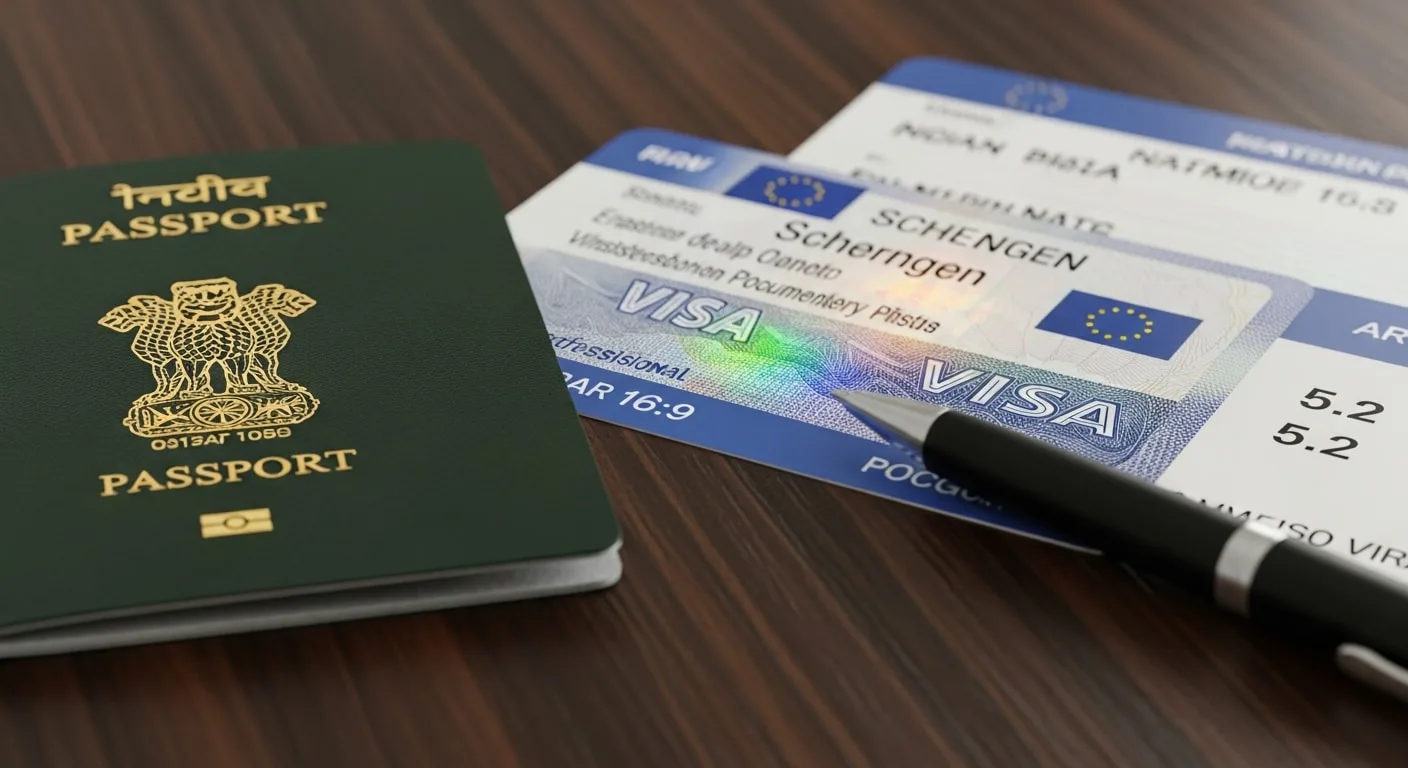
Schengen Visa for Indians: Step-by-Step Application Guide 2026
In this guide (11)
- What Exactly is a Schengen Visa?
- Which Embassy Should You Apply At for Schengen Visa for Indians 2026?
- The Complete Document Checklist for Schengen Visa for Indians 2026
- The VFS Global Application Process
- Processing Time and What Happens After Submission
- Why Applications Get Rejected — and How to Avoid It
- First-Time Applicant vs Returning Applicant Strategy
- 2026 Changes: What is New for Indian Applicants
- Planning Your Europe Trip from India
- Practical Information Summary
- Frequently Asked Questions
I spent three sleepless nights in 2019 convinced the French embassy would reject my Schengen visa application. My bank balance was decent, my job was stable, and my travel history included Southeast Asia and the Middle East. But every Google search led me down a rabbit hole of rejection horror stories from fellow Indians. Spoiler: I got the visa. Since then, I have helped over a dozen friends and family members through the same process — all successful. The Schengen visa for Indians 2026 application process is genuinely straightforward once you understand what the consulates actually want.
This complete guide covers everything about applying for a Schengen visa for Indians 2026: the exact document requirements, VFS Global process, fees, common rejection reasons, and strategies that significantly improve your approval odds.
What Exactly is a Schengen Visa?
The Schengen Area comprises 26 European countries that abolished passport control at their mutual borders. One visa gets you into all of them: Austria, Belgium, Czech Republic, Denmark, Estonia, Finland, France, Germany, Greece, Hungary, Iceland, Italy, Latvia, Liechtenstein, Lithuania, Luxembourg, Malta, Netherlands, Norway, Poland, Portugal, Slovakia, Slovenia, Spain, Sweden, and Switzerland.
As of January 2026, Bulgaria and Romania are partially integrated into the Schengen zone for air and sea travel, though land border controls remain. Croatia joined fully in 2023. Practically speaking, your single Schengen visa opens doors to nearly 30 European countries.
The standard tourist visa (Type C) allows stays of up to 90 days within any 180-day period. This is a rolling window, not a calendar-based calculation. You cannot simply wait for a new year to reset your days. The 90/180 rule trips up many travellers, so plan accordingly.

Which Embassy Should You Apply At for Schengen Visa for Indians 2026?
This confuses many first-time applicants. The rule is straightforward: apply at the embassy of your main destination country. "Main destination" means where you will spend the most nights. If you are spending five nights in Paris and three in Rome, apply at the French embassy (or VFS France). Equal nights? Apply at your first port of entry.
Some embassies have reputations for being "easier" than others. The Italian and German consulates in Mumbai reportedly have higher approval rates than others, but I would caution against gaming this. If your itinerary shows six days in Spain and you applied at the Italian embassy claiming two nights in Rome, the visa officer will notice. It is not worth the risk.
Indians apply through VFS Global for most Schengen countries. A few exceptions use TLS Contact or direct embassy appointments. VFS operates visa application centres in Delhi, Mumbai, Chennai, Bangalore, Kolkata, Hyderabad, Ahmedabad, Pune, Kochi, Jaipur, Chandigarh, and Goa. Check your specific embassy's website for the current arrangement.
The Complete Document Checklist for Schengen Visa for Indians 2026
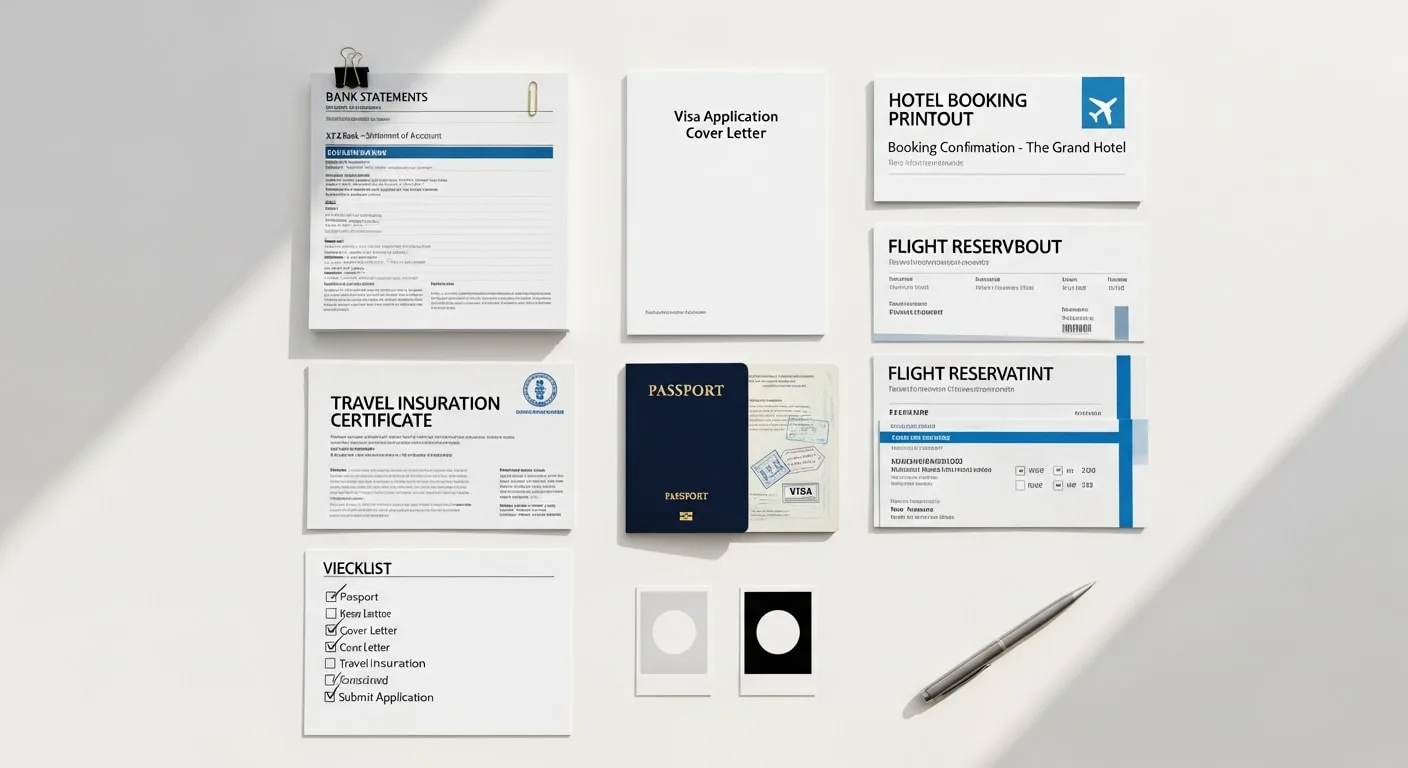
Below is every document you need, with specifics on what Indian applicants often get wrong.
1. Visa Application Form
Download from the specific embassy website. Fill it digitally, print, and sign by hand. Some embassies now accept fully online applications through their portals. Use black ink for signatures. Leave nothing blank — write "N/A" if a field does not apply.
2. Passport Requirements
Valid for at least three months beyond your intended return date. Must have at least two blank pages. If your passport is older than ten years, some consulates prefer you get a new one, though this is not an official requirement.
3. Passport-Sized Photographs
Two recent photographs (taken within six months) meeting Schengen specifications: 35mm x 45mm, 70-80% face coverage, white background, no glasses, neutral expression. Indian photo studios know these requirements well. Cost: ₹50-100 for a set.
4. Cover Letter
This is your chance to present yourself. Keep it one page maximum. Include:
- Your full name, passport number, and contact details
- Purpose of visit and intended travel dates
- Countries you plan to visit and duration in each
- Who is financing the trip (self, employer, family sponsor)
- Strong ties to India (job, property, family, ongoing education)
- A declaration that you will return before the visa expires
Do not write a novel. Visa officers process hundreds of applications weekly. Clear, factual, one page.
5. Flight Reservation (Not Confirmed Tickets)
Here is the trick experienced travellers use: do not buy confirmed tickets before your visa is approved. Book a cancellable flight reservation instead. Many travel agents offer this service for ₹500-1,500. Alternatively, some airlines like Emirates and Lufthansa allow free cancellation within 24 hours. The embassy needs proof you intend to travel on specific dates — they do not require you to have spent ₹80,000 on non-refundable tickets that become worthless if rejected.
6. Hotel Bookings
Book fully refundable hotels through Booking.com or similar platforms. Print the confirmations showing your name, dates, and the cancellation policy. For multi-city trips, ensure you have accommodation proof for every night.
If staying with friends or family, you need an invitation letter from your host, their ID proof, and proof of their accommodation (rental agreement, utility bills, or property documents).
7. Day-by-Day Travel Itinerary
Create a simple table showing each day's activities: "Day 1 - Arrive Paris CDG, check into hotel, evening walk to Eiffel Tower." This demonstrates you have an actual plan, not a vague notion of "seeing Europe."
8. Financial Documents — The Critical Part
This is where most Indian applications are made or broken. The embassy wants proof you can afford your trip without working illegally in Europe. Your Schengen visa for Indians 2026 application hinges heavily on this section.
Bank statements: Last six months, stamped and signed by the bank. The informal benchmark is ₹5 lakh (~€5,500) minimum in your savings account, though more is better. Sudden large deposits look suspicious — if your parents transferred ₹3 lakh last week to inflate your balance, the visa officer will see the transaction history and wonder.
Income Tax Returns: Last three years of ITR acknowledgements. These documents prove you have legitimate income in India.
Salary slips: Last three months if employed.
Form 16: Your annual tax deduction certificate from employer.
Fixed deposits, mutual funds, property documents: Supplementary proof of financial stability. Not mandatory, but helpful.
If someone else is sponsoring your trip (a parent, spouse, or sibling), you need their financial documents plus a sponsorship letter and proof of your relationship (birth certificate, marriage certificate).
9. Employment Proof
For salaried employees: Leave sanctioned letter on company letterhead, stating your designation, joining date, monthly salary, and confirmation you have approved leave for travel dates. Include company registration details.
For business owners: Company registration documents, latest GST returns, business bank statements, ITR.
For students: Bonafide letter from institution, leave approval if dates fall during term.
For retired individuals: Pension statements, retirement letter, substantial savings evidence.
10. No Objection Certificate (NOC)
If employed, get a letter from your employer stating they have no objection to your travel and will hold your position. Self-employed individuals can skip this. Students need an NOC from their institution.
11. Travel Insurance
Mandatory for every Schengen visa for Indians 2026 application. Minimum coverage of €30,000 for medical emergencies and repatriation is required. The policy must be valid in all Schengen countries and cover your entire travel period plus a few buffer days. Buy it only after your dates are finalised. Indian insurers like ICICI Lombard, HDFC ERGO, and Bajaj Allianz offer Schengen-compliant policies from ₹500 for a two-week trip. Our detailed guide on affordable international travel insurance for Indians breaks down the best options.
The VFS Global Application Process
Step one: Book an appointment online through the specific country's VFS portal. Popular embassies like France and Germany fill up fast — book 4-6 weeks before your intended submission date. Do not wait until the last minute; summer season slots disappear quickly.
Appointment slot availability varies by city. Delhi and Mumbai have more slots but also more applicants. Smaller centres like Chandigarh or Kochi sometimes have better availability.
On appointment day, arrive 15 minutes early. Carry all original documents plus one set of photocopies. VFS charges extra for photocopying on-site (and the queue is painful).
The VFS staff will verify your documents, collect your application, and take your biometrics (fingerprints and photograph). Biometrics are valid for 59 months, so returning applicants may not need to repeat this. First-time applicants must appear in person.
Fees for Schengen Visa for Indians 2026
The standard Schengen visa fee is €80 (~₹7,200 at current rates) for adults. Children aged 6-12 pay €40, while children under 6 are free. VFS charges an additional service fee of approximately ₹1,800-2,200 depending on the country. Optional services like SMS tracking, courier return, and premium lounge access cost extra.
Payment is typically by cash or card at the VFS centre. Some centres accept online payment during appointment booking.
Processing Time and What Happens After Submission
Official processing time is 15 calendar days, though it can extend to 45 days during peak season or for complex applications. In practice, most Indian applicants receive decisions within 10-12 working days.
You can track your application status through the VFS website using your reference number. "Decision made" means the embassy has decided — it does not tell you whether it is approval or rejection. You find out when you collect your passport.
Some embassies conduct interviews, though this is increasingly rare for straightforward tourist applications. If called, stay calm, answer honestly, and bring all original documents. The interview is usually just to clarify details in your application.
Why Applications Get Rejected — and How to Avoid It
Understanding rejection reasons helps you build a stronger Schengen visa for Indians 2026 application. The most common issues are:
Insufficient funds: Your bank balance does not convincingly cover the trip cost. Fix: Ensure your statement shows consistent income and a healthy balance, not sudden deposits.
Weak ties to India: The embassy fears you will overstay. Fix: Emphasise job stability, property ownership, dependent family members, ongoing professional commitments.
Incomplete documentation: Missing signatures, outdated photos, wrong application form version. Fix: Double-check every requirement against the official embassy website.
Inconsistent information: Your cover letter says Paris but your hotel booking is for Barcelona. Fix: Review everything for consistency before submission.
Previous immigration violations: Overstays in other countries or visa fraud history. Fix: This is harder to overcome. Be completely transparent and provide explanation letters if applicable.
Unclear travel purpose: The itinerary does not make sense or seems like a cover for work/migration. Fix: Create a detailed, realistic tourist itinerary.
If you have faced rejection before, read our comprehensive guide on visa rejection reasons and how to reapply successfully.
First-Time Applicant vs Returning Applicant Strategy
First-time applicants with no travel history face more scrutiny. Your strategy should be:
- Apply for exactly the dates you intend to travel — do not ask for a three-month visa for a ten-day trip
- Choose one or two countries maximum for your first trip
- Book everything refundable but make it look solid
- Provide more financial documents than technically required
- Consider adding your previous travel stamps (Southeast Asia, Middle East, etc.) to demonstrate you respect visa terms
Returning applicants with clean Schengen history often receive multiple-entry visas valid for one, two, or even five years. Your previous compliance works in your favour. You may provide slightly less documentation, though the core requirements remain the same.
2026 Changes: What is New for Indian Applicants
The India-EU Free Trade Agreement negotiations have progressed, with visa facilitation being a key discussion point. While nothing is finalised, several positive changes are emerging for Schengen visa for Indians 2026:
Digitisation push: Multiple Schengen countries now offer online application portals, reducing paperwork. France, Germany, and the Netherlands have particularly streamlined processes.
Longer validity visas: The 2019 Schengen visa code revision mandates longer validity visas for repeat applicants with clean records. Indian travellers who have properly used two previous Schengen visas now routinely receive two-year multiple-entry visas. Three Schengen stamps can get you a five-year visa.
Biometric validity extended: Fingerprints are now valid for 59 months (nearly five years), reducing repeat biometric requirements for frequent travellers.
Fee increase postponed: The proposed increase to €90 has been delayed. For now, €80 remains standard.
Planning Your Europe Trip from India
If this is your first time visiting Europe, start with our first-time Europe trip planning guide for Indians. That article covers budgeting, itinerary building, and practical tips that Indian travellers specifically need.
Budget-conscious? Check out our list of the cheapest European countries to visit from India. Portugal, Czech Republic, and Poland offer incredible value compared to Western Europe's expensive capitals.
Practical Information Summary
Visa fee: €80 (~₹7,200) + VFS service charge ₹1,800-2,200
Processing time: 15-45 days (typically 10-12 working days)
Validity: Single-entry for first-timers; multi-entry up to 5 years for repeat applicants
Application centres: VFS Global offices in 12+ Indian cities
Book appointments: 4-6 weeks in advance (earlier for summer travel)
Bank balance recommended: ₹5 lakh+ in savings account
Insurance requirement: €30,000 minimum coverage, all Schengen countries
Biometric validity: 59 months
Official Schengen info: EU Home Affairs - Visa Policy
Frequently Asked Questions
Can I apply for a Schengen visa if I have less than ₹5 lakh in my bank account?
Yes, there is no official minimum balance requirement. However, you need to demonstrate you can afford your trip. A two-week trip might cost ₹2-3 lakh including flights, hotels, food, and activities. If your balance is low, supplement with fixed deposits, mutual fund statements, or a sponsorship from a family member with sufficient funds.
How early can I apply for a Schengen visa before my travel date?
You can apply up to six months before your intended travel date, but not later than 15 days before. I recommend applying 6-8 weeks in advance to allow for processing time and any potential delays or additional document requests.
What happens if my Schengen visa is rejected?
You will receive a rejection letter stating the reason(s). You can reapply immediately after fixing the issues mentioned. There is no mandatory waiting period, though multiple quick rejections look bad. Take time to properly address the concerns before reapplying.
Can I travel to non-Schengen EU countries like Ireland or the UK with a Schengen visa?
No. Ireland and the UK are not part of the Schengen Area and require separate visa applications. However, some Schengen countries like Cyprus, and partially Bulgaria and Romania, may allow entry with a valid multi-entry Schengen visa under certain conditions. Always verify specific country requirements.
Is it true that having previous travel stamps improves Schengen visa chances?
Generally yes. A passport showing previous international travel (especially to countries like USA, UK, Canada, Australia, or other Schengen nations) where you respected visa terms demonstrates you are a genuine tourist who returns home. That said, a clean application with strong documentation can succeed even with a blank passport.
Can TripCabinet help with my Europe visa application?
While we do not handle visa applications directly, our team books complete Europe packages from India — flights, hotels, transfers, and itineraries — which gives you professionally prepared documents that strengthen your visa application. A well-organised trip with confirmed bookings (refundable ones, of course) makes the visa officer's job easier.
The Schengen visa for Indians 2026 process looks intimidating on paper, but thousands of Indians receive approvals every month. Prepare your documents thoroughly, present a clear travel purpose, and demonstrate strong ties to India. Your European adventure is closer than you think.
Once your Schengen visa is approved, the Netherlands is an excellent first destination. Our Amsterdam trip from India guide covers flights, canals, museums, Keukenhof tulips, and a full budget breakdown in INR.