

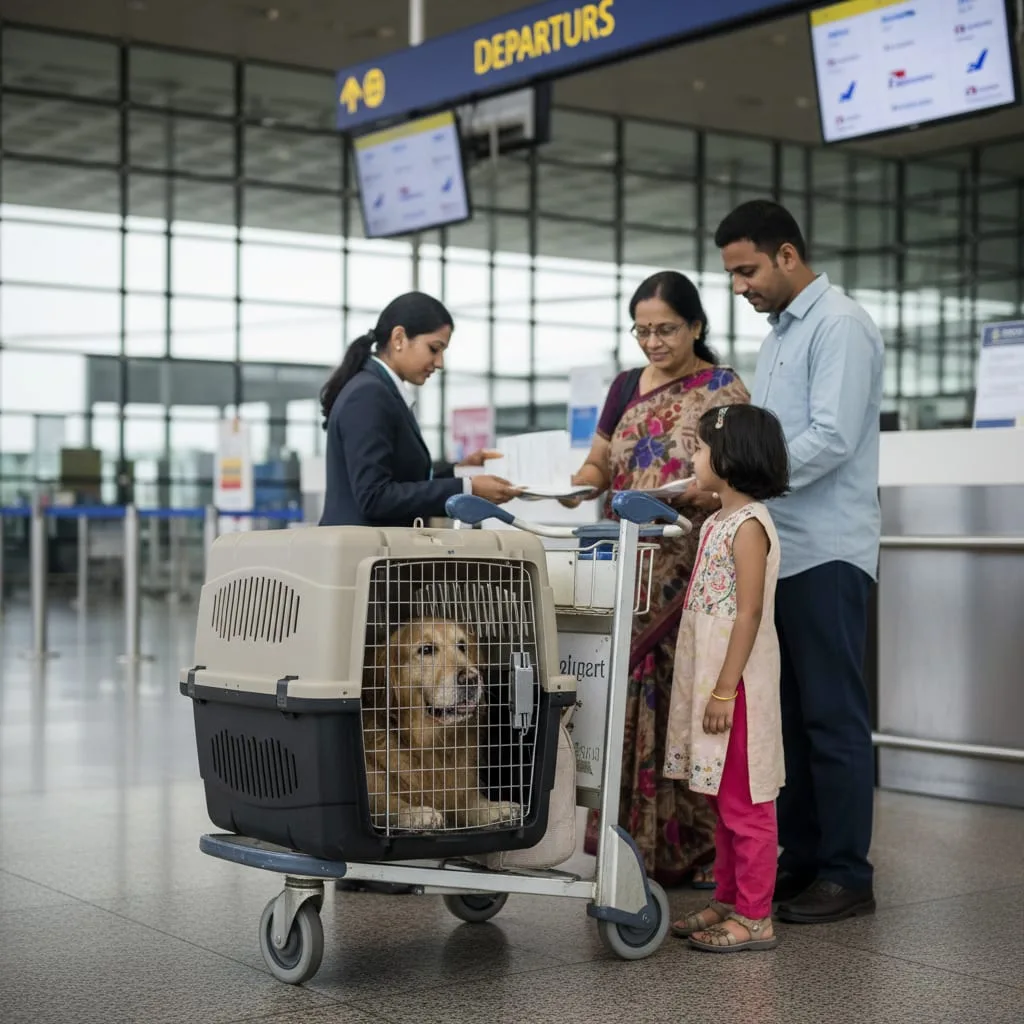
Pet-Friendly International Travel from India: Rules, Airlines & Destinations 2026
In this guide (13)
- The Reality of Flying with Pets from India: Cabin vs Cargo
- Airlines That Actually Accept Pets from India for International Flights
- IATA Crate Requirements: Getting the Right Size for Pet Travel International from India
- The Paperwork Nightmare: AQCS, Microchips, and Titer Tests
- Country-by-Country Quarantine Rules for Pet Travel International from India
- The Real Costs: Budget Breakdown
- Pet-Friendly Destinations Worth the Effort
- The Sedation Myth: Why You Should Never Drug Your Pet for Flying
- Pet-Friendly Hotels: What to Look For
- Common Mistakes Indian Pet Owners Make
- Professional Pet Relocation Services: When to Use Them
- Final Thoughts from Someone Who's Done It
- Frequently Asked Questions
Flying Mumbai to Dubai with my golden retriever was the most stressful day of my life — and she slept through the whole thing. Pet travel international from India sounds complicated because it genuinely is, but not impossible. I spent three months preparing paperwork, called the airline seventeen times, bought the wrong crate size twice, and showed up at the airport four hours early convinced something would go wrong. Meanwhile, Luna curled up in her crate, ignored the chaos around her, and woke up in Dubai asking for treats like nothing happened.
That trip taught me everything the official websites don't tell you about taking your furry companion abroad. The government portals give you a checklist. The airline websites give you measurements. But nobody tells you that the AQCS office in Delhi closes randomly for "VIP visits," or that your vet's signature needs to match exactly what's on file with the government database, or that Emirates cargo has different rules than Emirates passenger services. I learned all of this the hard way, so you don't have to.
This is not a sanitized guide with generic advice. I'm going to tell you exactly what works, what doesn't, and where Indian pet owners waste the most money and time when planning pet travel international from India. Grab a chai. This is going to be detailed.
The Reality of Flying with Pets from India: Cabin vs Cargo
Let me clear up the biggest confusion first. When people ask about pet travel international from India, they imagine their dog sitting next to them on the flight, maybe looking out the window. That's not how it works for most of us.
Cabin travel is only available for small pets — generally under 8kg including the carrier. Your pet stays in a soft carrier under the seat in front of you. Sounds cozy, right? Here's the catch: very few international routes from India allow cabin pets. Lufthansa does on certain European routes. Air India technically allows it but good luck getting confirmation. Most Middle Eastern carriers? Cargo only.
Cargo hold travel is what 90% of Indian pet owners end up using for international pet travel. Your pet travels in a climate-controlled, pressurized section of the aircraft belly. It sounds scary, but modern cargo holds maintain the same temperature and pressure as the cabin. Airlines transport thousands of pets this way every week without incident.

The real difference? Cost and stress. Cabin travel for a small dog to Europe runs around INR 25,000-40,000 on top of your ticket. Cargo for a large dog? INR 80,000-1.5 lakhs depending on crate size and route. And cargo requires you to drop your pet at a separate cargo terminal, often hours before your own flight.
Airlines That Actually Accept Pets from India for International Flights
Not every airline flying out of Indian airports takes pets. And among those that do, policies vary wildly. Here's the real breakdown based on what Indian pet owners actually experience when arranging pet travel international from India:
Emirates
The most popular choice for Middle East connections. Emirates only allows pets in cargo hold — no cabin exceptions, not even for emotional support animals. They accept dogs and cats, no snub-nosed breeds like Pugs or Persians because of breathing risks at altitude. Crate must be IATA-compliant. Cost: approximately INR 8,000-15,000 per kg for excess baggage rates, minimum charges apply. Check their official pet policy page for current requirements.
My experience: booking was straightforward online, but you must confirm 72 hours before departure. They once bumped Luna because someone else had already booked the pet space limit for that flight. Always book pet space as early as possible when planning pet travel international from India.
Etihad Airways
Similar to Emirates — cargo only, no brachycephalic breeds. Etihad has slightly lower rates sometimes, and their Abu Dhabi hub connects well to Europe. They require a vet health certificate issued within 5 days of travel, not 10 like some others. Don't get this wrong.
Lufthansa
The best option if your pet is small enough for cabin travel to Europe. Lufthansa allows pets under 8kg (including carrier) in cabin on most routes. For larger pets, their cargo service through Lufthansa Cargo is professional but expensive — expect INR 1-1.5 lakhs for a large dog crate to Frankfurt. This makes Lufthansa a premium choice for international pet travel.
Air India
Our national carrier technically allows pets in both cabin and cargo. In practice, getting confirmation is like winning a lottery. Their website information is outdated, phone support gives conflicting answers, and policies seem to change by airport. I know people who've successfully flown with pets on Air India, but I also know people who showed up at check-in and were refused because "that flight doesn't allow pets today." Use at your own risk for international pet travel.
Singapore Airlines
Only cargo, but their service is excellent. Singapore itself has strict quarantine requirements, so factor that into your planning. Their cargo booking system is clean, and I've heard consistent positive reports from pet owners.
Airlines That Don't Take Pets from India
IndiGo, SpiceJet, and other budget carriers? Forget it. Qatar Airways has suspended pet cargo from India multiple times — check current status before planning. Vistara (now merged with Air India) had limited pet policies that were never consistent.
IATA Crate Requirements: Getting the Right Size for Pet Travel International from India
This is where I wasted the most money. Bought a crate online that looked big enough. Measured my dog, measured the crate, perfect fit. Got to the airport and was told the crate was 2 inches too short because the airline measures differently than the crate manufacturer.
Here's how to actually measure for IATA compliance:
Length: Nose to base of tail + add a few inches. Your dog must be able to lie down flat without curling.
Height: Floor to top of ears (or head if ears are floppy) + 10%. Dog must stand without touching the top.
Width: Shoulder width × 2. Dog must be able to turn around completely.
Airlines can refuse any crate that doesn't meet these minimums. Some airlines add their own requirements — metal bolts instead of plastic clips, specific ventilation patterns, live animal stickers in a particular language. Emirates provides detailed specs on their website. Download and print it before buying any crate.

Crate prices in India range from INR 8,000 for a basic compliant crate to INR 25,000+ for premium brands. Don't cheap out here. A flimsy crate that breaks during handling puts your pet at risk.
The Paperwork Nightmare: AQCS, Microchips, and Titer Tests
If the crate is the physical hurdle, paperwork is the bureaucratic one. Pet travel international from India requires documents that most countries don't even think about. Here's everything you need:
Microchip
Your pet must be microchipped with an ISO 11784/11785 compliant chip. This is a small chip injected under the skin, usually between the shoulder blades. Any qualified vet can do this for INR 500-1,500. The microchip number becomes your pet's international ID — it appears on every other document.
Important: the microchip must be implanted BEFORE the rabies vaccination. If you did it the other way around, some countries won't accept your rabies certificate. Start over.
Rabies Vaccination
Your pet needs a current rabies vaccination. Most countries require it to be at least 21-30 days old at the time of travel but not expired. Standard rabies vaccines in India are valid for 1-3 years depending on the brand — keep your certificate safe.
Rabies Titer Test
This is the big one for international pet travel. Many countries require a blood test proving your pet has rabies antibodies above a certain level. The test must be done at an approved lab — in India, that's often the IVRI Bareilly or certain labs approved by the destination country.
The titer test costs INR 5,000-8,000 and results take 2-3 weeks. Some countries require a 3-month waiting period AFTER the test before entry. Yes, 3 months. Plan accordingly.
Countries requiring titer tests: Japan, Australia, UK, EU countries, Singapore, Taiwan. Countries that don't require it: UAE, Thailand, Malaysia (for now).
Health Certificate
A veterinary health certificate issued by a government-registered vet within 10 days of travel (some countries say 5 days). This confirms your pet is healthy and free of contagious diseases. Your regular vet can usually do this, but they must be registered with the state animal husbandry department.
NOC from AQCS (Animal Quarantine Certification Services)
This is India's exit permit for your pet. You apply through the AQCS office — there's one in Delhi, Mumbai, Chennai, and Kolkata. The process involves submitting all your other documents, paying a fee (around INR 500-1,000), and getting a certificate that allows your pet to leave India.
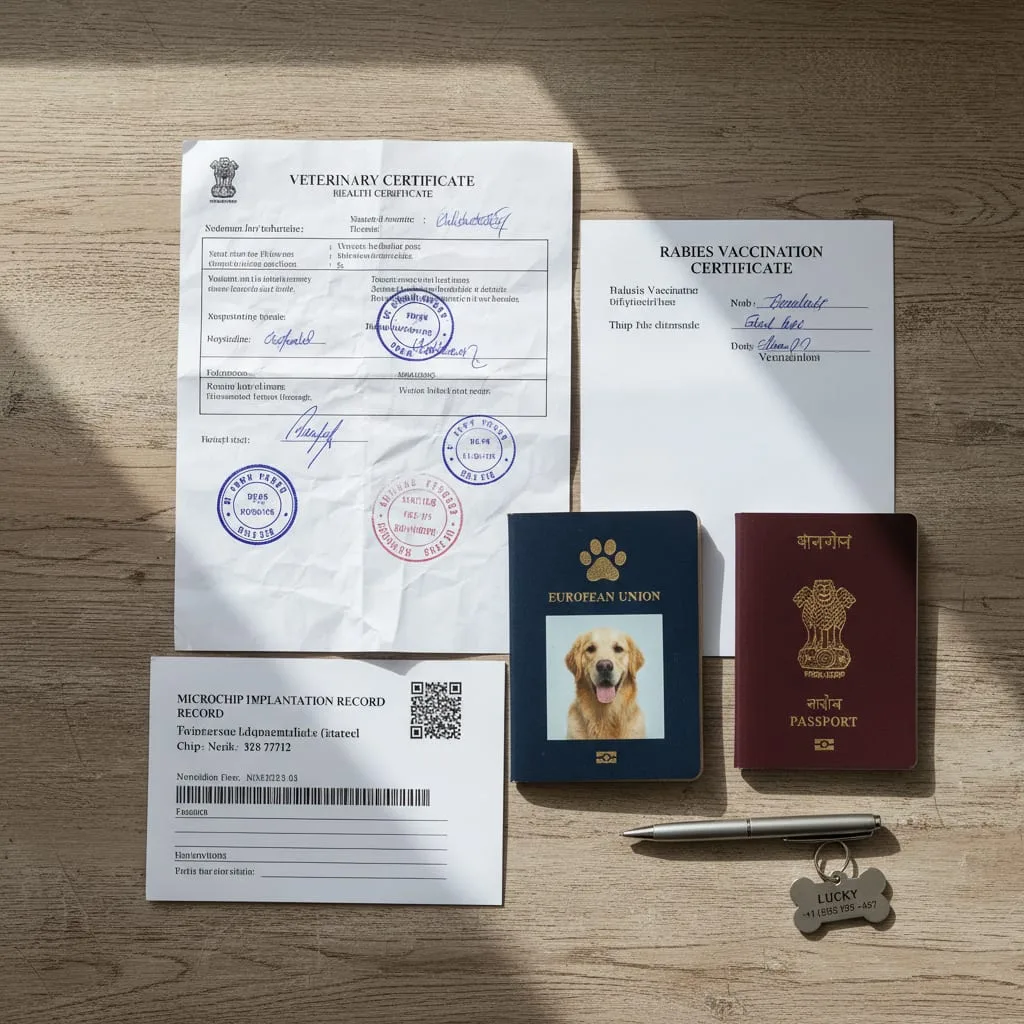
Here's the frustrating part: AQCS offices are understaffed and unpredictable. In Delhi, I've heard of people getting their NOC in 2 hours and others waiting 3 days. Call ahead, arrive early, bring multiple copies of everything, and be patient. Getting aggressive with the staff will not help your pet travel international from India go smoothly.
Destination Country Import Permit
Many countries require you to apply for an import permit before bringing your pet. Australia, Singapore, UK, and several EU countries have this requirement. The permit is issued by the destination country's agriculture or veterinary department. Applications are usually online now, but processing takes 2-4 weeks.
Country-by-Country Quarantine Rules for Pet Travel International from India
This is what keeps Indian pet owners up at night. Some countries welcome your pet with open arms. Others act like you're trying to smuggle contraband.
Dubai & UAE: The Easy One
No quarantine. Present your documents at the airport, customs checks the microchip matches your papers, and you're free to go. This is why Dubai is the most popular destination for Indian pet owners testing pet travel international from India for the first time. If you're planning a Dubai trip from India, adding your pet is relatively straightforward.
Documents needed: microchip certificate, rabies vaccination (at least 30 days old), health certificate (within 10 days), and import permit from UAE Ministry of Climate Change. Total time from start of process to travel: approximately 4-6 weeks.
Thailand: Also Manageable
No quarantine for dogs and cats from India if documentation is correct. You need an import permit from Thailand's Department of Livestock Development, health certificate, and rabies vaccination. The airport process in Bangkok can take a couple hours for inspections, but you leave the same day with your pet.
Singapore: Medium Difficulty
Singapore requires a 30-day home quarantine in India before travel, with AVA (Agri-Food & Veterinary Authority) inspectors verifying conditions remotely. You also need a titer test. At arrival, your pet goes through another inspection but typically doesn't require facility quarantine if papers are perfect.
Cost is higher here — import permits, inspections, and strict compliance add up. Budget INR 50,000-80,000 for a medium-sized dog including all requirements for taking your pet to Singapore.
UK: The Paperwork Olympics
Britain requires a rabies titer test followed by a 3-month waiting period. No quarantine at arrival IF everything is perfect. But "perfect" is the operative word. The UK has specific form requirements, specific vet endorsements, specific tapeworm treatment 24-120 hours before arrival. Miss any of these and your pet goes into quarantine at your expense — around GBP 1,000+ per month.
I know someone whose dog spent 2 weeks in UK quarantine because the tapeworm treatment was given 22 hours before landing instead of 24. The rules are brutal.
Australia: The Hardest
Australia has the strictest pet import rules in the world for a reason — they have no rabies and want to keep it that way. Expect minimum 10 days quarantine at the Melbourne or Sydney quarantine facility, costing AUD 2,000+. The preparation timeline is 6+ months minimum.
Steps: microchip, two rabies vaccines 30+ days apart, titer test, 180-day waiting period, import permit, specific internal and external parasite treatments on schedule. Most Indian pet owners relocating to Australia use professional pet relocation services because the process is too complex to DIY for international pet travel.
European Schengen Countries
EU requires EU-format health certificate, microchip, rabies vaccine, and titer test with 3-month wait. Once you're in one Schengen country, you can travel to others freely with your pet. Germany, France, Netherlands — all the same rules. This makes Europe surprisingly accessible for Indian pet owners once you clear the initial hurdle of pet travel international from India.
The Real Costs: Budget Breakdown
Everyone asks "how much?" without understanding that the answer is "it depends on everything." Let me give you actual numbers from real trips:
Small dog (under 8kg), cabin to Dubai:
Airline pet fee: INR 20,000-25,000
Carrier bag: INR 3,000-5,000
Paperwork (vet, AQCS, permits): INR 5,000-8,000
Total: approximately INR 28,000-38,000
Medium dog (15-25kg), cargo to Dubai:
Airline cargo fee: INR 35,000-50,000
IATA crate: INR 12,000-18,000
Paperwork: INR 8,000-12,000
Total: approximately INR 55,000-80,000
Large dog (30-40kg), cargo to UK:
Airline cargo fee: INR 70,000-1,00,000
Large IATA crate: INR 20,000-28,000
Titer test: INR 6,000-8,000
UK import permit and processing: INR 15,000-20,000
Paperwork: INR 10,000-15,000
Total: approximately INR 1,20,000-1,70,000
These numbers don't include your own travel costs. And if you're using a pet relocation agency (recommended for Australia and complex destinations), add another INR 30,000-80,000 for their services.
Speaking of costs, don't forget travel insurance. Most standard policies don't cover pets, but some do offer pet coverage add-ons. Check out affordable travel insurance options for international trips and look for pet-inclusive policies.
Pet-Friendly Destinations Worth the Effort
Not every destination deserves the hassle of pet travel international from India. Here's where the effort pays off:
Dubai
Beyond easy entry, Dubai has pet-friendly beaches (at specific times), pet-friendly malls, and numerous dog parks. Many apartments and hotels accept pets. The lifestyle here actually accommodates pet owners in ways Indian cities don't.
Thailand
Bangkok and Phuket have growing pet-friendly cultures. Beach resorts increasingly allow pets, and Thai people generally love dogs. The tropical climate is similar to coastal India, so your pet won't struggle with adjustment.
Europe (Germany, Netherlands, France)
Europe is wonderfully pet-friendly once you're in. Dogs allowed in most restaurants, many hotels, public transport, and parks. Germans especially treat dogs as family members who go everywhere. A European road trip with your dog is genuinely possible — I've met Indian families who drove across four countries with their Labrador.
Bali, Indonesia
Tricky import rules but manageable. Bali has a relaxed pet culture, and many villas are pet-friendly. If you're staying long-term, Bali can work beautifully.
The Sedation Myth: Why You Should Never Drug Your Pet for Flying
This comes up constantly: "Should I sedate my dog for the flight?"
No. Airlines explicitly refuse sedated pets because sedation affects breathing and temperature regulation at high altitudes. A sedated pet cannot brace themselves during turbulence, increasing injury risk. Veterinary associations worldwide advise against it.
What actually works for international pet travel:
Crate training: Start weeks before travel. Feed meals in the crate. Let your pet sleep there. The crate should feel like a safe den, not a prison.
Familiar scents: Put your worn t-shirt in the crate. Your smell calms your pet more than any medication.
Calming supplements: Vet-approved options like Zylkene or pheromone sprays can take the edge off anxiety without sedation effects.
Exercise before the flight: A tired pet is a calm pet. Long walk or play session before heading to the airport.
Freeze water in the bowl: Spilled water makes a mess and leaves your pet thirsty. Ice cubes melt slowly and keep them hydrated without soaking the crate.
Pet-Friendly Hotels: What to Look For
Finding accommodation that accepts pets abroad is easier than in India. But "pet-friendly" means different things:
Truly pet-friendly: No extra fees, pets allowed in rooms, sometimes pet amenities like beds and bowls. Common in Europe and increasingly in Dubai.
Pet-tolerant: Pets allowed with hefty fees (INR 2,000-5,000 per night extra), restrictions on leaving pet alone in room, and deposit requirements. Common in Southeast Asia.
Pet-negotiable: Official policy says no, but smaller properties may allow it if you ask nicely and offer a deposit. Common everywhere.
Apps like BringFido and booking sites with pet filters help. Always confirm directly with the hotel before booking — policies change, and you don't want surprises at check-in.
Common Mistakes Indian Pet Owners Make
After going through this process and talking to dozens of pet owners who've done pet travel international from India, these are the mistakes that trip people up:
Starting too late: Most international pet travel requires 2-4 months preparation minimum. Some destinations need 6+ months. Don't book your flight first and then figure out pet logistics.
Trusting airline websites: Information is often outdated or incomplete. Call the airline's cargo department directly. Get confirmation in writing.
Getting the wrong crate: Buy the crate early, let your pet use it for weeks, and bring exact measurements when confirming with the airline.
Missing the titer test deadline: If your destination requires a 3-month wait after the titer test, you cannot compress this timeline. There's no rushing it.
Forgetting about return logistics: India also has pet import requirements. If you're coming back, make sure your pet's vaccines and certificates will still be valid for re-entry.
Professional Pet Relocation Services: When to Use Them
DIY pet travel international from India makes sense for simple routes like Dubai or Thailand. For complex destinations like Australia, UK, or Japan, professional relocators earn their fee. They handle:
All paperwork and government liaisons
Correct crate sourcing and preparation
Airport pickup/dropoff and cargo handling
Customs clearance at destination
Quarantine liaison if required
Services like Petfly, Airpets, and Oscar Pet Logistics operate from India. Costs range from INR 30,000 for coordination-only services to INR 2+ lakhs for full-service Australia relocations.
Final Thoughts from Someone Who's Done It
Is pet travel international from India worth it? For me, absolutely. Luna has been to three countries now. She's swum in the Arabian Gulf, hiked in the Swiss Alps, and confused many European pigeons. The preparation is exhausting, the costs add up, and there's always anxiety until your pet is safely with you at the destination.
But leaving her behind wasn't an option I could accept. If you feel the same way about your pet, know that it's entirely possible. Thousands of Indian pet owners do this every year. The process is complicated but not impossible. Start early, document everything, and don't trust anything until you have it in writing.
And if your pet sleeps through the whole flight while you stress for 8 hours straight? Consider it a blessing. At least one of you was comfortable.
Frequently Asked Questions
Can I take my pet on an international flight from India?
Yes, but rules vary by airline and destination. Air India, Lufthansa, and Emirates allow pets in cabin (under 8kg including carrier) or as checked baggage. Larger pets fly as cargo. Book pet tickets 48-72 hours before departure. Cabin pet fees range from $100-300 per flight segment.
What documents do I need to fly with a pet from India?
You need: pet passport or health certificate from a registered vet (within 10 days of travel), rabies vaccination certificate (at least 30 days old), microchip implant certificate, NOC from Animal Quarantine office (AQCS), and airline-approved pet carrier. Some countries require blood titer test 3-6 months before travel.
Which countries are easiest to travel to with pets from India?
UAE (Dubai, Abu Dhabi) is the easiest — simple import permit, no quarantine. Thailand requires only a health certificate and rabies vaccination. Singapore has strict but straightforward rules with no quarantine. Avoid Australia, UK, Japan, and New Zealand — they require 6-month quarantine or extensive pre-testing.
How much does international pet travel cost from India?
Budget ₹30,000-80,000 per pet for international travel. Breakdown: airline pet fee ₹8,000-25,000, vet certificates and vaccinations ₹3,000-5,000, AQCS NOC ₹1,000, microchipping ₹1,500, IATA-approved carrier ₹5,000-15,000, pet relocation agent (optional) ₹15,000-30,000.
Can my pet travel in the cabin on international flights?
Only small pets (under 8kg with carrier) can fly in-cabin. Airlines allowing cabin pets from India: Lufthansa, KLM, Air France, Turkish Airlines, and select Air India routes. The pet must stay in an airline-approved soft carrier that fits under the seat. No pit bulls, snub-nosed breeds, or pets over weight limit.